News Story: Growing LKCMedicine’s Footprint – It Goes Beyond Real Estate
 | By Edwin Ong |
LKCMedicine, having just turned 15 last year, is embarking on its first-ever campus expansion—an important step in strengthening its competencies in medical education and research.
In an email interview, Chief Operating Officer Dr Serene Ng shares insights into the transformation of the former Dover Park Hospice building into a new Annex Block. Designed to support growing student enrolment and expanding research collaborations, the new space will feature modern teaching facilities and collaborative environments.
But more than just additional capacity, Dr Ng tells us the expansion reflects LKCMedicine’s long-term commitment to nurturing future doctors and advancing impactful healthcare innovation in Singapore and beyond.
Q: The School is expanding its campus footprint to accommodate a larger student intake, enhance its learning facilities, amongst other reasons. Can you elaborate on how this expansion will enhance the campus experience for staff and students?
Dr Serene Ng (SN): What makes the Annex block especially meaningful is its history. The former Dover Park Hospice was once a place of care, dignity and human connection at the most vulnerable moments of life. Repurposing that space for education—specifically to train future doctors—feels deeply fitting. In many ways, it carries forward the same spirit of service, compassion, and purpose, but in a new chapter.
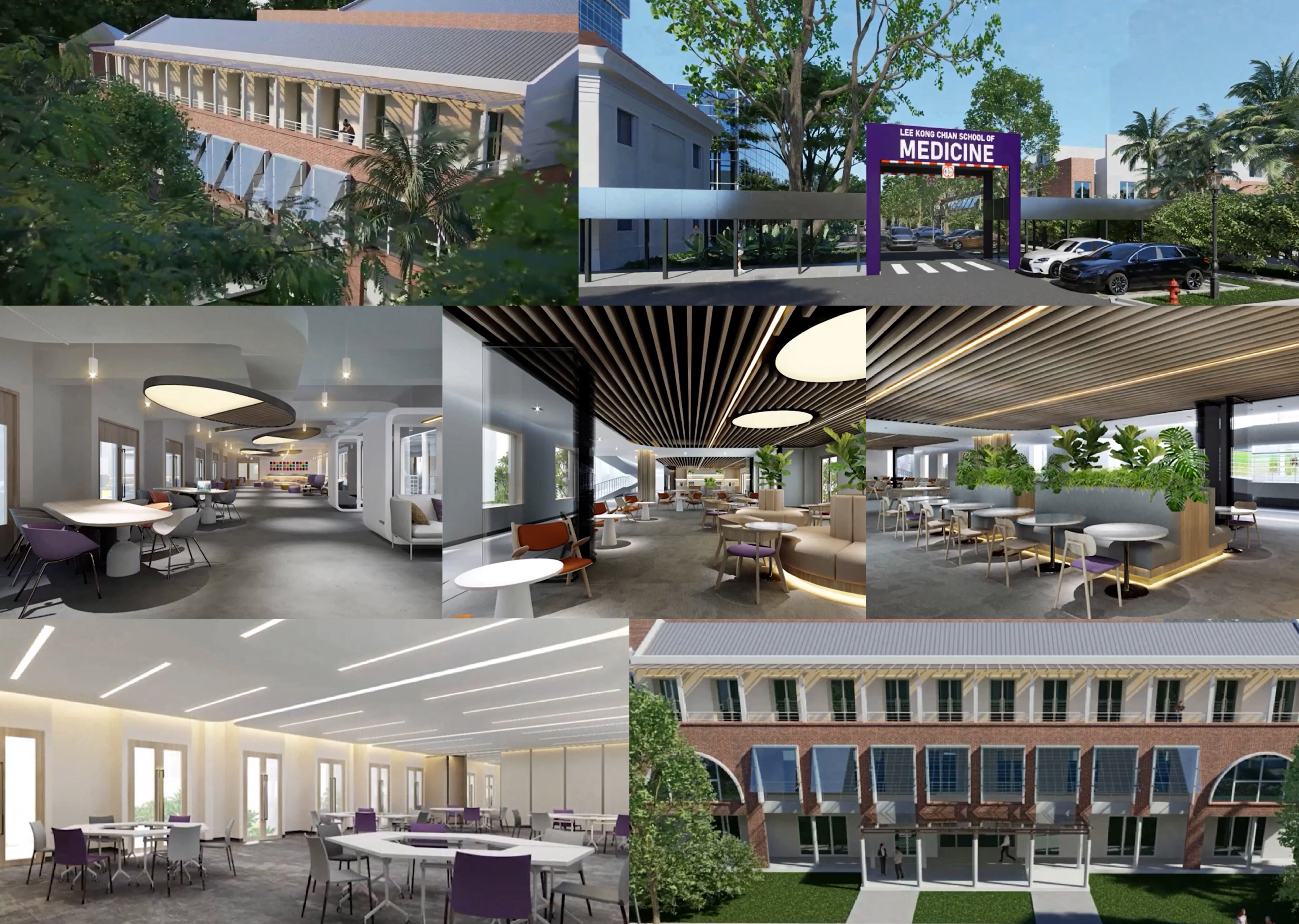
While the overall structure of the building remains largely unchanged, the experience of the space is completely different. The Annex has been reimagined to feel open, restorative and welcoming—almost like a resort—offering a sense of calm that contrasts with the intensity of academic life. This was intentional. We wanted a place that supports not just learning and work, but also wellbeing and connection.
For our students, faculty and staff, the Annex provides dedicated spaces to learn, work and play hard. There are areas for focused study and collaboration, as well as spaces to pause, recharge and interact informally. Together, these elements create an environment that supports people holistically recognising that how we feel in a space directly affects how well we learn, teach and work.
Q: Beyond the numbers, can you share more on what this expansion means for the School in terms of its growth and development?
SN: This expansion allows the School to grow in tandem with our increased student intake, in a way that is thoughtful and sustainable. Growth brings opportunity, but it also brings pressure. Without adequate space, that pressure is felt most acutely by our students, faculty, and staff. The additional capacity gives us the ability to plan responsibly rather than constantly operate at the edge of our limits.
Just as important, the expansion reflects a deliberate effort to balance the real demands of academic life. Learning here is intense. The work is demanding. At the same time, people need space to pause, recharge, and connect in order to sustain that intensity over time. The campus must therefore support all of these dimensions, rather than prioritizing one at the expense of another.
By creating environments where our community can study hard, work hard and play hard, we are not diluting academic rigor—we are strengthening it. This approach supports resilience, collaboration, and wellbeing, and ultimately enables the School to continue delivering excellence as it grows, without losing its sense of humanity or cohesion.
Q: The School is entering its next phase of growth, after 15 years of accelerated development and surpassing expectations. What is your wish and ambition for the School from this phase?
SN: As we enter this next phase, my strongest wish is that we continue to stay true to our core mission—to educate and nurture doctors who serve patients and society with skill, integrity and compassion. Growth is important, but it should never come at the expense of why we exist in the first place.
Ultimately, success for the School is not measured by the size of our campus, but by the doctors we train. My ambition is simple but demanding: that every graduate from our School becomes the kind of doctor you and I would want to care for us and our loved ones—clinically competent, emotionally grounded, ethically strong, and deeply humane.
If we can hold on to that clarity of purpose as we grow—making deliberate choices that reinforce both excellence and empathy—then this next phase will not just be about expansion, but about deepening our impact where it matters most.
Q: You are overseeing the School’s first campus expansion since its inception. Tell us how that makes you feel as the architect of this milestone?
SN: Overseeing the School’s first campus expansion is deeply humbling and, at times, emotionally demanding. You are constantly aware that the decisions being made will shape how students, faculty and staff experience the School not just today, but many years into the future. That sense of responsibility stays with you every step of the way.
Much of the work involves navigating difficult trade‑offs. There are the competing needs and wants of different stakeholders, the tension between urgency and the patience required to get things right, and the reality that external uncertainties—such as the ongoing conflict in the Middle East—can affect costs, timelines and risk assumptions in ways that are beyond our control. Making long‑term decisions amid such uncertainty requires steadiness, judgement and, at times, the willingness to make unpopular but necessary choices.
What anchors me through this is a strong sense of stewardship. This campus is not a personal project, nor does it belong to any one leadership team. It is something we hold in trust for the community—present and future. My responsibility is to ensure that, despite constraints and uncertainty, we make decisions that are thoughtful, responsible and aligned with our mission.
If, years from now, people feel that this is a place where our people can do their best work and still feel cared for, then the trade-offs would have been worth it.
Q: What were some of the challenges you encountered or anticipate over the course of this project? Are there any interesting anecdotes to share?
SN: One of the earliest challenges was simply stepping into the building for the first time. The Annex had been vacant for some time, and those initial visits felt unusually quiet—almost eerie. There was a sense of pause in the space, and it was difficult then to imagine it becoming a vibrant part of campus life. That feeling was reinforced when, after one early site visit, two of our colleagues later tested positive for COVID-19. Thankfully, they recovered well, but it was a sobering reminder of the challenges and difficulties of overcoming obstacles to forge a new path forward. It reinforced the determination — not just to transform a physical space, but to do so thoughtfully and safely, with the wellbeing of our people always in mind.
Beyond those early moments, repurposing a building constructed nearly 30 years ago brought significant technical challenges. While the overall structure was sound, many systems had been designed to older standards. Repurposing the building from palliative care to educational space and retrofitting it to current BCA requirements—particularly elements such as the lift—required careful planning, close coordination, and difficult decisions about what could be adapted and what needed to change.
There were also many practical, everyday considerations that turned out to be just as important. Ensuring a covered, sheltered walkway to connect the Annex Block to the main campus was one such example. In a place like Singapore, where rain is frequent and unpredictable, how people move between buildings matters greatly to their daily experience. While it may seem like a small detail, it reflects our broader approach—thinking carefully about how the campus is actually used and designing it to support comfort and accessibility.
Surprisingly, even small features prompted deeper reflection. One such discussion was whether to keep the koi pond and bring the koi fishes back. While modest in scale, it sparked conversations about the kind of environment we wanted to create.
Taken together, these challenges reminded us that campus expansion is never just about construction. It is about judgement, stewardship, and paying attention to both the big decisions and the small human details that ultimately shape how a place is experienced.
Q: What do you hope is the main takeaway for staff and students from the upcoming campus expansion?
SN: The main takeaway is that while we are expanding, our core mission remains unchanged. The spaces we build are not an end in themselves—they reflect who we are and what we stand for. At the heart of everything we do is the patient.
In that sense, the transformation of the former Dover Park Hospice is deeply symbolic. The building was once dedicated to palliative care, grounded in dignity, compassion and humanity. Today, it has been repurposed to support education—preparing future doctors to care for patients across their lives. The function has changed, but the underlying commitment to care remains constant.
As our campus grows, the intent behind our spaces remains the same. They are designed to support learning and work with one clear purpose—to ensure that patients remain at the heart of everything we do.