
Ultrascalable Hierarchical Micro/nanostructures on Additively Manufactured 316L Stainless Steel for Multifunctional High-Performance Interfaces
Assistant Professor Jin Yao Ho, Ms Xinrui Wang
Introduction
Additive manufacturing offers geometric freedom, yet the lack of scalable surface engineering strategies continues to limit interfacial performance in corrosive, humid, and freezing environments. This work leverages intrinsic AM microstructures with targeted surface chemistry and enables multifunctional interfaces without compromising manufacturability.
Key Highlights
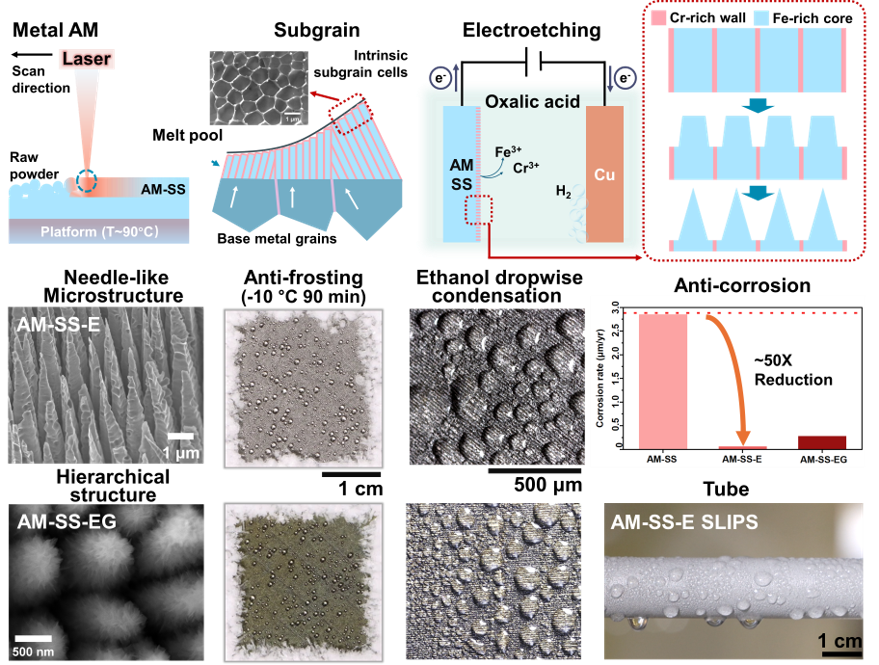
- Selective removal of SLM-fabricated SS316L (AM-SS) subgrains creates new microneedles.
- Extreme low water adhesion achieved by hierarchical AM-SS with additional oxidation.
- The new surface reduces corrosion rate by 98% and resists frosting down to -15°C.
- Enables stable dropwise condensation of low-surface-tension fluids for the first time.
- Micro/nanostructuring technique demonstrated on meter-scale tubes.
Conclusion
A scalable electrochemical strategy is developed to form hierarchical micro/nanostructures on AM SS316L with ultra-low droplet adhesion. Mechanistic insights into oxalic-acid electroetching show that optimized conditions generate dense needle-like microstructures, while FeO(OH) nanosheets further construct robust hierarchical structures. The resulting surfaces achieve ~50× corrosion-rate reduction, delay frosting to -15°C, and stable dropwise condensation of low-surface-tension fluids, demonstrating multifunctionality for advanced AM-enabled thermal and interfacial applications.
Source: https://doi.org/10.1016/j.cej.2026.172691