
3D Printed Gyroid Scaffolds Enabling Strong and Thermally Insulating Mycelium-bound Composites for Greener Infrastructures
Associate Professor Hortense Le Ferrand
Introduction
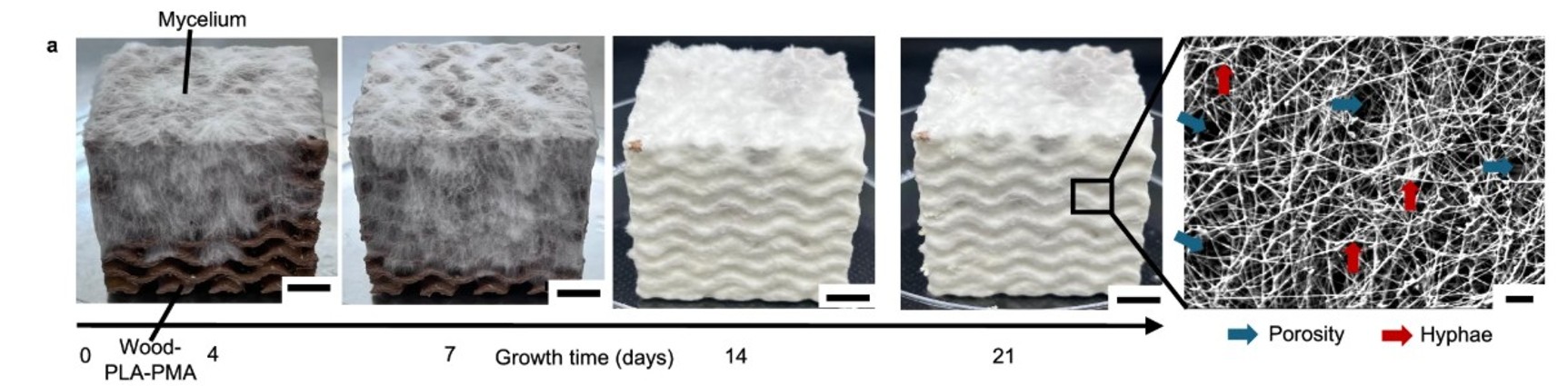
This study introduces a method to strengthen mycelium-bound composites (MBCs) by growing fungi onto 3D printed wood-PLA gyroid scaffolds. The scaffolds enhance mechanical strength while the mycelium provides additional properties such as thermal insulation, fire resistance, hydrophobicity, and durability. Optimal mycelium growth was achieved at 90% porosity, yielding a thermal conductivity as low as 0.012 W/mK, while strength improvements of up to ~78% were observed at 70–90% porosity. The design-dependent enhancements make these MBCs more viable for practical use, particularly in construction. Overall, the integration of 3D printing and biomaterials demonstrates a promising pathway toward sustainable alternatives to petroleum-based materials.
Key Highlights
- Mycelium growth across the entire 3D printed wood-PLA scaffold is essential for achieving the desired composite brick properties.
- Growth effectiveness is influenced by the nutrient-rich solution coating composition, unit cell size, and scaffold porosity.
- The gyroid structure was chosen due to its strong mechanical performance, interconnected porous network, and high surface area.
Conclusion
This study addresses the key drawback of mycelium-bound composites (MBCs)—low mechanical strength and uneven growth - by integrating 3D-printed wood-PLA porous scaffolds. The scaffolds improved stiffness, supported uniform mycelium colonisation, and enabled design-dependent enhancements in strength, thermal insulation, fire resistance, and durability. Results showed performance levels comparable to clay bricks in strength and insulating foams in thermal conductivity, while maintaining sustainability benefits such as low embodied energy and biodegradability in natural environments. Despite modest strength at high porosities and longer production times, MBCs present strong potential as eco-friendly alternatives in construction, packaging, and product design. This work highlights the path toward multifunctional, bio-inspired materials that combine structural stability with sustainable performance.