
Dual Crosslinkable Bioink for Direct and Embedded 3D Bioprinting at Physiological Temperature
Professor Paulo Bartolo, Dr Huang Boyang, Dr Cian Vyas
Introduction
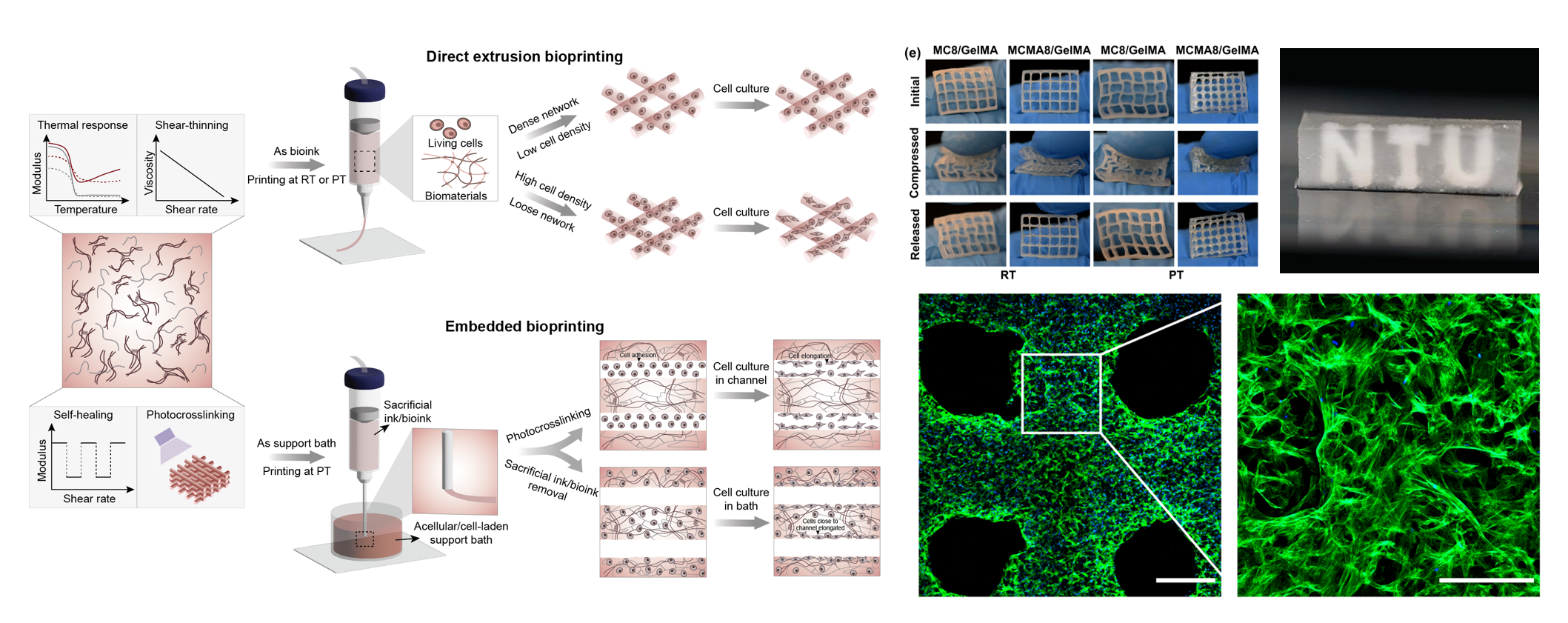
This study reports a dual thermoresponsive and photocrosslinkable GelMA-methylcellulose platform designed to enable both direct extrusion and embedded 3D bioprinting at physiological temperature (37 °C). This addresses a common trade-off where bioinks become low-viscosity (cell-friendly) but lose print fidelity at 37°C. Combining GelMA with MC or MCMA creates a semi-interpenetrating/interconnected network whose temperature-dependent rheology (gel-sol-gel) provides extrusion-friendly shear-thinning plus self-healing support-bath behaviour at a broad range of temperatures, and then “locks in” structure via photocrosslinking.
Key Highlights
- Bioprinting temperature-dependent printability window broadened due to complementary rheological behaviour of methylcelluose and gelatin.
- Quantified extrusion printability across broad temperature range 18-37°C.
- Mechanically tuneable and dual-crosslinked hydrogel platform suitable for a range of tissue applications and biofabrication strategies.
- Support bath performance at physiological temperature enables embedded bioprinting of complex features and perfusable channel networks after sacrificial ink removal.
- Cell viability improves at 37°C and the bioink support high cell densities.
Conclusion
Overall, the study presents a versatile, physiological temperature-compatible bioink/support-bath that expands extrusion and embedded bioprinting capability to 37°C, whilst highlighting an important design constraint: rheology/printability gains from higher MC/MCMA can reduce cell spreading and growth, implying that composition, crosslink density, and cell density must be tuned for tissue-specific applications.