
In-Process Filament Repair in 3D Concrete Printing with Instance Segmentation
Professor Ming Jen Tan, Associate Professor Teck Neng Wong, Associate Professor King Ho Holden Li, Assistant Professor Yi Wei Daniel Tay, Dr Ming Yang Li, Dr Zhi Xin Liu, Dr Tan Kai Noel Quah
Introduction
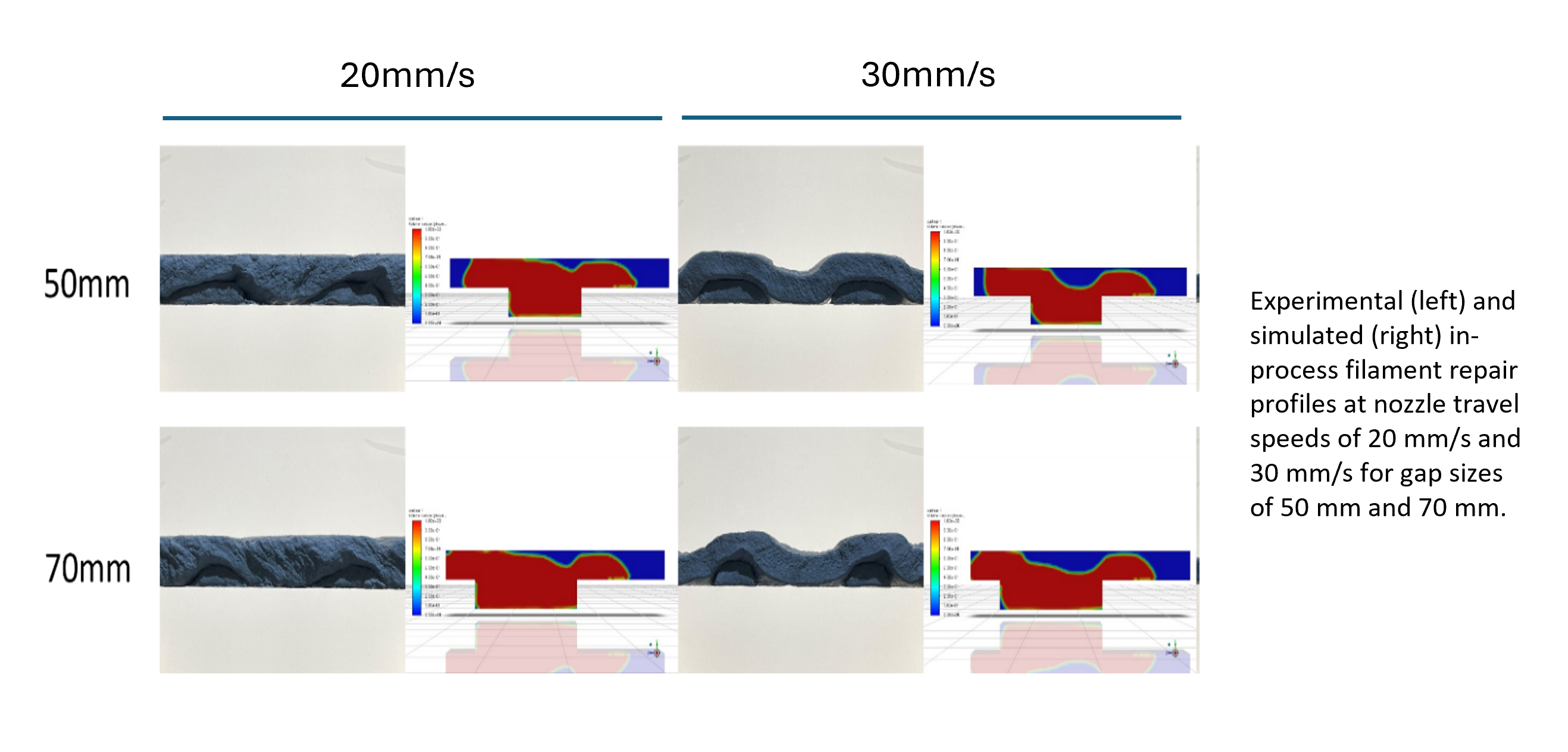
3D Concrete Printing (3DCP) stands as an automated method using robotics to construct concrete structures layer by layer, offering time efficiency, cost savings, and improved safety. Despite its practical relevance, on-site operators are still necessary to identify printing issues. While research focuses primarily on material optimization, lesser attention is given to processing, software, and building integration aspects. This study delves into the gaps and correction behavior of 3DCP cementitious materials, employing simulation tools and computer vision. Using varied nozzle speeds (60mm/s, 30mm/s, and 20mm/s), repairs were attempted above simulated gaps on the base layer. Assessing real-time in-process scanning and repair for a closed-loop system proved promising, though hardware limitations introduced unforeseen noise. Future work suggestions encompass improved simulated models, nozzle travel speed optimization, enhanced inference models for higher layers, and nozzle adaptations for smaller repairs.
 Key Highlights
- The paper proposes an in-process restoration strategy for 3DCP that allows interrupted prints to be resumed without initiating reprints.
- It identifies and categorizes different interruption scenarios (e.g., early-, mid-, and late-stage pauses) that link to specific restoration requirements and interface quality concerns.
- Experimental results show that appropriately designed restoration protocols can recover a substantial portion of defect propagation, although visually evident.
- Guidelines and limitations for applying in-process restoration in real-world 3DCP projects emphasize the need for standardization and long-term durability studies.
Conclusion
This study displayed the novel Next-Layer Delivery (NLD) methodology for in-process repair in 3DCP and has highlighted the importance and complexity of process control and automation, specifically focusing on nozzle travel speed adjustments and their impact on repair efficacy. The findings underscore that real-time in-process scanning and autonomous repair is realistic and highly promising for a fully autonomous 3DCP process.