
3D Printing of Salmon Sashimi Analogues using Fish-Derived Food Inks
Dr Wei Long Ng (Presidential Postdoctoral Fellowship Project)
Introduction
While sashimi is a globally popular delicacy, raw fish consumption carries risks of parasites and foodborne illnesses. Existing plant-based alternatives often lack complete nutritional profiles and fail to replicate the delicate, smooth texture of raw salmon. This study utilizes fish gelatin as a base matrix due to its high digestibility and almost complete amino acid profile. By combining it with gellan gum, a robust hydrogel network is formed, which can be 3D printed with high precision to create salmon analogues that mimic the visual and textural attributes of raw salmon without post-processing.
 Key Highlights
- The inks demonstrated strong shear-thinning behaviour (conformity to the Ostwald-de Waele model, R2 >0.95), which is essential for smooth flow during extrusion and rapid structural recovery post-printing.
- Incorporating gellan gum significantly elevated the gel-to-liquid transition temperature, allowing the 10-1 formulation to maintain structural integrity at physiological body temperature of 37oC.
- Among nine tested formulations, the 10-1 gelatin-gellan gum ink exhibited textural properties closest to raw salmon, successfully replicating its unique mouthfeel.
- The 10-1 formulation retained ~44% of the protein content and 22.7% - 46.8% of the amino acid profile (excluding tryptophan) found in raw salmon.
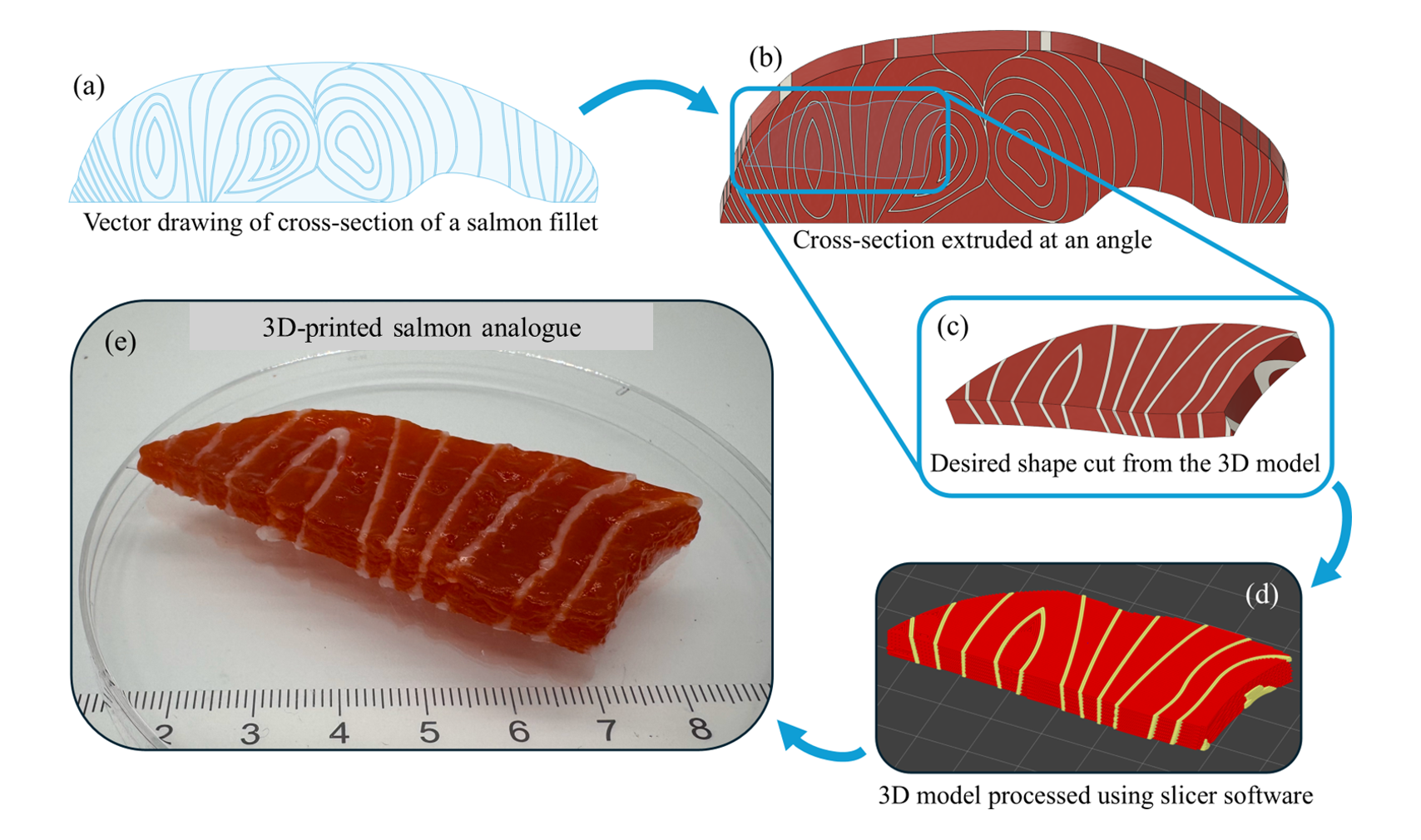
- Using multi-material 3D printing, the team fabricated constructs that replicate the intricate red-and-white layered patterns (myomeres and myosepta) of salmon sashimi.
Conclusion
This research advances 3D food printing by providing a customizable solution for high-resolution, nutritionally enriched seafood analogues. The developed edible scaffolds offer a stable platform for future integration with cultivated cell extracts, which could further enhance the realism, flavour, and nutritional density of alternative seafood products.