
Case Studies
Semiconductors and microelectronics
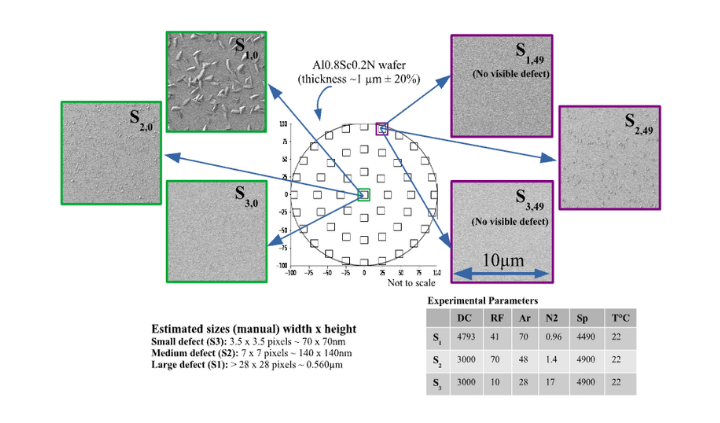
Ferroelectric AlN Devices
Challenge
Improve the performance of ferroelectric aluminium nitride thin films for RF/mm-wave and edge-computing devices, where outcomes are highly sensitive to processing conditions and defect microstructure.
Discovery
A workflow combining image-based defect analysis with machine learning and optimisation algorithms to identify process conditions that minimise defects and balance performance trade-offs.
Impact
Demonstrated reduced defect density and improved process control, highlighting a scalable AI-assisted approach for process window optimisation in advanced semiconductor and electronic materials.
Functional & structural alloys and inorganics
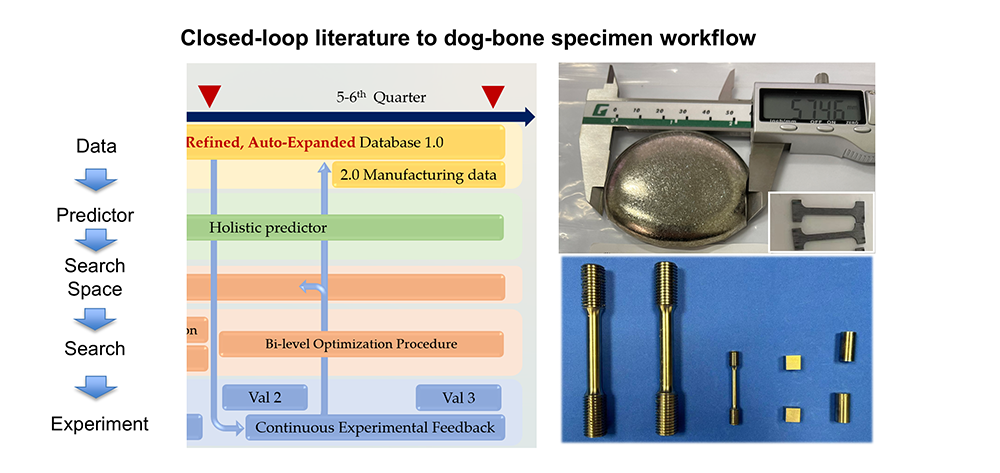
FeCoNi-based Magnetic Alloys
Challenge
Design high-strength, lightweight alloys while navigating complex compositional and thermodynamic constraints in Ti-Al systems.
Discovery
A bi-level optimisation framework integrating LLM-assisted feasibility checks with CALPHAD simulations to guide alloy design within realistic physical constraints.
Impact
Identified and experimentally validated candidate alloys achieving ~860 MPa specific yield strength at low density, demonstrating the potential of AI-assisted approaches to outperform conventional design benchmarks.
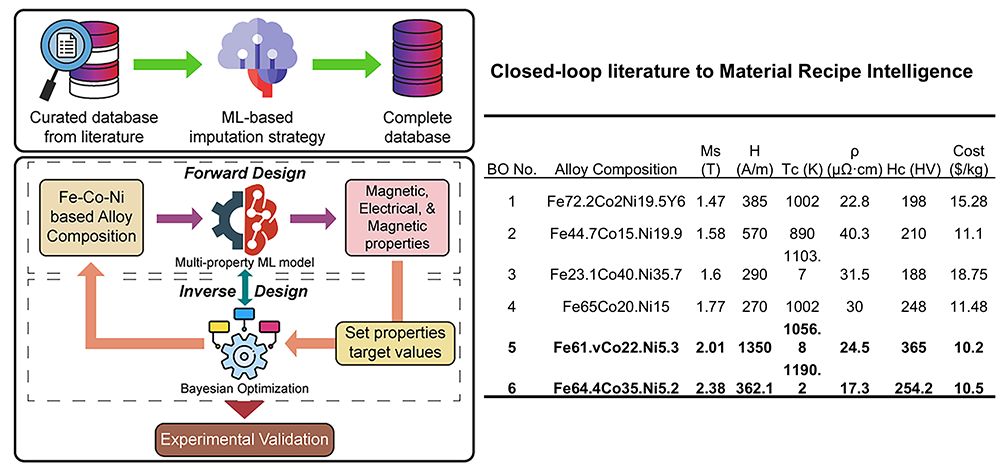
Structured high-entropy alloy
Challenge
Accelerate discovery of high-performance soft magnetic alloys despite sparse and fragmented data across Fe–Co–Ni composition systems.
Discovery
An ML-driven data imputation approach reconstructed a complete property database from literature, enabling inverse alloy design. Bayesian optimisation then guided the search for compositions balancing magnetic performance and material cost.
Impact
Identified and experimentally validated alloys achieving saturation magnetisation above 2.0 T while reducing material cost, demonstrating a scalable pathway for AI-assisted magnetic materials optimisation.
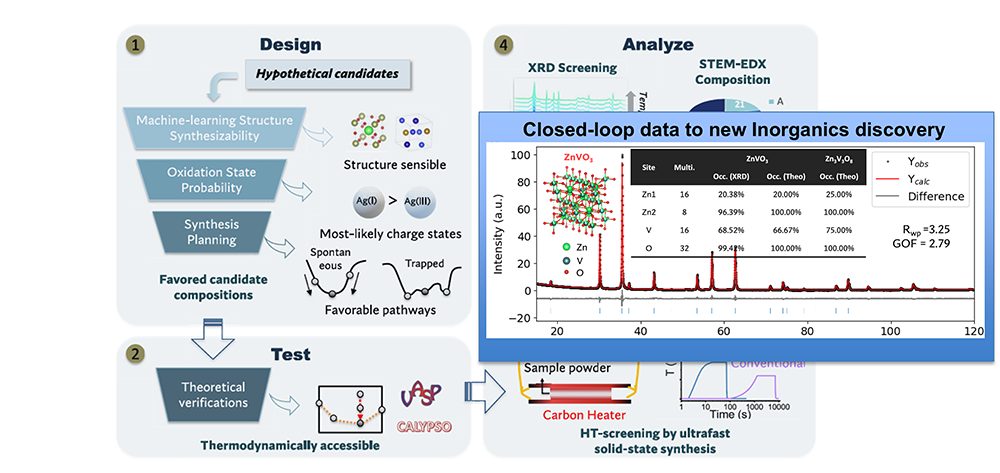
Inverse Design of Inorganic Ternary Oxides
Challenge
Translate computational predictions of new materials into experimentally synthesizable crystal structures.
Discovery
A design–test–make–analyse (DTMA) workflow integrating synthesizability filters, reaction network calculations, ultrafast synthesis, and microED characterisation to bridge theory and experiment.
Impact
Enabled the first-ever synthesis of ZnVO₃ and identified a novel structure Y₄Mo₄O₁₁, demonstrating how closed-loop discovery can accelerate the realisation of predicted materials.
Soft and bio-materials and devices
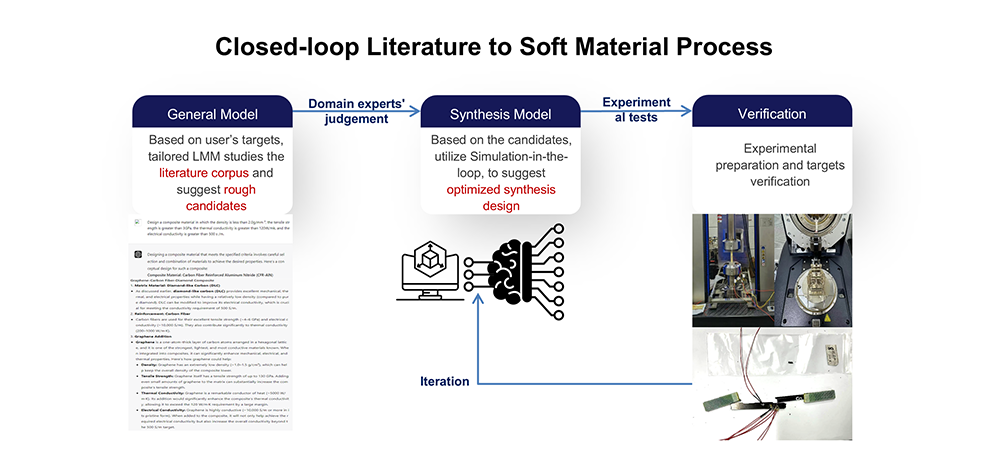
Multi Functional Composite Materials
Challenge
Identify composite material formulations that meet specific performance targets, such as density and thermal conductivity, without lengthy trial-and-error experimentation.
Discovery
A multi-stage workflow combining literature mining by a large multimodal model (LMM), simulation-in-the-loop optimisation, and experimental validation to rapidly refine candidate material recipes.
Impact
Delivered a partner-ready composite formulation within one week, compressing a discovery process that typically takes about a year, and demonstrating the potential of AI-assisted workflows for rapid materials development.
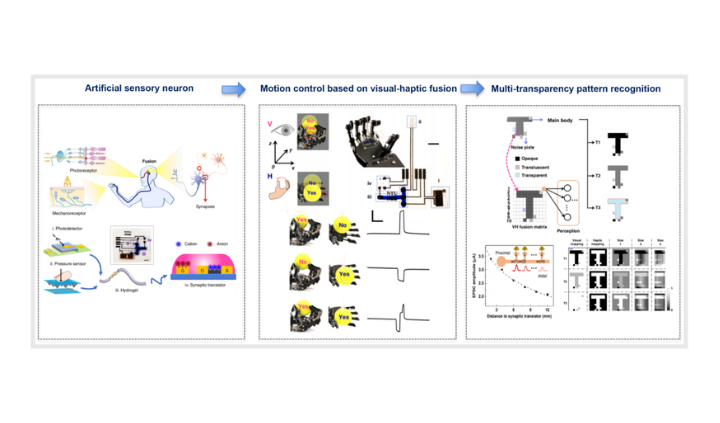
Artificial sensory neuron with visual‑haptic fusion
Challenge
Enable robotic systems to reliably interpret complex environments where single sensing modalities, such as vision alone, can be ambiguous.
Discovery
A bio-mimetic artificial sensory neuron integrating signals from photodetectors and pressure sensors through a synaptic transistor to emulate biological multisensory fusion.
Impact
Enabled a robotic hand to recognise patterns and perform precise motion control across varying transparency conditions, demonstrating a pathway toward more adaptive and intelligent robotic systems.
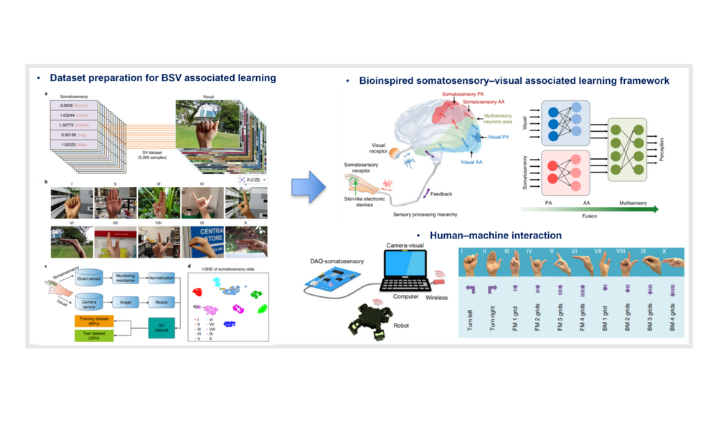
Bio‑inspired somatosensory–visual learning for gesture recognition
Challenge
Improve gesture recognition for human–robot interaction in environments where visual signals alone are unreliable or noisy.
Discovery
A somatosensory–visual learning framework that fuses data from stretchable strain sensors and cameras, mimicking the brain’s hierarchical processing of touch and sight.
Impact
Significantly improved gesture recognition accuracy, enabling precise control of mobile robots using complex hand signs, even under visually challenging conditions.
Applied‑AI platforms
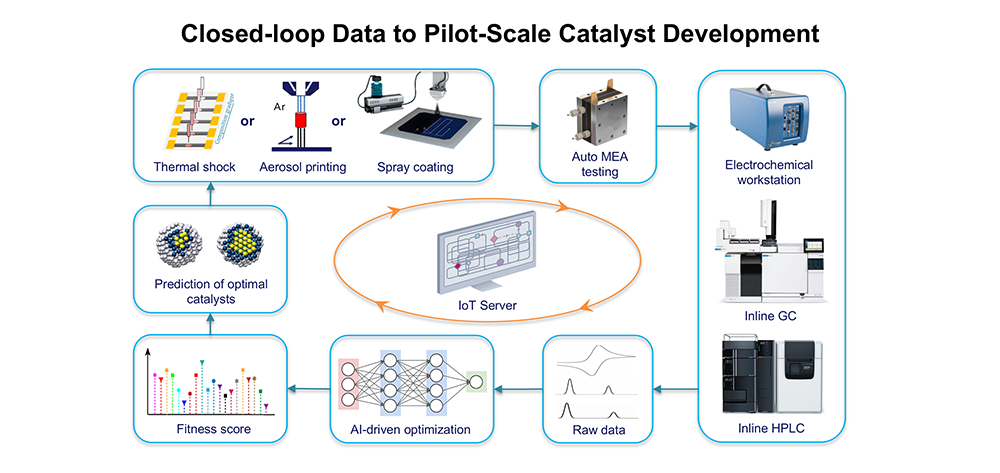
Electrocatalyst Pilot-scale Discovery
Challenge
Developing high-performance electrocatalysts for clean energy applications is traditionally a slow, trial-and-error process — with vast compositional spaces, expensive MEA fabrication, and limited throughput creating significant bottlenecks between lab-scale screening and pilot-scale deployment.
Discovery
The closed-loop SDL integrates aerosol printing, automated MEA testing, and inline HPLC with AI-driven optimisation to continuously refine catalyst compositions. This enables rapid traversal of the electrocatalyst design space and direct feedback between electrochemical performance data and the next synthesis iteration.
Impact
The platform accelerates electrocatalyst discovery by orders of magnitude compared to conventional approaches, enabling pilot-scale validation of optimised candidates within weeks rather than years — directly supporting Singapore's hydrogen and clean energy roadmap.
Thermal Catalyst Discovery
Challenge
Identifying optimal thermal catalysts across multi-dimensional compositional and processing parameter spaces demands a scale of synthesis and characterisation that far exceeds what conventional one-at-a-time laboratory workflows can realistically achieve.
Discovery
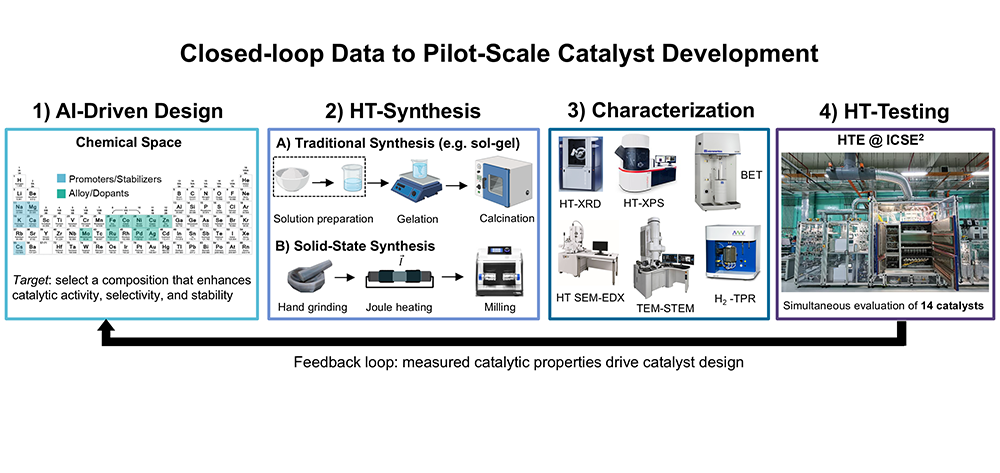
A fully integrated closed-loop pipeline couples AI-driven design with high-throughput sol-gel synthesis, automated characterisation, and HT testing. Measured catalytic properties are continuously fed back to refine the design model, enabling the system to self-direct towards high-performing compositions.
Impact
By closing the loop between data and synthesis at scale, we dramatically reduce the time and material cost of catalyst development, with direct applications in industrial chemical processes and sustainable manufacturing.
Smartphone RGB + LiDAR for non‑destructive nitrogen/biomass assessment
Challenge
Provide accurate, scalable methods to estimate crop health indicators such as leaf nitrogen and biomass in real farming environments.
Discovery
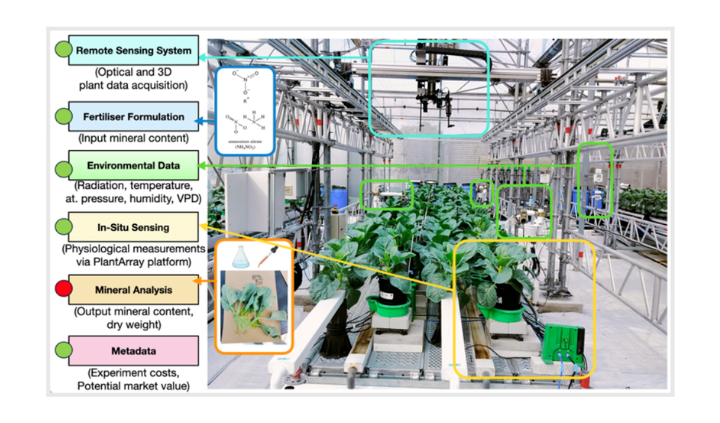
A sensing-to-prediction workflow combining smartphone RGB imagery with LiDAR point cloud data, enabling rapid field data collection and machine learning-based crop analysis.
Impact
Delivered a practical approach for real-time crop monitoring and nutrient assessment, supporting more precise farm management and scalable agricultural analytics.
Solar and clean‑energy materials
Perovskite-based Solar Cell Device
Challenge
Accelerate optimisation of perovskite solar cell materials while balancing efficiency and stability across complex additive compositions.
Discovery
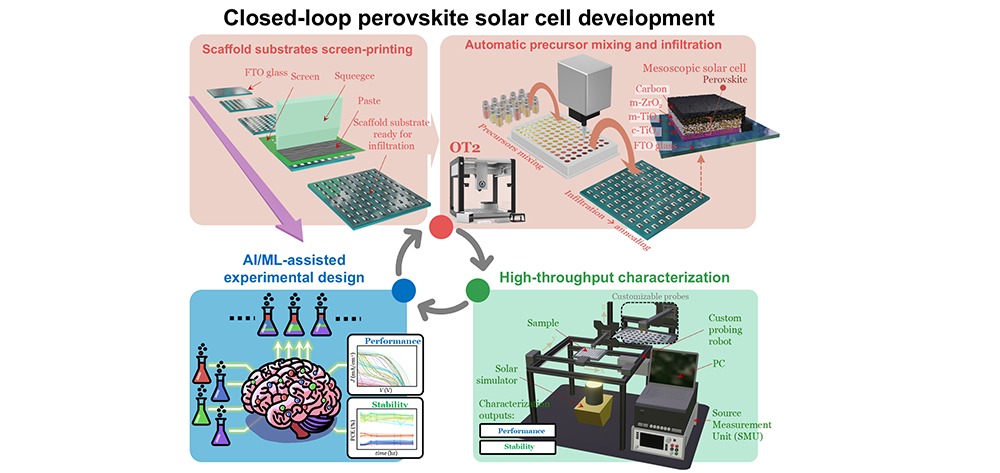
A screen-printed triple-mesoscopic architecture enabling in-device high-throughput screening of up to 81 solar cells per batch, paired with machine learning to optimise additive composition across multiple perovskite systems.
Impact
Achieved >100× faster experimental throughput and a 5.75-fold performance improvement, demonstrating a scalable pathway for AI-assisted optimisation of next-generation printed solar cells.
Carbon Capture Material
Challenge
Develop functional cellulose-based textiles faster than traditional trial-and-error R&D cycles allow.
Discovery
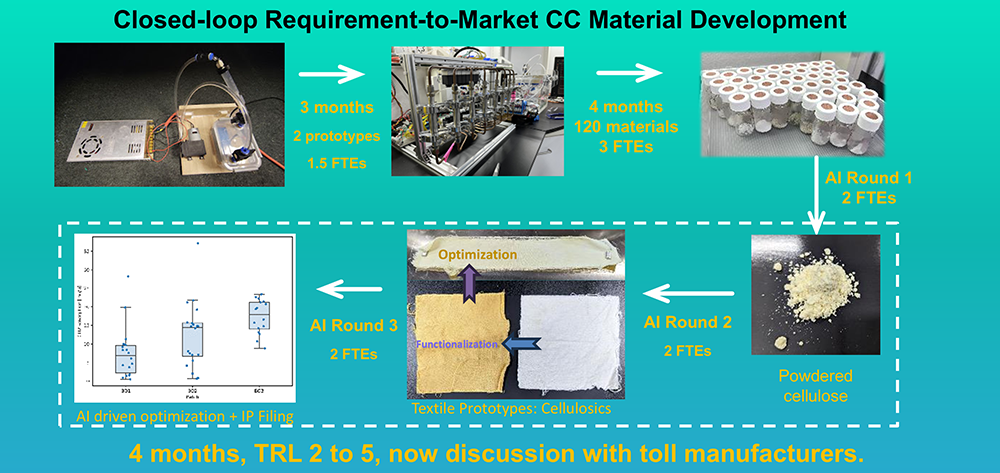
An AI-integrated design–build–test–optimise loop combining expert chemistry, rapid prototyping, and high-throughput testing to guide material functionalisation and processing decisions.
Impact
Advanced prototypes from TRL 2 to TRL 5 within four months, demonstrating a pathway to >10× faster materials development and accelerated time-to-market for sustainable textiles.