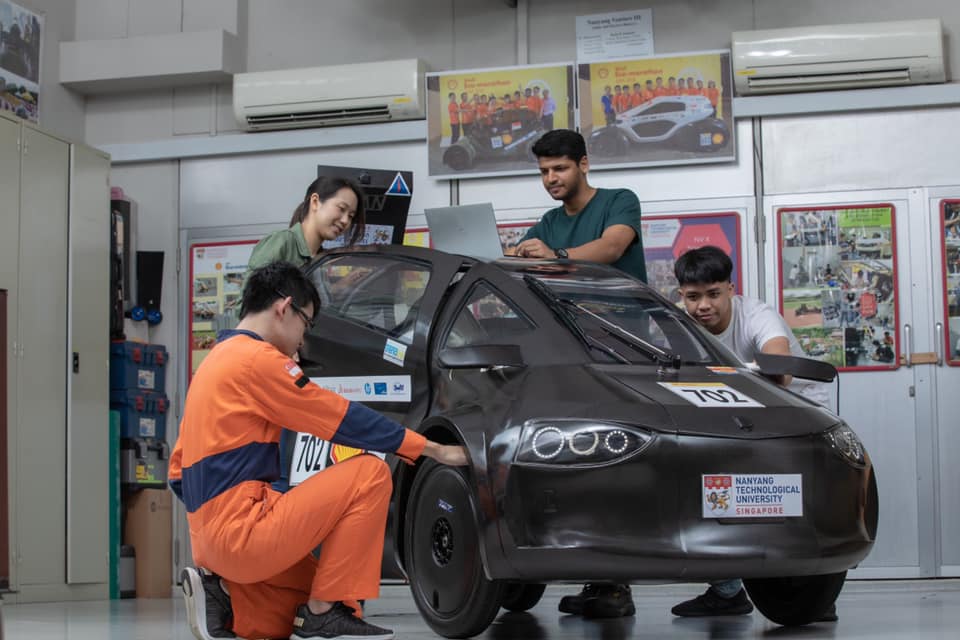
The Bachelor of Engineering (Mechanical Engineering) is a diverse discipline that encompasses areas from electric vehicles to greener 3D-Printed parts. The curriculum is constantly updated to match industries’ evolving trends. In the second year, students can opt for the Intelligent Design and Manufacturing Stream or the Mainstream. There are six areas of specialization within the Mainstream, reflecting the all-encompassing nature of the discipline.
#1 in Asia and #4 in the world for Mechanical, Aeronautical & Manufacturing, according to the 2025 QS World University Rankings by Subject.
Mechanical Engineers apply principles of physics, mathematics, and engineering to design, develop, and improve mechanical systems that power modern industries and everyday technologies. Their work spans a wide range of sectors, from advanced manufacturing and robotics to energy systems and transportation, contributing to technological innovation, improved productivity, and sustainable development.
The Mechanical Engineering programme offers a comprehensive and versatile education that prepares students to address complex engineering challenges across diverse industries. Combining flexibility with strong academic rigour, the curriculum provides a solid foundation in mathematics, physics, and core engineering principles such as mechanics, thermodynamics, materials science, and manufacturing processes. Students can further deepen their expertise through specialised courses and practical learning experiences, enabling them to design, analyse, and optimise mechanical systems and products.
- Programme Streams: Students may opt for one of the following streams (Mainstream or Intelligent Design and Manufacturing Stream) from Year 2 onwards.
- Areas of Specialisation: Aeronautical Engineering, Autonomus Systems, Energy & The Environment, Naval Architecture, Marine Engineering and Management, Smart Manufacturing and Digital Factory and Systems Engineering
Minimum Subject Requirements
Applicants are expected to fulfil these minimum subject requirements.
| Institution | Requirements |
|---|---|
| Singapore Cambridge GCE 'A' Level | H2 Level pass in Mathematics, and H2 Level pass in Physics / Chemistry / Biology /Computing |
| International Baccalaureate Diploma | Mathematics at Higher Level, and Physics / Chemistry / Biology / Computer Science at Higher Level |
| NUS High School Diploma | Major CAP of 2.0 in Mathematics, and Major CAP of 2.0 in Physics / Chemistry / Biology |
| International and Other Qualifications | Mathematics at Senior High School Level, and Physics / Chemistry / Biology at Senior High School Level, and Physics at Junior High School Level* * Physics at Junior High School level is only applicable to applicants who have not read Physics at Senior High School Level. |
| Polytechnic Diploma | Applicants with relevant diplomas from one of the local polytechnics may apply for admission. |
Accelerated Bachelor's Programme
If students perform extremely well in their first semester of Year 1, they will be offered entry into the Accelerated Bachelor’s Programme. The degree could be completed in 7 semesters (3.5 years) instead of the usual 8 semesters (4 years).
The Bachelor of Engineering (Mechanical Engineering) and the Bachelor of Engineering (Aerospace Engineering) degrees are accredited by the Engineering Accreditation Board of the Institute of Engineers, Singapore (IES).
Related Programmes
- Bachelor of Engineering in Mechanical Engineering with Second Major in Business
- Bachelor of Engineering in Mechanical Engineering with Second Major in Entrepreneurship
- Bachelor of Engineering in Mechanical Engineering with Second Major in Data Analytics
- Bachelor of Engineering in Mechanical Engineering with Second Major in Sustainability
- Bachelor of Engineering in Mechanical Engineering with a Second Major in Society & Urban Systems
71c552b9-56d0-4df7-a4b1-8ea31da180b9.png?sfvrsn=71e9d4da_3)