Download brochure

For more information about this programme, please contact: [email protected]

FlexiMasters in Integrated Circuit Design

Stackable towards Full Master’s programme: Master of Science in Integrated Circuits and Microelectronics

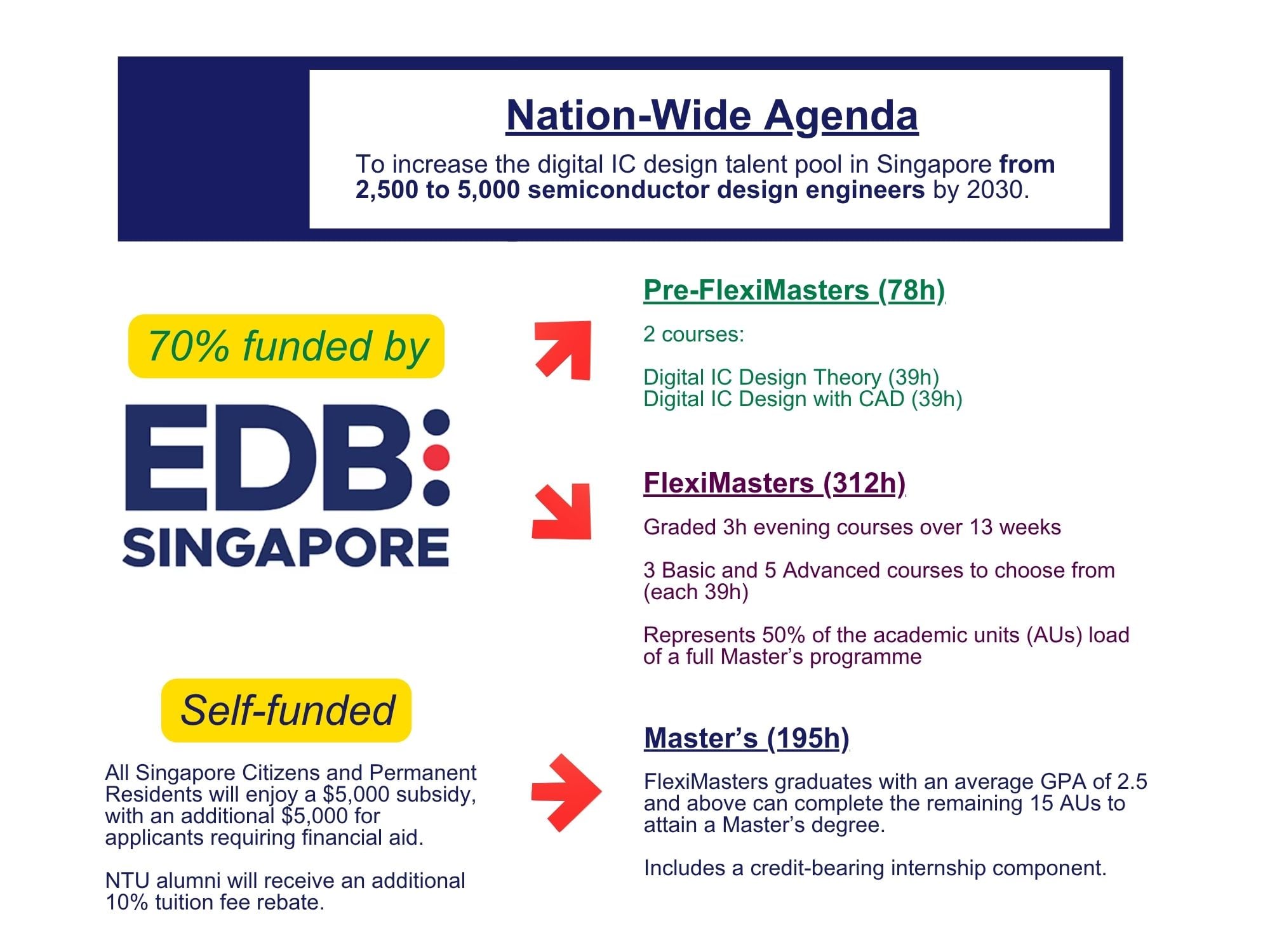
This FlexiMasters programme is conceived and developed by industry through SSIA to increase the digital IC design talent pool in Singapore and to serve as a bridging programme to ensure industry-ready skill sets.

The programme aims to provide the graduates, practicing engineers, R&D managers and technical staff who wish to gain technical knowledge as well as the practical hands-on experience in the area of digital IC design. The learning syllabus provides both basic as well as advanced modules so that students will receive practical training and understand the challenging demand of IC design industry.
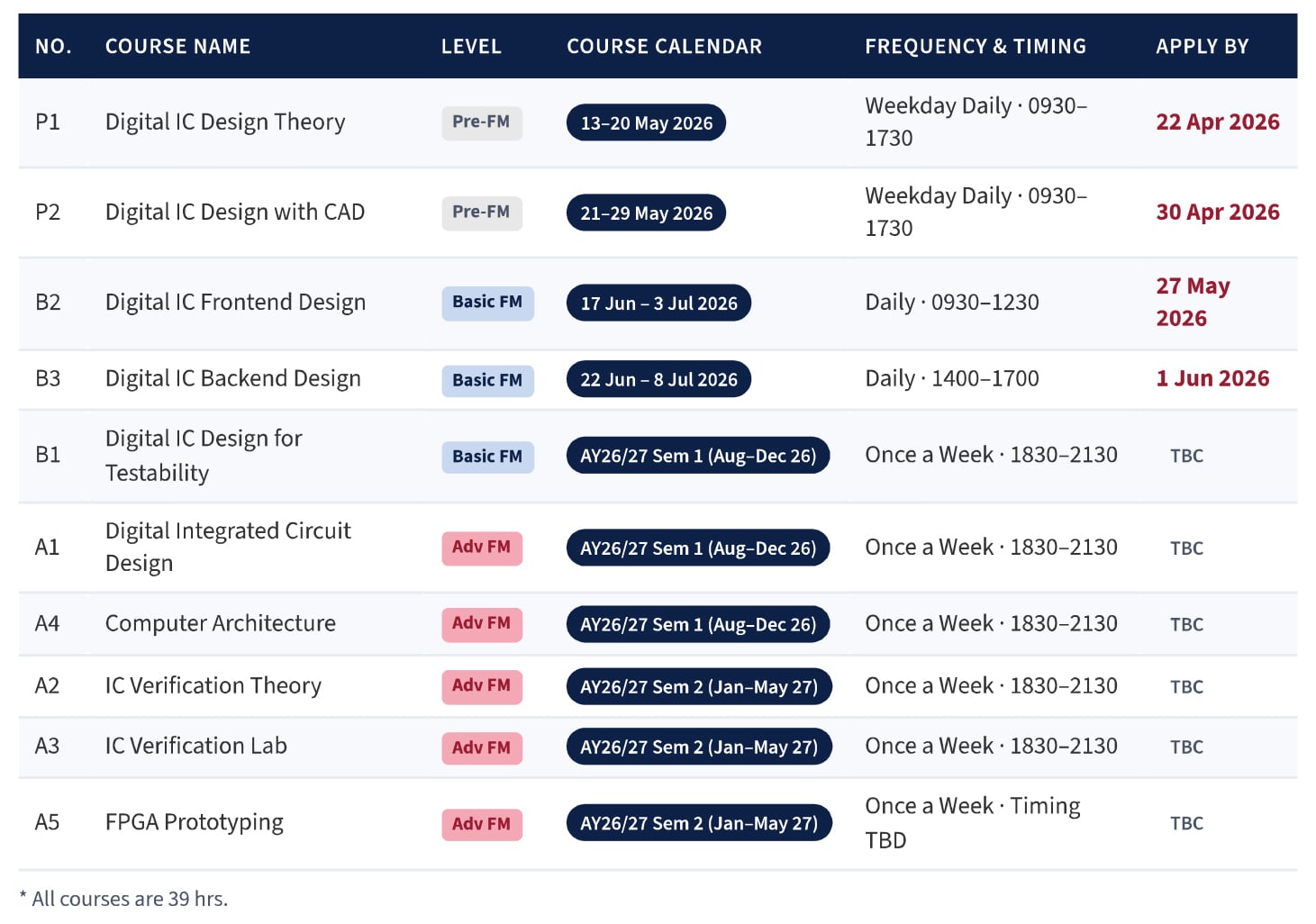
Digital IC Front-End Design

  • Design and characterise basic complementary metal–oxide–semiconductor cells
  • Implement sequential and combinational digital circuits with Hardware Description Language (HDL)
  • Construct testbenches for simulation and design validation
  • Perform logic synthesis with technology mapping
  • Simulate corner conditions for design optimisation

Digital IC Back-End Design

  • Integrate back-end design methodologies within Very-Large-Scale Integration (VLSI) design flow, from synthesis to Graphic Data System II (GDSII)
  • Demonstrate proficiency in layout, routing and physical verification using industry-standard Electronic Design Automation (EDA) tools
  • Analyse and verify digital designs through timing analysis, Design Rule Checking (DRC), and Layout Versus Schematic (LVS) verification

Digital IC Design for Testability

  • Demonstrate the understanding of VLSI testing basics
  • Explain IC device failure mechanisms and accelerated testing
  • Explain IC fault models, concept of testability, Design for Testability (DFT), Built-In-Self-Test (BIST) and random access memory test
  • Identify key techniques for test vector generation and fault simulation
  • Compare functional testing with current-based testing

Digital Integrated Circuit Design

  • Understand transistor device physics, as well as the secondary effects of these devices
  • Appreciate basic silicon device processes and be able to draw layout for a block of CMOS circuits
  • Analyse and design digital CMOS circuits with high speed and low power considerations
  • Describe the Bipolar CMOS (BiCMOS) processes and be able to analyse and design BiCMOS digital circuits
  • Explain digital functional modules and more complex digital integrated systems with low power consumption

Computer Architecture

  • Understand the fundamentals of computer design, including machine models and the concept of stored-programme computers, and the components of a modern Central Processing Unit (CPU), including the Arithmetic Logic Unit (ALU) and registers, from the transistor-level to the combinatorial circuits and memory units
  • Understand the design of simple instruction set architectures, including Multi-Directional Impact Protection System (MIPS)
  • Understand how a CPU communicates via buses with Input/Output devices
  • Compare performance of computers and storage devices in various dimensions
  • Deduce the method of improving CPU performance through a cache memory with the use of temporal and spatial locality
  • Describe the five steps of a DLX machine operating on un-pipelined hardware and explain the DLX main features such as fixed instruction format, fixed instruction length, Load/Store architecture, different addressing modes and the use of numerous registers
  • Differentiate the structural, data and control hazards associated with pipelined DLX execution and be able to devise methods to remove or reduce these hazards


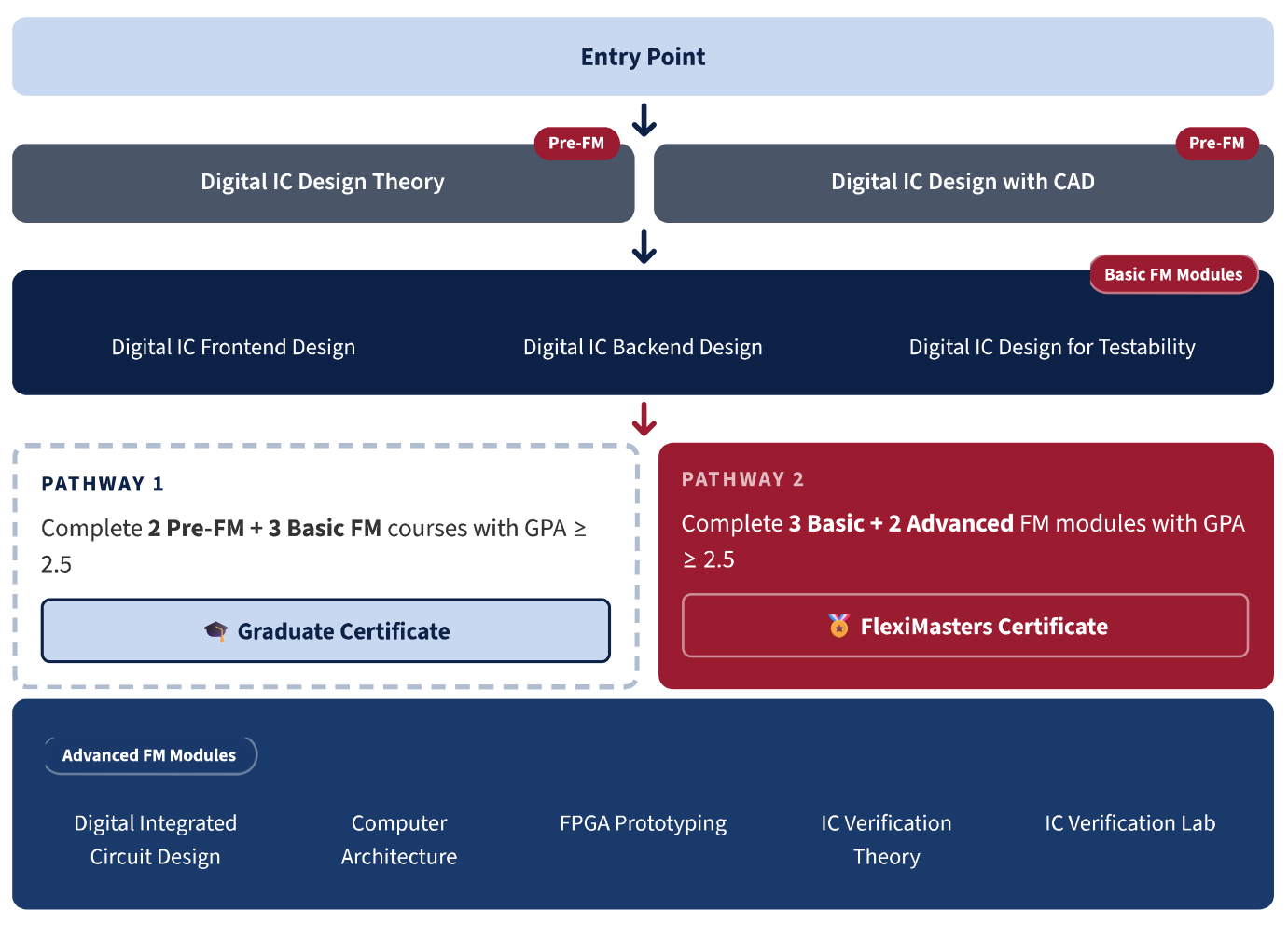
FlexiMasters will be awarded to learners who attain at least 15 academic units (AUs) with a minimum GPA of 2.5 for each course (equivalent to a C+ grade or above). The validity period of credits transfer from a FlexiMasters to a full Master's programme is 5 years from the date of award of the AUs as reflected in the official transcript.

  • Graduates in electrical engineering, electronics or related engineering disciplines
  • Practising engineers and R&D managers in the IC / semiconductor sector
  • Technical staff seeking structured upskilling in digital IC design

Admission criteria:

  • A formal bachelor's degree is a pre-requisite.
  • Relevant engineering background or work experience is advantageous.
  • Shortlisting will be conducted.

Language competency:

  • For applicants whose native language is not English, TOEFL/IELTS score would be required to be submitted during the application.
  • Applicants without TOEFL/IELTS may be subjected to an interview/test.

Course fee: S$5,615.68 per course (inclusive of GST, before 70% EDB subsidy for Singapore Citizens & Permanent Residents)

Venue: NTU Main Campus

Note:

  • NTU/NIE alumni may utilise their Alumni Course Credits. Click here for more information.
  • This programme is offered by NTU in collaboration with EDB and SSIA. NTU reserves the right to cancel, postpone or modify the course including the course schedules, course fees, funding, etc.