
Master of Science in Applied Materials Analytics
From materials characterisation to failure investigation — develop the analytical expertise needed to solve real-world engineering problems.
Newly introduced in 2026, the Master of Science in Applied Materials Analytics expands NTU MSE’s postgraduate coursework offerings in response to growing industry demand for expertise in materials characterisation, diagnostics, and failure analysis.
As technologies become increasingly complex — from semiconductor devices and aerospace systems to sustainable infrastructure and advanced manufacturing — organisations require specialists who can interpret materials data, diagnose performance issues, and identify the root causes of material degradation and failure. The ability to translate analytical insights into engineering solutions has become critical across modern R&D, manufacturing, and reliability engineering environments.
While the existing MSc programme provides a strong foundation in materials science and engineering, this programme focuses specifically on the analytical techniques and investigative approaches used to understand how materials behave under real operating conditions.
To reflect evolving industry needs, the programme also introduces elective courses that apply materials analytics and failure investigation to key engineering sectors, including:
MS6017 – Basic Introduction to the Solid State NMR Technique
MS6018 – Failure Analysis in Aerospace
MS6019 – Failure Analysis in Marine Engineering
MS6004 – Failure Analysis of Engineering Materials (Forensic Investigations)
MS6026 – Failure Analysis in Integrated Circuit
Who This Programme is For
The MSc in Applied Materials Analytics is designed for those who wish to develop advanced capabilities in materials characterisation, diagnostics, and failure investigation.
The programme is suitable for:

Materials, mechanical, civil, chemical, aerospace, and electrical engineers seeking deeper expertise in materials testing and analysis
Professionals working in semiconductor manufacturing, aerospace, marine engineering, construction, and advanced manufacturing who are involved in quality, reliability, or failure investigations
Engineers and researchers in analytical laboratories or R&D environments, looking to strengthen their understanding of modern materials characterisation techniques
Graduates with a background in materials science, engineering, physics, or related disciplines who are interested in applying analytical tools to real-world engineering challenges
By combining advanced analytical techniques with case-based learning in failure analysis, the programme equips students with practical skills that are directly relevant to industrial and research environments.
Career Prospects
Graduates of the MSc in Applied Materials Analytics are prepared for roles that require advanced expertise in materials diagnostics, reliability, and analytical investigation.
Potential career pathways include:
Materials Analyst / Materials Scientist
- Conduct materials characterisation and testing using advanced analytical techniques.
- Analyse microstructure, composition, and properties of materials.
- Work in R&D labs, testing facilities, or manufacturing companies.
Failure Analysis Engineer
- Investigate why materials or components fail in products or systems.
- Use microscopy, spectroscopy, and other techniques to identify defects.
- Common in semiconductor, electronics, and aerospace industries.
Characterisation Scientist / Engineer
- Specialise in advanced characterisation tools (e.g., electron microscopy, XRD, spectroscopy).
- Provide analytical insights to support product development and research.
Quality Assurance / Quality Control Engineer
- Ensure materials and components meet industry standards and specifications.
- Implement testing procedures and analyse quality data.
Process Engineer
- Optimise materials processing and manufacturing processes.
- Improve performance, reliability, and production efficiency.
Laboratory / Analytical Scientist
- Work in testing laboratories or research institutes performing materials analysis.
- Provide analytical services for industry clients.
Research and Development (R&D) Engineer
- Develop new materials, coatings, or components.
- Conduct experiments and analyze data to improve materials performance.
Technical Specialist / Applications Engineer
- Work with companies supplying analytical instruments or materials technologies.
- Provide technical support and solutions to industry clients.
These roles are in demand across industries such as semiconductors, aerospace, energy, marine engineering, infrastructure, biomedical technology, and advanced manufacturing, where understanding materials performance and failure mechanisms is critical to ensuring safety, reliability, and innovation.
Graduates may also pursue research careers in industrial laboratories, government agencies, or doctoral programmes.
Apply for Admission
There are two intakes each year – January and August.
The online application period opens from July to August for the January intake. From 19 March to 17 April 2026 for the August 2026 intake.
Apply NowWhy Pursue MSc with NTU MSE

Top Ranked Globally
Access high-quality education in Materials Science and Engineering at NTU, which is one of the top ranked in the world by subject, based on QS World University Rankings and US News Best Global Universities Rankings.

World-Class Faculty
Learn from a world-class Materials Science and Engineering faculty whose expertise and innovative research will enhance your educational experience, providing valuable insights and mentorship to prepare you for successful careers in the field.

Unlock Greater Financial Opportunities
Invest in upgrading your knowledge and expertise to access career advancement opportunities, secure positions in leading companies and industries, and ultimately pave the way for a more fulfilling career.

Flexibility
Enjoy the flexibility of a mixed-learning approach that combines asynchronous online learning with conventional face-to-face teaching. This approach empowers you to maximize learning outcomes while allowing you to balance your personal and professional commitments.Academic Pathways
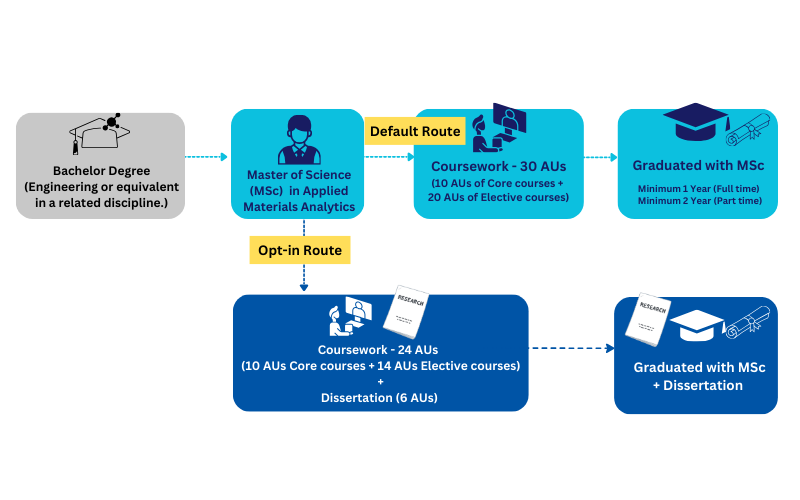
1) Default route (Coursework study only) -
MSc students will be enrolled on the coursework study option by default 30 AUs (10 AUs of core courses + 20 AUs of elective courses).
2) Opt-in routes – (Optional: Dissertation study option) -
MSc students may opt in to pursue coursework study 24 AUs (10 AUs core courses + 14 AUs elective courses) and Dissertation (6 AUs). For more information, please click here.
Frequently Asked Questions and Answers
Admission Criteria
| Minimum Score Required (Test dates must be within 2 years or less from the date of application) | ||
|---|---|---|
| TOEFL iBT ≥ 85 (internet-based) | OR | IELTS ≥ 6.0 |
Applicants without TOEFL/IELTS would still be eligible to apply, but they may be subjected to an interview/test if deemed necessary by the School. GRE is not required for MSc programme (by coursework).
Total Graduation Requirement: 30 AUs and attain a minimum CGPA of 2.5
| Minimum Candidature | Maximum Candidature | |
| Full Time Study | 1 year (2 semesters) | 3 years (6 semesters) |
| Part Time Study | 2 years (4 semesters) | 4 years (8 semesters) |
For Master of Science in Applied Materials Analytics programme tuition fees, please click here.
For international students, the required amount of the living expenses is estimated at S$18,000 per year, in addition to the tuition and miscellaneous student fees.
Deposit fee will be used to offset first payment.
The following courses are offered under the Master of Science in Applied Materials Analytics programme. Students must complete total of 30 AUs (10 AUs of core courses + 20 AUs of elective courses).
Core Courses
| Course Code | Course Title | No. of AUs |
| MS6023 | Diffraction, Imaging and Spectroscopy Techniques for Materials Analysis | 3 |
| MS6005 | Failure Analysis: Fundamentals | 3 |
| MS7320 | Physical Analysis of Materials | 2 |
| MS7310 | Chemical Analysis of Materials | 2 |
Elective Courses
| Course Code | Course Title | No. of AUs |
| MS6003 | Failure Analysis of Engineering Materials (Civil & Mechanical) | 2 |
| MS6004 | Failure Analysis of Engineering Materials (Forensic Investigations) | 2 |
| MS6006 | Failure Analysis in Semiconductor Packaging | 3 |
| MS6010 | Crystal Chemistry of Nanomaterials | 3 |
| MS6017 | Basic Introduction to the Solid State NMR Technique | 3 |
| MS6018 | Failure Analysis in Aerospace | 3 |
| MS6019 | Failure Analysis in Marine Engineering | 3 |
| MS6020 | Fundamentals of Intellectual Property in Materials Science & Engineering | 3 |
| MS6026 | Failure Analysis in Integrated Circuit | 2 |
| MS7001 | Materials Laboratory Techniques | 3 |
Please note that there is a maximum credits for course registration allowed per semester:
- Full time M.Sc. student could take maximum 15AUs of courses in each semester.
- Part time M.Sc. student could take maximum 9AUs of courses in each semester.
A coursework student with poor academic performance will be subjected to the following actions:
- Academic warning if TGPA < 2.50 in any term of study
- Termination of Candidature if TGPA < 2.50 for the second consecutive term of study.
Apply Now
There are two intakes each year – January and August.
The online application period opens from July to August for the January intake. From 19 March to 17 April 2026 for the August 2026 intake.
Apply Now
Contact Us
Email: [email protected]