Satellite Events
What Is Life?

20 July 2026
A satellite workshop on the origins of life, biological intelligence, and bio-inspired AI, in association with the APSA26 conference.
Living organisms are best understood not as a fixed entity, but rather as an ongoing, dynamic process arising from myriad interacting parts forming complex biological networks. These large-scale networks operate through nonlinear dynamics and their components, such as organs, tissues, cells, genes, and proteins, interact and synchronize to generate coherent, emergent patterns of behaviour. Even when governed by deterministic rules, these systems can produce unpredictable outcomes, due to sensitivity to initial conditions and feedback loops, shaping development and evolution. Order does not merely result from external design; it can spontaneously emerge through self-organization, especially in regimes that balance stability with flexibility. Life therefore persists by maintaining structure far from equilibrium, continuously exchanging energy and matter with its surroundings to sustain organization. Across multiple scales, from molecular networks to whole organisms, biological systems process information in ways that integrate robustness with adaptability, while remaining fragile to disease, ageing, and death. In this view, life is an emergent, self-organizing, energy-dissipating network, finely poised between order and chaos. What new forms of computation might arise if biology-inspired artificial intelligence were modelled as a dynamic, self-organizing, adaptive network?
Co-organizers:
Prof. Kumar Selvarajoo (Senior Principal Investigator, Bioinformatics Institute, A*STAR)
Dr. Melvin Chen (Senior Lecturer in Philosophy & Faculty Member of the NTU-USP, NTU)
Register for the workshop at http://soh.school/apsa-life-workshop
Upper limit for the number of participants will be 50.
Heart of Science: Book Workshop
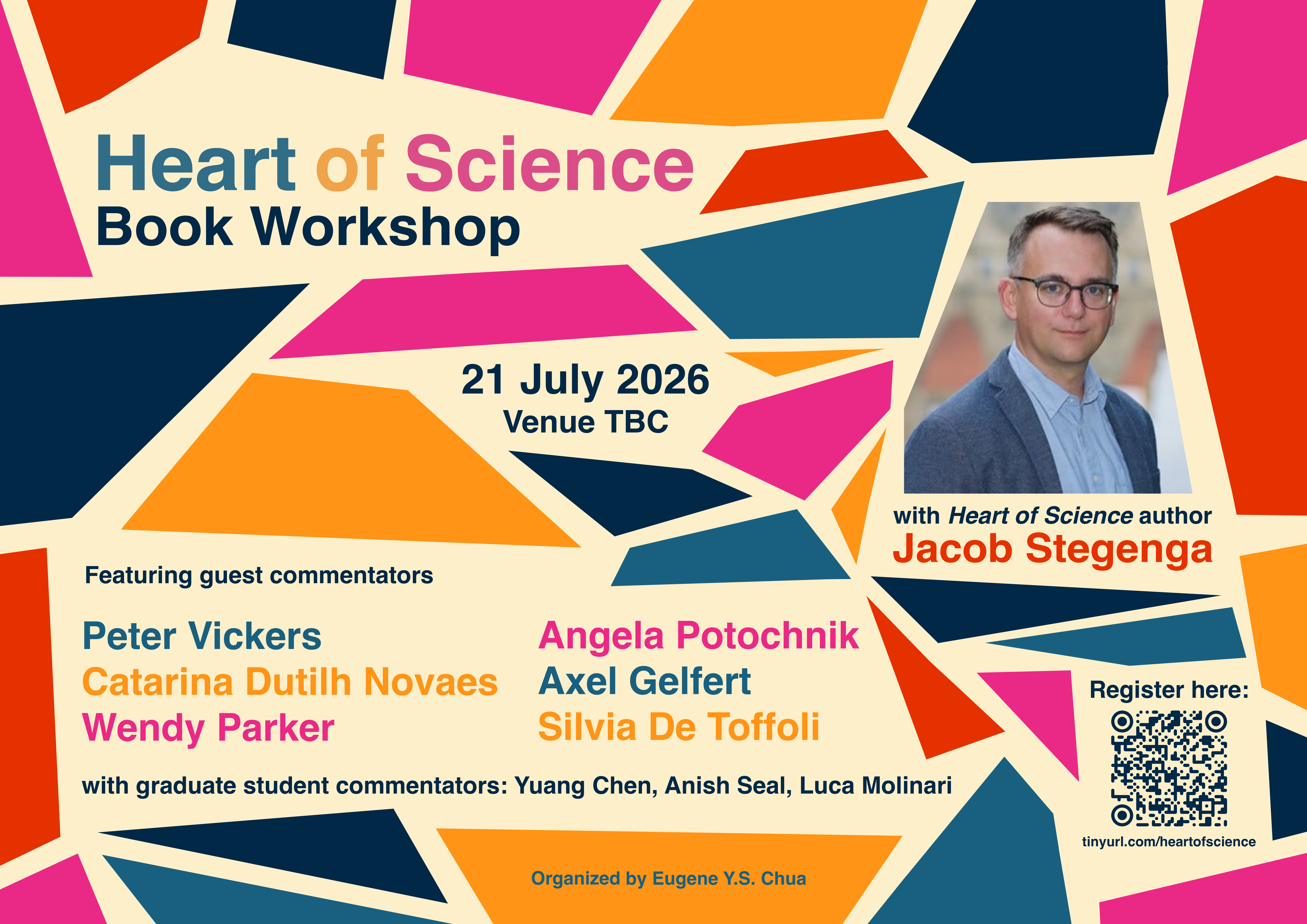
21 July 2026
*Limited attendee spots available
In his latest book, Heart of Science: A Philosophy of Scientific Inquiry, Jacob Stegenga, professor of philosophy at Nanyang Technological University, and author of Medical Nihilism and Care and Cure: An Introduction to Philosophy of Medicine, argues for a novel epistemology of science that contends that good science need not attain its aims, but it must justify its claims.
The workshop will feature discussions by six international philosophy guest commentators, a few local graduate student commentators and Jacob on the ideas explored in the book.
Finding Balance: Foundations of Thermodynamics Workshop 2026
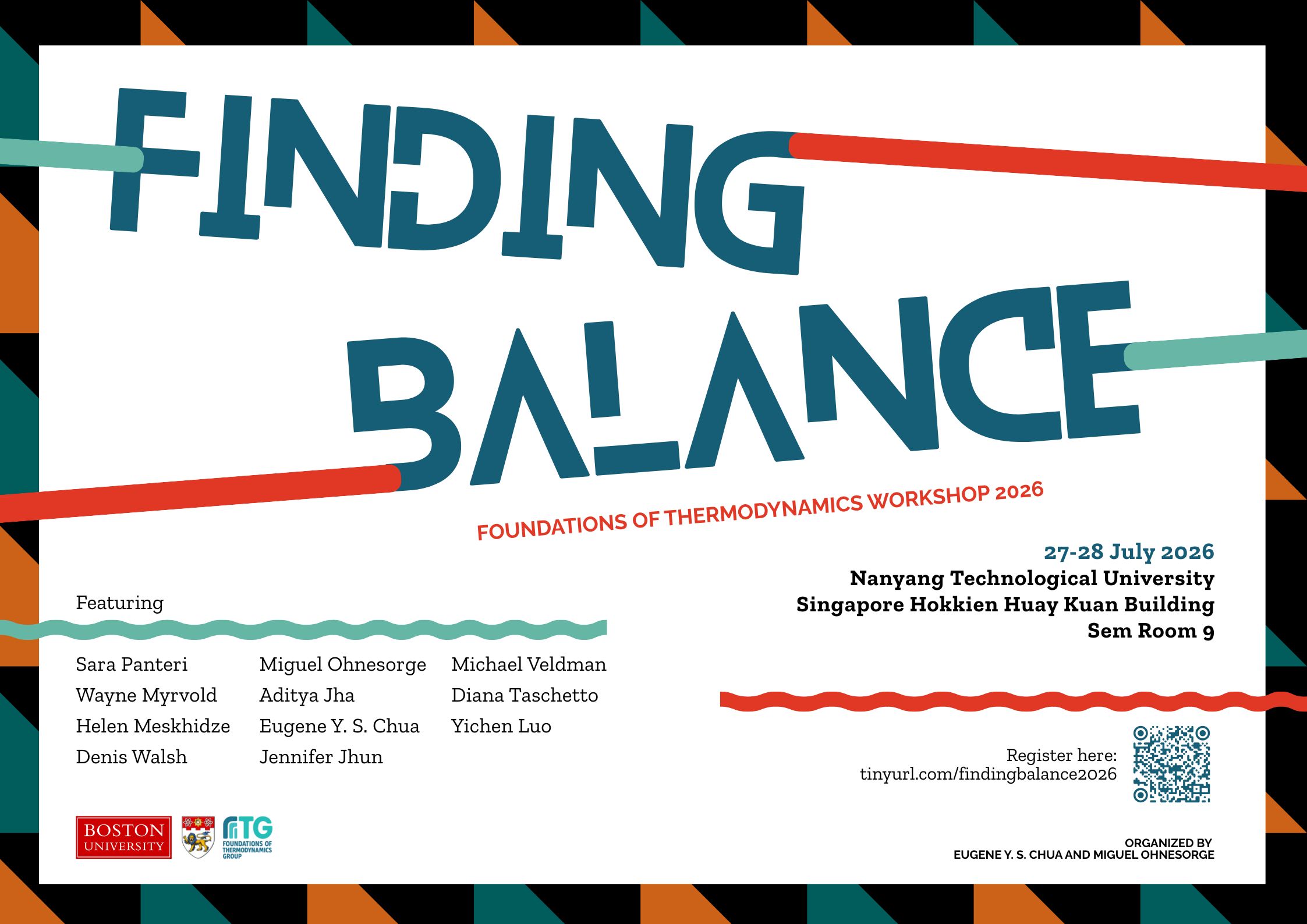
27-28 July
SHHK Building, Sem Room 9
*Limited attendee spots available
Co-organized with Miguel Ohnesorge, the theme will be a conceptual history of equilibrium and static reasoning. Bringing historians and philosophers of science together, we hope to have a clearer picture of the genealogy of equilibrium and static reasoning, and its role in scientific theorizing -- we hope to trace the idea from Archimedean mechanics, to Newton and the post-Newtonians, classical thermodynamics, quantum mechanics, general relativity, contemporary quantum and gravitational physics, biology, and economics.
Learn more about the Foundations of Thermodynamics group here: https://www.eugenechua.com/foundations-of-thermodynamics