Hot-AIRSS - bringing temperature to structure search by Professor Chris Pickard
Tan Chin Tuan Exchange Fellowship Lecture Hosted by Dr Feng Xiaolei
Abstract
Machine-learned interatomic potentials speed up atomistic calculations by several orders of magnitude. I will show how long high-throughput anneals, between direct structural relaxation, enabled by ephemeral data-derived potentials (EDDPs), can be incorporated into AIRSS to bias the sampling of challenging systems towards low-energy configurations. Hot AIRSS (hot-AIRSS) preserves the parallel advantage of random search, while allowing much more complex systems to be tackled. I will then show how low-energy carbon structures can be directly generated from a single, experimentally determined, diamond structure. An extension to the generation of random sensible structures, candidates are stochastically generated and then optimised to minimise the difference between the EDDP environment vector and that of the reference diamond structure. The distance-based cost function is captured in an actively learned EDDP. The relationship of this approach to modern diffusion-model-based generative methods is discussed.
Biography
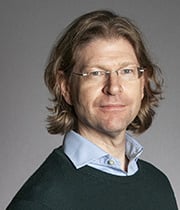
Chris Pickard
Tan Chin Tuan Engineering Fellow at NTU
MTG - Department for Materials Science & Metallurgy,
Cambridge, United Kingdom
Chris Pickard is the inaugural Sir Alan Cottrell Professor of Materials Science held in the Department of Materials Science and Metallurgy, University of Cambridge. Previously he was Professor of Physics, University College London, and Reader in Physics, University of St Andrews. He has held EPSRC Advanced and Leadership Research Fellowships, and a Royal Society Wolfson Research Merit Award. He is a lead developer of the widely used CASTEP computer code and introduced both the GIPAW approach to the prediction of magnetic resonance parameters and Ab Initio Random Structure Searching (AIRSS). CASTEP has provided a significant source of licencing income for Cambridge Enterprise for over 20 years, while his AIRSS software is freely available through an open-source license. In 2015 he won the Rayleigh Medal and Prize of the Institute of Physics, awarded for distinguished research in theoretical, mathematical or computational physics. Since 2022 he has been a Fellow of Christ’s College Cambridge, and from 2025, President.