Light-Driven Separations & Separation-Enabled Electrosynthesis by Assistant Professor Richard Liu
Tan Chin Tuan Exchange Fellowship Lecture Hosted by Assistant Professor Leonard Ng
Abstract
My research group is focused on the use of synthetic and physical organic chemistry to solve problems in the environment, sustainability, and health domains. We will summarize work over the past three years on using photochemistry to perform separation of carbon dioxide (CO2) from point sources and from ambient air. We will analyze a cyclic process for capture and release of CO2 using metastable-state photoacids. Then, we will outline our development of reversible hydroxide emitters that can concentrate CO2 from ambient air using sunlight as the sole energy input. In the second half of the talk, we will describe efforts to use liquid-liquid phase separation as an enabling element in electrosynthesis. Aqueous organic electrochemical systems, well optimized over the past decades for energy storage, are repurposed to perform redox transfer at an oil-water interface. We will show that this biphasic approach allows for efficient, catalytic PCET hydrogenations without adding supporting electrolyte nor reagents in the organic phase. These examples highlight the potential for innovation at the intersection of photochemistry, electrochemistry, and separations science.
Biography
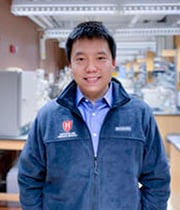
Richard Liu
Tan Chin Tuan Engineering Fellow at NTU
Assistant Professor of Chemistry and Chemical Biology, Harvard University
Richard obtained his A.B. in chemistry and physics from Harvard College, where he conducted research with Eric Jacobsen. During his graduate studies at the Massachusetts Institute of Technology (MIT), Richard worked with Stephen Buchwald on the development of copper-hydride catalysts for olefin hydrofunctionalization. After earning his Ph.D. in 2019, he joined the laboratory of Timothy Swager at MIT and the Institute for Soldier Nanotechnologies (ISN) as a postdoctoral associate, during which he demonstrated new applications of photochemistry performed on and by organic polymers. Richard returned to Harvard University to join the faculty in July 2022. His independent research focuses on catalysis for organic synthesis and sustainability. Some recent awards include the Amgen Young Investigator Award, Bayer Early Excellence in Science Award, and the NIH Director’s New Innovator Award.