
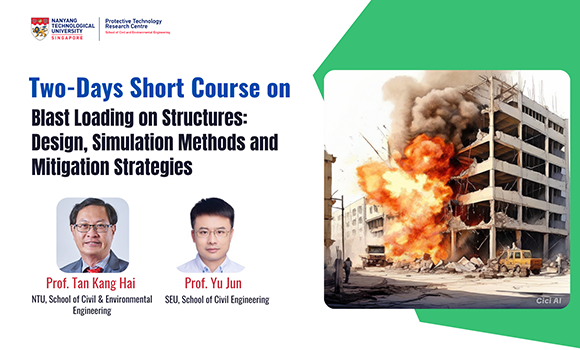
Short Course on Blast Loading on Structures: Design, Simulation Methods and Mitigation Strategies
Organized By
Protective Technology Research Centre
Topic
Blast Loading on Structures: Design, Simulation and Mitigation Strategies
For Whom
The course is designed for practicing engineers and consultants, researchers and graduate students, and public-sector officers who are engaged in the analysis, testing, modelling, design, and assessment of structures under blast and impact loading. It provides comprehensive coverage of fundamental theory, material characterization, analytical solutions, numerical simulation methods, design procedures, and practical applications for enhancing structural resilience against blast and impact effects.
Registration Fee
| Public | SGD $900* / pax |
| NTU Alumni | SGD $800* / pax |
| * Fees inclusive of prevailing GST, tea breaks & buffet lunch | |
| Cancellation:The organisers reserve the right to amend any details relating to the seminar, revise the seminar fees without prior notice, cancel or postpone the seminar. | |
Abstract
Impact, blast, and shock hazards present critical challenges in industrial safety, security, and defense, particularly for the protection of critical infrastructure and high-value assets. This two-day short course provides a structured overview of the fundamentals, analysis methods, and design strategies for mitigating blast and impact effects on structures. Key topics include blast load characterization and computation, blast simulation methods such as load blast enhanced (LBE), multi-material ALE (MM-ALE), and coupled LBE–ALE approaches, structural response and SDOFapproaches, pressure–impulse (P–I) concepts, material characterization and strain-rate effects, and practical protective design methodologies. Delivered by leading experts, the course integrates focused lectures with real-world case studies and interactive discussions, enabling participants to develop practical competence in blast-resistant assessment and design. Participants will leave with actionable insights and a clear understanding of contemporary approaches and best practices in structural protection.
About the Speakers
Speaker 1: Prof Tan Kang Hai (TKH)
Prof. Tan Kang Hai is currently a professor at Nanyang Technological University and the director of Protective Technology Research Centre.
Prof. Tan has published over 300 internationally renowned SCI journal papers with over 14000 citations. He has been ranked among the top 2% of global scientists at Stanford University for many consecutive years. Prof. Tan has high international reputation in the filed of progressive collapse and fire resistance of structures, and won the Best Paper Award from SCI journal Structures in 2023 and the High Citation Research Award from the journal Engineering Structures. He serves on the editorial board of Cement and Concrete Composites, a premier journal in the filed of cementitious materials and concrete technology. At the same time, he is also a registered professional engineer and expert-level engineer in the field of protection in Singapore.
He has been awarded the Public Administration Medal (Bronze) and MND Medallion for service and contributions to the HDB Civil & Structural Engineering Advisory Panel. He is a member of the 17th Singapore Building Structure and Substructure Standards Committee and serves as the Chairman of Appeals Advisory Board for Infrastructure Protection Act. He has supervised over 50 PhD students to date, several of whom have received the Best PhD Thesis Award and other academic honors.
Prof. Yu Jun is currently working as a professor in School of Civil Engineering, Southeast University (SEU), Nanjing, China. He has been ranked among the top 2% of global scientists at Stanford University for many consecutive years. Prof. Yu has high international reputation in the field of progressive collapse of structures, and won the Best Paper Awards from the SCI journal Structures in 2023 and from the International Conference on Design & Analysis of Protective Structures (DAPS) in 2012.
He has awarded “Distinguished Young Scholar Fund of Jiangsu Province” in 2018, and 3 grants from National Science Foundation of China. He served as a committee member in China to draft “Standard for anti-collapse design of building structures (T/CECS 392-2021)”, successfully organized 2024 China and Singapore International Conference on Applied Mechanics and Engineering (CSAME) and other two domestic academic conferences regarding disaster mitigation for civil structures. He is also a member of American Society of Civil Engineering (ASCE) and International Association of Protective Structures (IAPS).
Course Outline
| Day 1 - Thursday, 16 April 2026 | ||
| Time | Theme | Speaker |
| 09:00 | Introduction to Blast Loading on Structures and Protection Concepts
| TKH |
| 09:55 | Tea Break | |
| 10:15 | Blast Load Idealization and Computation for Structural Design Part I & II
| YJ |
| 12:15 | Lunch | |
| 13:15 | Structural Response to Blast Loading & PI Diagrams Part I & II
| TKH |
| 15:15 | Tea Break | |
| 15:30 | Energy Approach & Equivalent SDOF for Design Part I & II
| TKH |
| 17:30 | End of First Day | |
| Day 2 - Friday, 17 April 2026 | ||
| Time | Theme | Speaker |
| 09:00 | Design of Reinforced Concrete Structures to Blast Loading Part I
| TKH |
| 10:00 | Tea Break | |
| 10:15 | Design of Reinforced Concrete Structures to Blast Loading Part II
| TKH |
| 11:15 | Security By Design and Threat & Vulnerability Risk Assessment | TKH |
| 11:45 | Lunch | |
| 12:45 | Methods for modelling air blast load and case studies Part I
| YJ |
| 13:45 | Methods for modelling air blast load and case studies Part II
| YJ |
| 14:45 | Tea Break | |
| 15:00 | Design of Steel-Concrete-Steel Composite Structures to Blast Loading
| YJ |
| 16:00 | Response of Structures to Near-Field Blast and Contact Detonation
| YJ |
| 17:00 | End of Course | |
Registration
Click here for registration
- Please register by 1April 2026.
- The payment details/link will be sent separately, after we have confirmed your registration.
- Please note that there is no refund of fees for cancellation.