
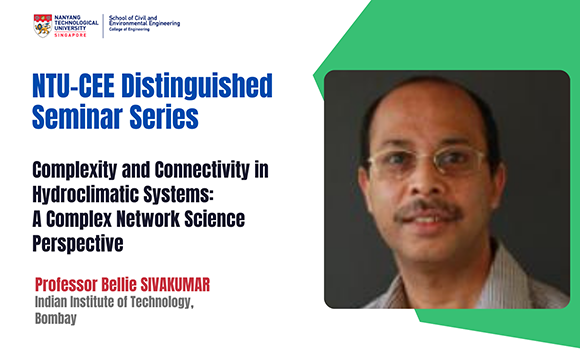
NTU-CEE Distinguished Speaker Series: Professor Bellie SIVAKUMAR
Organized By
CEE Seminar Committee
Host By
Associate Professor QIN Xiaosheng
Topic
Abstract
Hydroclimatic systems are complex, nonlinear, and dynamically evolving systems composed of many interconnected components that vary in space and time. Numerous scientific concepts and methods have been proposed to study their complexity and connectivity. Among these, complex network theory offers useful perspectives for analyzing hydroclimatic systems and has seen increasing application in recent years. This talk reviews recent advances in the use of complex network–based approaches in hydroclimatology and discusses future research directions.
First, key concepts of complex networks and their relevance for characterizing complexity and connectivity in hydroclimatic systems are introduced. Next, several applications are reviewed, including their coupling with chaos theory. These applications include representing spatial and temporal connections in rainfall and streamflow, identifying optimal hydrologic monitoring networks, and assessing the performance of global climate models. Finally, potential roles for complex network approaches in addressing future hydroclimatic challenges are highlighted.
Biography
Bellie Sivakumar is a Professor in the Department of Civil Engineering, Indian Institute of Technology Bombay (IIT Bombay), India. He received his Ph. D.degree (in Civil Engineering) from the National University of Singapore in 1999. He has 25 years of experience in research, teaching, and professional services in the areas of hydrology, hydroclimatology, and water resources. Sivakumar is internationally recognized for his contributions and commanding role in advancing research in nonlinear dynamics, chaos, and complex networks theories in the above areas. He has authored/co-authored three books and over 250 peer-reviewed journal articles, among others. He has been an Editor-in-Chief/Associate Editor/Editorial Board Member of over 15 highly-reputed international journals, Guest Editor of 12 journal special issues, and reviewer for over 55 international journals and funding agencies.
He has been a member of several professional societies, and a Fellow of the Asia-Oceania Geosciences Society (AOGS). He has received a number of international competitive research fellowships, including the Australian Research Council (ARC) Future Fellowship and the Japan Society for the Promotion of Sciences (JSPS) Fellowship.