

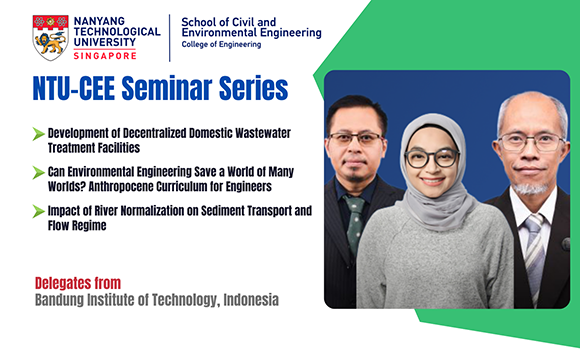
NTU-CEE Seminar Series: Delegates from Bandung Institute of Technology
Organized By
CEE Seminar Committee
Host By
Dr Lim Tuti Mariana
Topics
1. Development of Decentralized Domestic Wastewater Treatment Facilities
2. Can Environmental Engineering Save a World of Many Worlds? Anthropocene Curriculum for Engineers
3. Impact of River Normalization on Sediment Transport and Flow Regime
About the Seminar
Topic 1
Domestic wastewater is a major contributor to river and water body pollution, especially in areas where there are no centralized wastewater treatment plants, including some specific areas. Conventional Septic Tank as common on-site wastewater treatment facilities in Indonesia are inadequate to remove contaminants and to meet water quality standards. Improving the performance and affordability of treatment facility is a crucial element in achieving more sustainable technologies.
Currently, Conventional Septic Tanks are being modified with anaerobic-aerobic MBBR processes, integrated with microbial fuel cells, connected to solar panels as an energy source, and developed with typologies suitable for specific areas. Laboratory and pilot scale experiments have shown that the development of decentralized domestic wastewater treatment facilities has potential to provide better treatment performance, produce alternative energy, reduce operational costs, and be suited to local conditions.
Topic 2
This essay aims to craft the groundwork for re-engineering environmental engineering in/of the Anthropocene. Reflecting on experimental fieldwork in Muaragembong, Indonesia, raises the question of designing for water infrastructures for more-than-human beings and sets the stage for retracing the colonial origins and the postcolonial trajectory of environmental engineering in the postcolonial state. It concludes with a critical review of the current curriculum of environmental engineering at a technical university. (Prabaharyaka et al. Engineering Studies, 2025).
Topic 3
This study investigates the rapid reaccumulation of sediment in the Citarum-Majalaya River following a 2020 normalization project. Using HEC-RAS 2D modeling integrated with DEM, SWAT+ discharge, and field sediment data, the research quantifies post-normalization sedimentation and its impact on flood risk. Within just two years, nearly 50% of the previously dredged sediment volume had returned, reducing river capacity by 23% and significantly increasing flood-prone areas. The findings underscore the urgency of adaptive sediment management and continuous monitoring in urbanizing watersheds. Future Research Prospects:
Development of real-time sediment monitoring systems using remote sensing and IoT based sensors
Integration of machine learning with hydrodynamic models to improve sediment transport prediction accuracy
Scenario-based evaluation of nature-based solutions (e.g., riparian buffers, reforestation) for upstream erosion control
Socioeconomic impact modeling of sediment-induced flooding on vulnerable communities
Optimization of dredging schedules using predictive analytics and cost-benefit frameworks
About the Speakers
Speaker 1
Ir. Ahmad Soleh Setiyawan, ST. MT. Ph.D, is an associate professor in the Faculty of Civil and Environmental Engineering at the Bandung Institute of Technology. He is part of the water and wastewater engineering research group. He specializes in decentralized domestic waste water management. His research areas include domestic wastewater engineering, water quality monitoring, public health, fecal sludge and sanitation management. His works integrate engineering analysis with water quality monitoring and risk assessment on the public health towards sustainable sanitation management.
Speaker 2
Anindrya is a systems-level sustainability scholar with 10+ years’ experience integrating environmental governance, behavioral science, and institutional systems in climate adaptation, water governance, and just transitions. She holds a double Doctorate (environmental engineering ITB & water governance at the Institute for Science in Society of Radboud University), with full interdisciplinary research leadership capacity.
She has secured and led research funding exceeding USD 1.4 million, serving as Principal Investigator for national and international research grants and as proposal contributor and Indonesia country lead in international multi-country consortia. Projects cover inclusive water and sanitation, climate adaptation, urban heat resilience, youth well being, and nature-based solutions, with funding from UKRI, Newton Fund, CLaRE, PHC Nusantara, IDS UK, KNAW NL, uGood National Research Foundation, and national Indonesian funding schemes. She published extensively across interdisciplinary journals and proceedings, including PNAS, Water International, Environment & Urbanization, Interdisciplinary WIREs Water, Journal of Urbanism: International Research on Placemaking and Urban Sustainability, Habitat International and Journal of Urban Affairs.
She generate 1,294 citations and co-authored 50 articles with 245 collaborators (Scopus data, October 2025). She was in-country research collaborator contributing field data collection and research samples for Cozzarelli Prize-winning PNAS study (Class VI, 2021 13947), part of an international multi-institutional research consortium.
Speaker 3
Joko Nugroho, is an Associate Professor at the Faculty of Civil and Environmental Engineering, Institut Teknologi Bandung (ITB), Indonesia. His research focuses on water resources engineering, with a particular emphasis on river engineering and hydraulic structures. He earned his Bachelor's degree in Civil Engineering from ITB in 1997, followed by a Master's degree in 2000. He completed his Ph.D. in Civil Engineering at Nanyang Technological University, Singapore, between 2002 and 2005.
He has involved in many researches and community services in the fields of water resources engineering: Hydraulic Physical modelling of Ciliwung-Cipinang Diversion Tunnel, Estimates of Scour around Bridge Piers and Abutments by Physical Numerical Model, Application of Hydram Pump for Rural area at Alor NTT, Improvement of water supply by PV at Wailabu – North West Papua.