Integrating AI and Analytics in Manufacturing Operations with NTU’s FlexiMasters
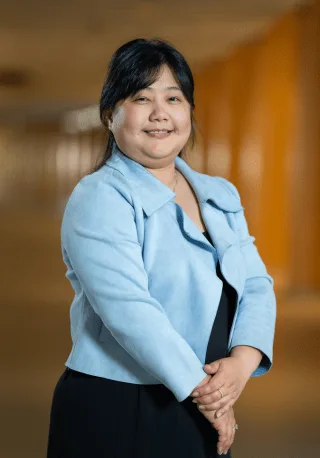
With the rise of Artificial Intelligence (AI) and analytics, finance professionals are redefining how they analyse data and make business decisions. For Geraldine Tay, a finance specialist in the pharmaceutical and medical device manufacturing sector, this transformation presented both a challenge and an opportunity.
Having spent years managing budgeting, forecasting, and financial analysis in a global eye-care company, Geraldine witnessed her organisation’s push toward smart technology and digital transformation. To stay ahead, she enrolled in the NTU FlexiMasters in Business AI and Technology, aiming to strengthen her understanding of analytics and AI-driven business strategy.
“The FlexiMasters helped me evolve from a finance professional to a tech-savvy leader at the intersection of manufacturing, pharmaceuticals, and AI,” she reflects.
Practical Impact: Bringing AI and Analytics to the manufacturing and pharma sectors
The FlexiMasters programme’s emphasis on practical application resonated with Geraldine’s hands-on approach. “I’m a hands-on person,” Geraldine explains, “and I like to do financial projects and analysis.”
“The lecturers are not only knowledgeable but also deeply engaging. Each session is enriched by their research insights and industry experience, making the learning both practical and immediately applicable.”
A Programme Designed for the Future
The modular structure, with Saturday classes and online resources, enabled Chandra to balance his studies with his demanding role and family life. “Time management was a challenge, but the supportive learning environment made it manageable,” he says. This flexibility was key in allowing him to stay committed to his learning journey without sacrificing his professional or personal responsibilities.
Through modules focused on tools like Tableau and regression modelling, she learned to build and update dashboards and models independently. “Now, I don’t need to rely 100% on engineers or IT associates to help me with modelling. I can refresh and update models with new data myself,” Geraldine notes, underscoring how the programme has empowered her to take a more active role in data-driven business decisions.
Her experience with the FlexiMasters in Business AI and Technology has been pivotal in this transformation, equipping her to navigate the opportunities and complexities of AI at work.
Navigating Regulatory Constraints in Pharma with New Tech Skills
Yet, Geraldine’s role straddles more than just budgeting, forecasting, and financial planning. The pharmaceutical sector, with its stringent regulatory requirements, presents unique challenges for AI adoption. “In pharma, everything needs to be documented. When approving a new product, we can’t just rely on a model that says there’s a 99.9% probability of safety,” she cautioned. “We need to account for the 0.1% as well.” So, AI’s tendency to focus on the broader trends and filter out outliers goes against the industry’s demand for exhaustive documentation and traceability. She notes that while AI can streamline backroom operations, such as compiling and scanning documentation, its application in regulatory affairs and quality assurance remains limited.
The “Black Box” Challenge and the Need for Human Oversight
“Pharma cannot stand for the ‘black box’ effect, meaning not knowing what is coming. We need to know exactly how a decision is made, not just that it was made based on data,” Geraldine emphasizes. This insight, sharpened by her FlexiMasters experience, has made her an advocate for responsible AI integration, ensuring that technology complements rather than overrides human oversight.
And rightly so, Geraldine has been upfront about the limitations of AI, especially in environments where transparency and accountability are non-negotiable. “AI tells you how it came up with a decision based on data alone,” she says. “But in pharma, we need human justification.”
She further added— “This ‘black box’ challenge underscores the importance of critical thinking and professional judgment-skills that the FlexiMasters programme continually reinforced through case studies and practical assignments.”
Using Data-Driven Insights for Strategic Decisions
Despite these challenges, Geraldine sees immense value in data-driven decision-making. The FlexiMasters programme has empowered her to enter meetings with IT teams prepared and confident, able to articulate her requirements and even prototype solutions.
“It opens the door for me. I can tell IT what I want, or even show them a prototype. I’m no longer just waiting for them to show me what’s possible,” Geraldine reflects. “It built my confidence to use analytics in both finance and non-finance areas, shaping my ability to make strategic decisions.”
For those considering whether to take on the FlexiMasters in Business AI and Technology, Geraldine advises— “Think about what you want professionally or personally, and see if the curriculum aligns with your goals. Talk to your colleagues, especially IT, to ensure what you learn can be applied at work. That way, you can maximize the benefits.”

FlexiMasters in Business AI and Technology
By the end of this programme, participants will be well-equipped to lead AI initiatives, drive technological transformation, and create a significant impact in their organisations and industries through the development and implementation of AI strategies to improve decision-making, operational efficiency, and competitive advantage.