Programme Structure
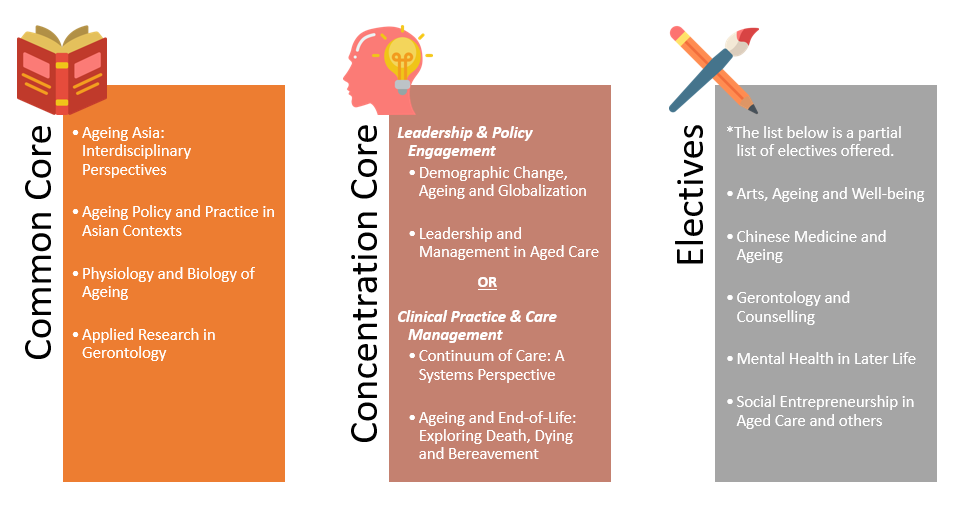
All students in the full-time, part-time and FlexiMaster pathways are required to complete a total of 30 Academic Units (AUs), comprising:
- 4 common core courses (3 AUs each)
- 2 concentration core courses (3 AUs each)
- 4–5 elective courses (each elective is either 1.5 AUs or 3 AUs)
If you are in the full-time pathway, you can complete all 30 AUs within one year. If you are in the part-time pathway, you typically require a minimum of 1.5 years to complete the 30 AUs.
The FlexiMaster pathway typically requires a minimum of 2 years to complete the programme. In your first year, you will complete the FlexiMaster requirements by taking 5 courses – 4 common core courses and 1 fixed elective – totalling 15 Academic Units (15 AUs). After you successfully complete the FlexiMaster (15 AUs), you can continue with an additional 15 AUs in the second year to attain the MSc in Applied Gerontology, comprising 2 concentration core courses and 3 electives.
To continue to the MSc programme after the FlexiMaster, you must obtain a minimum grade of C+ in all your courses, and these courses must have been taken within the last 5 years, subject to prevailing University policy.
Students in all pathways take the same courses and attend the same classes at the same timings. Each course is taught once a week in a 3-hour session over 13 weeks (one trimester). Classes are held on weekday evenings (7.00 pm – 10.00 pm) and on Saturdays, either in the morning (9.00 am – 12.00 pm) or afternoon (1.00 pm – 4.00 pm). For example, if you register for two courses in a trimester, you will need to attend classes on two separate days each week.
Most weekday classes are conducted at NTU’s One-North campus, with some at the Novena medical school campus, while weekend classes are held at NTU’s main campus.
Each academic year has three trimesters. The first trimester runs from August to October, the second from November to February, and the third from March to May. For the detailed academic calendar, please refer to: NTU Academic Calendar.
Practicum is offered as an elective and is not a requirement of the programme. Students who would like hands-on experience in organisations working on issues related to older persons may choose to do a practicum. In the practicum, you will work on a project with one of our practicum partner organisations, or you may propose your own practicum organisation. Our practicum partners include healthcare institutions, government agencies and voluntary welfare organisations.
Assessment for courses is based on continuous assessment (CA). The CA component consists of individual and group essays and projects, and may also include class participation, presentations, assignments, quizzes and in-class tests.