Plants have evolved two receptor systems to detect microbial threats and initiate successive defenses. Cell-surface pattern-recognition receptors (PRRs) perceive conserved pathogen-associated molecular patterns (PAMPs) and trigger pattern-triggered immunity (PTI). Intracellular nucleotide-binding leucine-rich repeat (NLR) proteins monitor pathogen-delivered effectors and activate effector-triggered immunity (ETI). Phytopathogenic bacteria, fungi, oomycetes, and insects deploy diverse effectors to undermine host defenses. Many effctors have enzymatic domains that modify host targets for function perturbation. However, prior work has largely overlooked intrinsically disordered regions (IDRs) within effectors, which may confer unique activities without folded domains. Here, we focused on XopR, a highly disordered effector from Xanthomonas campestris pv. campestris. Using an effector-less pathogen, we developed a new delivery method for XopR. Leveraging this tool, in vitro reconstitution, live-cell imaging, and biochemical assays, we found that XopR’s multivalent binding induced clusters of PRR complex components at the plasma membrane. Such clustering impaired endocytic turnover and sustained PAMP signaling. We also observed that XopR interacted with NADPH oxidase and blocked the conformational activation required for reactive oxygen species production. To identify XopR partners systematically, we performed a TurboID proximity-labeling screen and uncovered RIN4, a key guardee for the NLRs RPM1 and RPS2. We demonstrated that XopR remodeled RIN4 biomolecular condensates, altering RIN4’s material properties and immune activation. Finally, we employed hydrogen–deuterium exchange/mass spectrometry to map molecular dynamics within XopR–RIN4 coacervates. We identified several critical regions that contained previously known RIN4 regulatory sites, enabling further validation. Overall, we showed that IDR-rich effectors subverted host immunity by driving multivalent clustering, perturbing protein conformations, and reshaping the material properties of host biomolecular assemblies.
The 6th meeting of the Singapore Malaria Network intends to foster new ideas and concepts by bringing together scientists working in multiple aspects of malaria.
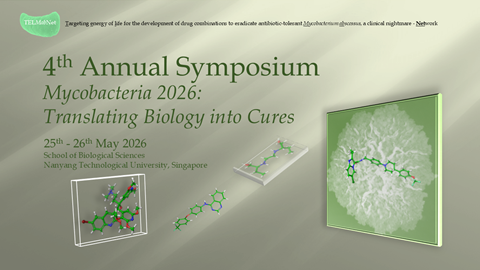
The 3rd Annual Symposium: Innovations in anti-mycobacterial Drug Discovery will include presentations from speakers from around the world who have made significant advances in TB- and NTM research and –drug discovery. The goal of this event is to present novel concepts and to provide a platform for vibrant and open discussions between industry, senior scientists, postdoctoral fellows and students from academia.
The symposium is organized by members of TELMabNet (Targeting energy of life for the development of drug combinations to eradicate antibiotic-tolerant Mycobacterium abscessus, a clinical nightmare, Network), an excellence cluster funded by the Singapore National Research Foundation.
Understanding the mechanical properties of plants and their response to environmental factors is essential for developing innovative and sustainable solutions to address the challenges facing agriculture and forestry. 'Plant Biomechanics for Sustainable Agriculture and Forestry’, co-organized by Nanyang Technological University-Singapore, and Zhejiang Agriculture & Forestry University-China, will delve into the critical intersection of plant biomechanics and its impact on sustainable agriculture and forestry. The conference scheduled to take place from May 19-22, 2024 in Singapore at NTU. The event will feature a distinguished lineup of Plenary Speakers and host presentations from invited speakers representing prestigious institutions, ensuring a comprehensive and diverse range of perspectives.
This conference aims to foster collaboration, knowledge exchange, and networking opportunities among researchers, scientists, and industry professionals working in the field of plant biomechanics. It will provide a platform for the dissemination of the latest research findings, innovative methodologies, and sustainable practices that contribute to the advancement of agriculture and forestry.
We invite all participants to engage in this enriching and rewarding experience, with the goal of fostering meaningful discussions and collaborations that will contribute to the sustainable future of agriculture and forestry. We look forward to welcoming you to this important gathering and to the valuable insights and contributions you will bring to the conference.
The workshop is funded by the Zhejiang Agriculture & Forestry University (ZAFU), China and Nanyang Technological University, School of Biological Sciences (SBS).
Join us in the celebration of our achievements through this research symposium where we invite our alumni, graduate students and postdocs to share their discoveries.
Speaker:
Professor Ernst H.K. Stelzer Bunchmann Institue for Molecular Life Sciences, Goethe Universität Frankfurt am Main
Hosted By:
Prof. Peter Török, A/P Li Hoi Yeung