
Clinical Psychology (ASPIRE)
Programme Overview
Developed by LKCMedicine and NHG Health, ASPIRE is for psychologists and healthcare professionals with relevant Psychology Honours qualifications in patient-facing roles looking to advance their clinical expertise in mental health care.
Launching in August 2026, ASPIRE will start with the intake for the Graduate Certificate in Clinical Psychology, followed by progression pathways to a FlexiMasters in Clinical Psychology and Master of Psychology (Clinical). ASPIRE is based on a work-study, stackable learning model that allows learners to continue working while progressing through the three tiers of training.
Our innovative approach directly supports national priorities articulated under the Singapore Mental Health Competency Framework. By combining academic learning with structured workplace supervision and learning, ASPIRE aims to equip participants with the clinical, ethical, and research competencies required to become competent clinical psychologists, aligning with the Ministry of Health’s direction for competency-based, modular, and workplace-integrated education.
Recognising the national need for a secure pipeline of clinical psychologists, NHG Health has been instrumental in shaping a curriculum that is "by practitioners, for practitioners". Through structured supervision, participants will learn safe and ethical practice, clinical reasoning, risk assessment and crisis intervention, and prepare for independent professional work. Training is competency-based and aligned with professional practice expectations.
Graduates of the Masters programme will meet the professional standards required for registration as clinical psychologists with the Singapore Psychological Society.
Unique Features of the Programme
Work-Study Model
Learners continue to work while studying, enabling immediate application of knowledge and skills and minimising work disruption. ASPIRE allows students to earn while they learn, thereby reducing financial burden.
Stackable Pathway
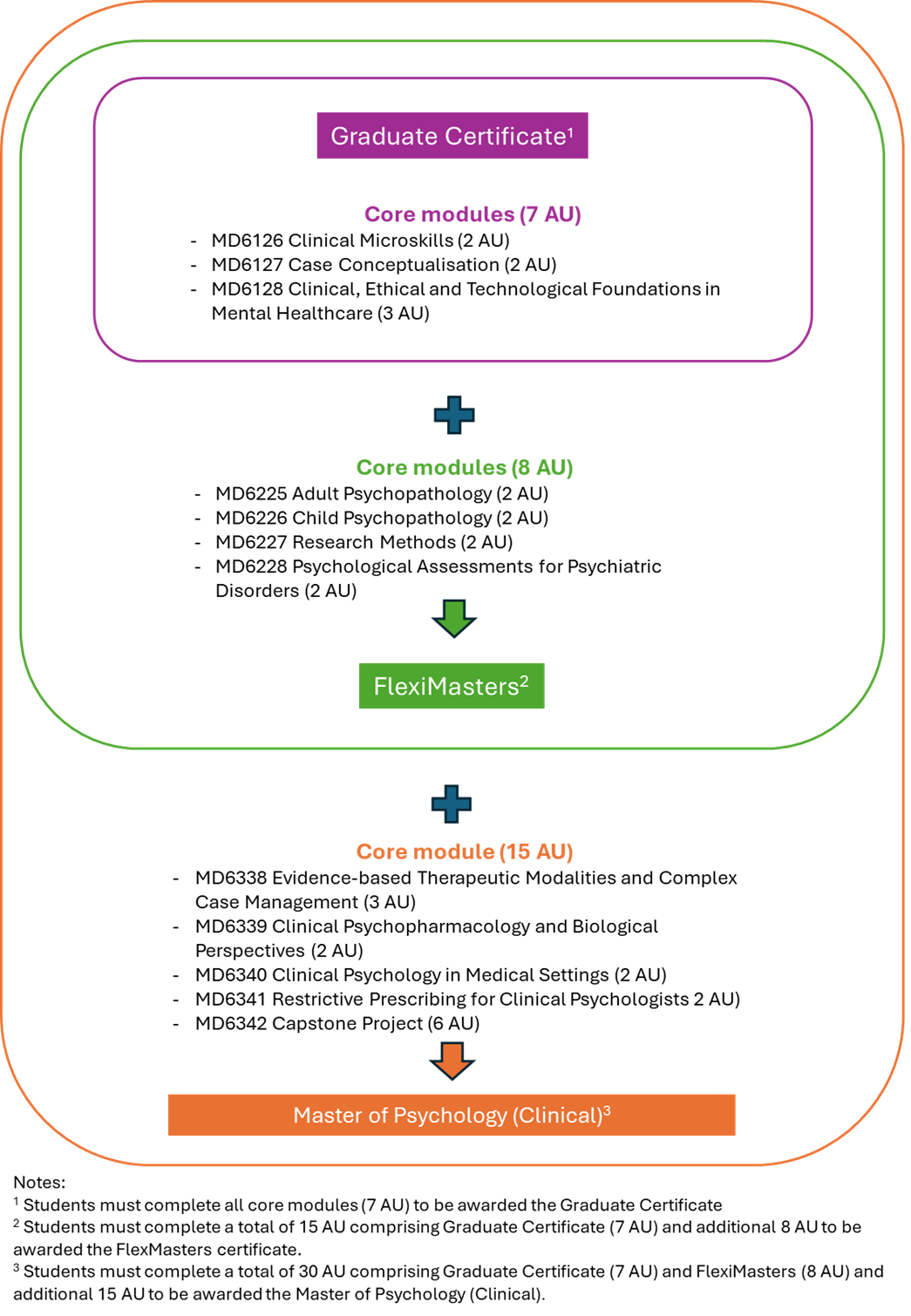
ASPIRE offers flexibility through 3 stackable tiers over time, leading to a Master’s qualification. This structure allows for a gradual and continuous learning journey, accommodating professional and personal commitments. The programme comprises three sequential qualifications:
- Graduate Certificate (9 months)
- FlexiMasters (9 months), and
- Master of Psychology (Clinical) (1.5 years) allowing participants to progress at their own pace
Enhanced Clinical Practicum Integration
Clinical placement hours are seamlessly integrated into work, enhancing real-world applicability and learning continuity.
Industry Co-creation and Alignment with National Priorities
Designed collaboratively by and with NHG Health, the curriculum aligns closely with Singapore’s mental health service needs and contributes directly to workforce transformation.
Programme Structure
ASPIRE is designed as a 3-tier stackable pathway leading to the Master of Psychology (Clinical). Currently all modules are offered on a part-time basis.
ASPIRE starts in August 2026 and comprises three sequential qualifications:
- Graduate Certificate in Clinical Psychology (9 months)
- FlexiMasters in Clinical Psychology (9 months), and
- Master of Psychology (Clinical) (1.5 years).
The Clinical Psychology programme is open to Singapore citizens, permanent residents or residents in Singapore.
To graduate with the Master of Psychology (Clinical), students are required to complete a total of 30 academic units (AU).
| Course Title | No. of AUs |
|---|---|
| Graduate Certificate in Clinical Psychology | 7 |
| Clinical Microskills | 2 |
| Case Conceptualisation | 2 |
| Clinical, Ethical and Technological Foundations in Mental Healthcare | 3 |
| FlexiMasters in Clinical Psychology | 8 |
| Adult Psychopathology | 2 |
| Child Psychopathology | 2 |
| Psychological Assessments for Psychiatric Disorders | 2 |
| Research Methods | 2 |
| Master of Psychology (Clinical) | 15 |
| Evidence-based Therapeutic Modalities and Complex Case Management | 3 |
| Clinical Psychopharmacology and Biological Perspectives | 2 |
| Clinical Psychology in Medical Settings | 2 |
| Restrictive Prescribing for Clinical Psychologists | 2 |
| Capstone Project | 6 |
Applicants seeking admission to this programme must possess the following:
- A Bachelor (Hons) in Psychology
- A job position as an Associate Psychologist (or equivalent; may be an existing staff or a new hire) within a mental health and/or clinical psychology service provider across the healthcare, social service or other sectors
- Two testimonials from two different referees
- For new hires: Two academic referees1
- For existing staff: One academic referee1 + one workplace referee2 (reporting officer or supervisor)
Notes:
1 Must be from your educational background (e.g., a university lecturer or thesis supervisor). These can be from either local or overseas institutions.
2 Must be from your current workplace. This should preferably be your direct Reporting Officer (RO) or supervisor to ensure your Head of Department is aware of your application.
- Candidates with other qualifications and experience may be considered on a case-by-case basis, subject to approval by Programme Committee.
- English test certificates must be dated within the last 2 years.
Applicants from countries whose native language is not English and whose medium of university instruction is not completely in English are required to provide one of the following:
Test of English as Foreign Language (TOEFL)
- For exams taken before January 21, 2026: We require a minimum TOEFL iBT score of 100
- For exams taken on or after January 21, 2026: We require a minimum TOEFL iBT score of 5.5
International English Language Testing System (IELTS)
- Minimum score of 6.5
The requirements for the tiered Clinical Psychology programme suite are sequential, ensuring that learners build upon a solid foundation as they advance through the qualifications.
| Programme | Requirements |
|---|---|
| Graduate Certificate in Clinical Psychology | Learners must complete all core modules worth 7 AUs to be awarded the Graduate Certificate |
| FlexiMasters in Clinical Psychology | Learners must complete the Graduate Certificate (7 AU), and an additional 8 AUs to be awarded the FlexiMasters Certificate |
| Master of Psychology (Clinical) | Learners must complete the Graduate Certificate (7 AU), the FlexiMasters Certificate (8 AU) and an additional 15 AUs to be awarded the Master of Psychology (Clinical) certificate |
| Programme | Fees | Location of Study |
|---|---|---|
| Graduate Certificate in Clinical Psychology | $19,456.50 inclusive of GST Price stated is before SSG subsidy The programme fees are reviewed annually and may be revised. The University reserves the right to adjust the programme fees without prior notice. | Singapore |
| FlexiMasters in Clinical Psychology | $41,692.50 inclusive of GST Price stated is before SSG subsidy *Learners must complete all modules from the Graduate Certificate before undertaking the FlexiMasters. The above cost is inclusive of Graduate Certificate. The programme fees are reviewed annually and may be revised. The University reserves the right to adjust the programme fees without prior notice. | Singapore |
| Master of Psychology (Clinical) | $83,385 inclusive of GST Price stated is before SSG subsidy *Learners must complete all modules from the Graduate Certificate and FlexiMasters before undertaking the Master of Psychology (Clinical). The above cost is inclusive of Graduate Certificate and FlexiMasters. The programme fees are reviewed annually and may be revised. The University reserves the right to adjust the programme fees without prior notice. A S$5,000 deposit is required: this amount will be deducted from the full billing of the course. It is non-refundable and non-transferable and payable upon acceptance of offer of admission. | Singapore |
| Programme | Course titles | Full Course Fee (inclusive of GST) |
|---|---|---|
| Graduate Certificate | Clinical Microskills | $5,559 |
| Case Conceptualisation | $5,559 | |
| Clinical, Ethical and Technological Foundations in Mental Healthcare | $8,338.50 | |
| FlexiMasters | Adult Psychopathology | $5,559 |
| Child Psychopathology | $5,559 | |
| Research Methods | $5,559 | |
| Psychological Assessments for Psychiatric Disorders | $5,559 | |
| MSc in Psychology (Clinical) | Evidence-based Therapeutic Modalities and Complex Case Management | $8,338.50 |
| Clinical Psychopharmacology and Biological Perspectives | $5,559 | |
| Clinical Psychology in Medical Settings | $5,559 | |
| Restrictive Prescribing for Clinical Psychologists | $5,559 | |
| Capstone Project | $16,677 |
Refund Policy
Students who apply for deferment or leave LKCMedicine, either through withdrawal of their own accord or end of candidature by LKCMedicine, after two weeks from commencement of each course will be liable to pay fees for the entire term. Requests for refund will not be considered.
The programme fees are reviewed annually and may be revised. The University reserves the right to adjust the programme fees without prior notice.
Who are clinical psychologists?
- Clinical psychologists are mental health professionals with advanced postgraduate training in the assessment, diagnosis, formulation, and psychological treatment of mental health conditions and emotional or behavioural difficulties.
- They practise in a wide range of settings, including hospitals, community mental health services, primary care, private practice, universities, the defence sector, and social service organisations.
- Their work spans the lifespan, supporting children, adolescents, adults, and older adults. Clinical psychologists use evidence-based psychological therapies and structured assessments to help individuals understand and manage distress, improve functioning, and enhance wellbeing.
- Beyond direct clinical care, they contribute to prevention and early-intervention initiatives, mental health promotion, research, teaching, supervision, and service development. Through these roles, clinical psychologists play a vital part in strengthening psychological wellbeing and improving health outcomes for individuals, families, and communities.
How can I tell if clinical psychology is right for me?
Clinical psychology is both challenging and rewarding. It requires strong communication skills, empathy, emotional resilience, and maturity. You must be prepared to work with distressed or difficult clients and be open to constructive feedback. If you can manage these demands while remaining compassionate and professional, the field may be a good fit for you.
How is the ASPIRE Programme structured?
This is a work-study programme comprising three sequential qualifications: Graduate Certificate in Clinical Psychology (9 months), FlexiMasters in Clinical Psychology (9 months), and Master of Psychology (Clinical) (1.5 years). This means that the student must be employed as an Associate Psychologist (or equivalent), complete the Graduate Certificate, then the FlexiMasters and finally Master in Psychology (Clinical) to graduate as a Clinical Psychologist.
Do I need to be currently employed to apply?
Yes - you must be currently employed to apply for ASPIRE. Employment can be at a Public Health Institution (PHI) or any organisation that provides mental health and psychological services. A Letter of Endorsement from your employer is required right from the point of application - not just at later stages. The integrated work-study model is designed to work hand-in-hand with your existing employment.
I have just started work as an Associate Psychologist less than 2 months ago, Will I be considered?
Yes, new hires are welcome to apply and will be considered during the review process.
How does the admission process work?
- All applicants will be reviewed to ensure the minimum admission criteria are met.
- Shortlisted applicants will be invited for a Multiple Mini-Interview (MMI).
- Applicants will be informed via the application portal regarding the outcome of their application.
How many referees are required?
Two testimonials from two different referees are required
- For new hires: Two academic referees1
- For existing staff: One academic referee1 and one workplace referee2 (reporting officer or supervisor)
To ensure fairness, please submit only two testimonials. If more than two are submitted, the first two submissions based on time-stamp will be selected and the rest are disregarded.
Can I be exempted from TOEFL/IELTS if I studied in a university which uses English as a medium of instruction?
Applicants may be considered for exemption from TOEFL/IELTS if they have completed a full degree taught and assessed entirely in English. An official letter from the awarding institution confirming the language of instruction and assessment is required. Exemptions are considered on a case-by-case basis and are subject to approval by the admissions committee.
Does the programme meet the requirements to practise as a clinical psychologist in Singapore?
Yes, the programme is designed to meet the standards stated by the Singapore Psychological Society (SPS) criteria for registration, including the requirement of at least 1,000 hours of clinical practicum.
Can I join the FlexiMasters or Master of Psychology (Clinical) directly without the Graduate Certificate?
No. Entry into the FlexiMasters requires completion of the ASPIRE Graduate Certificate and a minimum GPA. Entry into the Master of Psychology (Clinical) requires completion of the ASPIRE FlexiMasters with strong academic performance, demonstrated clinical experience, research capability, and professional recommendations. Direct entry into the FlexiMasters or Master's is not available.
Will I still be working full-time during the programme?
Yes - that is the core design of ASPIRE. You continue in your role at your institution while your clinical responsibilities are aligned to the academic milestones. Protected study time (approximately 8 hours per week during Residency 1) is built into your schedule.
Can I exit the programme early? What qualifications will I have?
Yes. ASPIRE is a stackable programme with formal exit points:
- Exit after Graduate Certificate: Graduate Certificate in Clinical Psychology (ASPIRE) - eligible for roles such as Associate Psychologist, Counsellor, Case Manager
- Exit after FlexiMasters: FlexiMasters in Clinical Psychology (ASPIRE) - eligible for roles such as Mental Health Practitioner, Psychotherapist
- Complete the full programme: Master of Psychology (Clinical) - Clinical Psychologist
Each award is a nationally recognised qualification in its own right. If you exit early and wish to return, you may do so within 5 years from the point you exit.
Is this degree recognised overseas?
As a postgraduate degree from NTU's LKCMedicine - a globally ranked institution - the Master of Psychology (Clinical) is expected to carry strong international standing. Specific overseas recognition (e.g., HCPC in UK, AHPRA in Australia) will depend on the requirements of each jurisdiction. Details will be updated as accreditation discussions progress.
Course Deferment
Any request for course deferment for successfully-admitted applicants is assessed on a case-by-case basis. Each deferment is for a period of one Academic Year (i.e. one intake).
Course Withdrawal Policy
Matriculated students must write in to the School to formally withdraw from the programme, however there will be no refund for the Tuition Fee and Student Services Fee.