2026 Lee Kong Chian Distinguished Professors
Our eminent speakers, Prof David Baker and Prof Hannele Ruohola-Baker were appointed as Lee Kong Chian Distinguished Professors in relation to the public lecture on 6 January 2026. Sponsored by the Lee Foundation, the event was organised as a partner event of the Global Young Scientists Summit 2026, with support from the National Research Foundation Singapore.
08ef5be4-d05d-4b72-b025-cec8d608a737.jpg?sfvrsn=dfabbf77_1)
[From left] Insightful lectures by Prof David Baker on challenges and solutions for achieving net-zero greenhouse gas emissions, and exploration of cryptography by Prof Hannele Ruohola-Baker.
Prof David Baker, Nobel Laureate in Chemistry (2024) demonstrated how computational protein design is redefining what is possible in medicine and sustainability. Prof Baker is a pioneer in AI-enabled protein engineering and is widely recognised for transforming proteins from products of evolution into programmable tools. In his lecture, “Design of New Protein Functions Using Deep Learning”, Prof Baker showed how deep learning now enables the design of entirely new proteins that can modulate immunity, target difficult cancers, clear toxic aggregates, and catalyse reactions such as plastic breakdown that nature never evolved. He also highlighted molecular switches and sensors that turn biology into an information-processing system, underscoring how computational design can address pressing health needs while opening new avenues for greener, protein-based solutions in industry and the environment.
Prof Hannele Ruohola-Baker (Co-Director of the Institute for Stem Cell and Regenerative Medicine, University of Washington) showcased how AI-designed proteins and stem cell biology can reshape aging and regenerative medicine. In her lecture, “AI-Driven Foundational Regenerative Medicine”, Prof Ruohola-Baker outlined how purpose-designed protein signals and organoid models can stabilise blood vessels, support nerves without causing pain, restore muscle strength in sarcopenia, and enable living repair of tooth enamel. She further introduced the concept of “virtual cells” that forecast when cellular systems begin to fail, paired with tailored protein interventions to maintain tissue health over time. Her work, strongly aligned with healthy aging priorities, illustrates how converging AI, protein design, and stem cell science can move medicine from late-stage intervention toward proactive, programmable resilience across the lifespan.
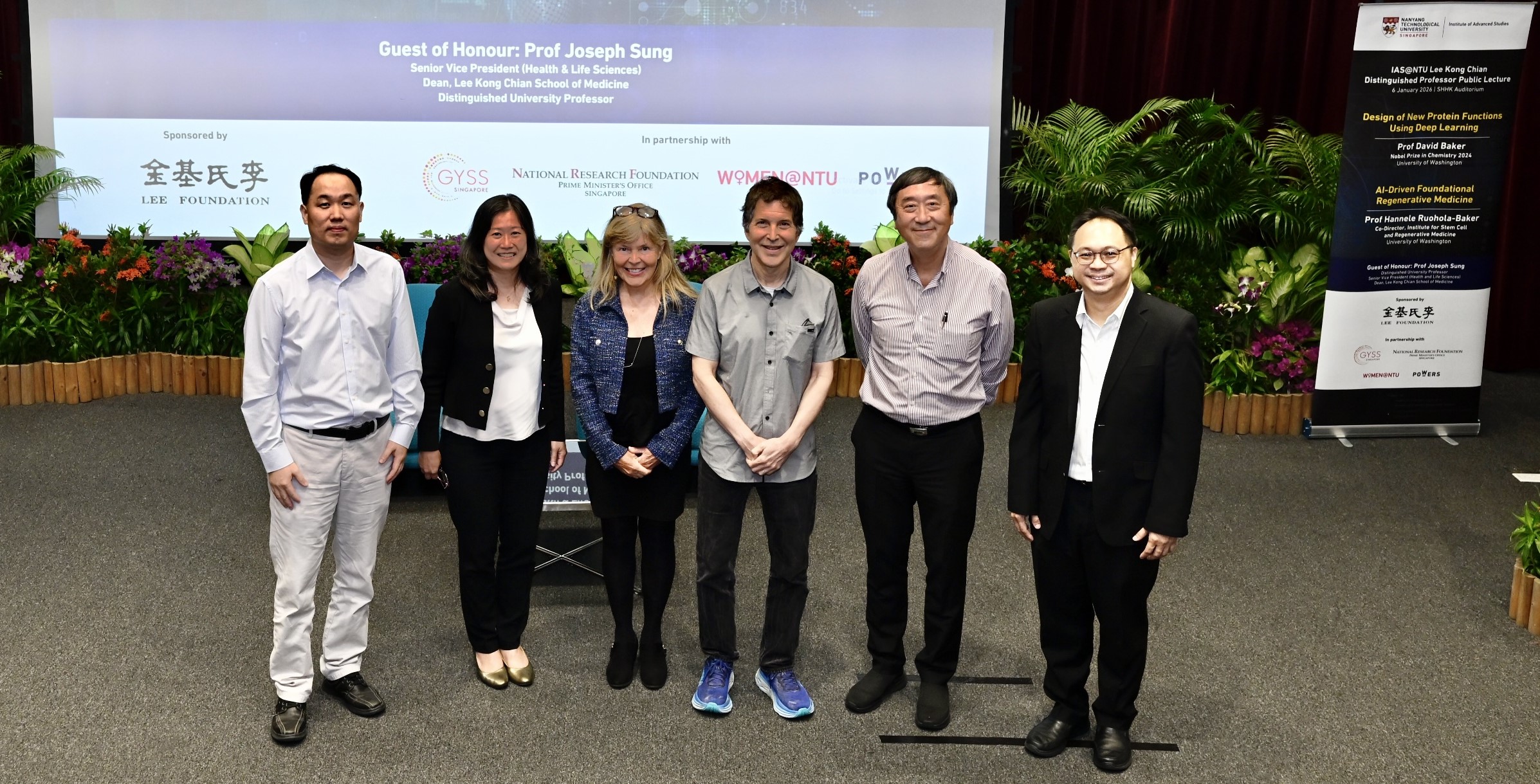
[From left] Assoc Prof Xia Kelin (SPMS, NTU), Assoc Sierin Lim (CCEB, NTU), Prof Hannele Ruohola-Baker, Prof David Baker, Prof Joseph Sung (Senior Vice President, Health and Life Sciences) and Prof Sum Tze Chien (Director, IAS NTU).
Our distinguished speakers, Prof Bantval Jayant Baliga and Prof Torsten Hoefler were appointed as Lee Kong Chian Distinguished Professors in relation to the public lecture on 7 January 2026. Sponsored by the Lee Foundation, the event was organised as a partner event of the Global Young Scientists Summit 2026, with support from the National Research Foundation Singapore.
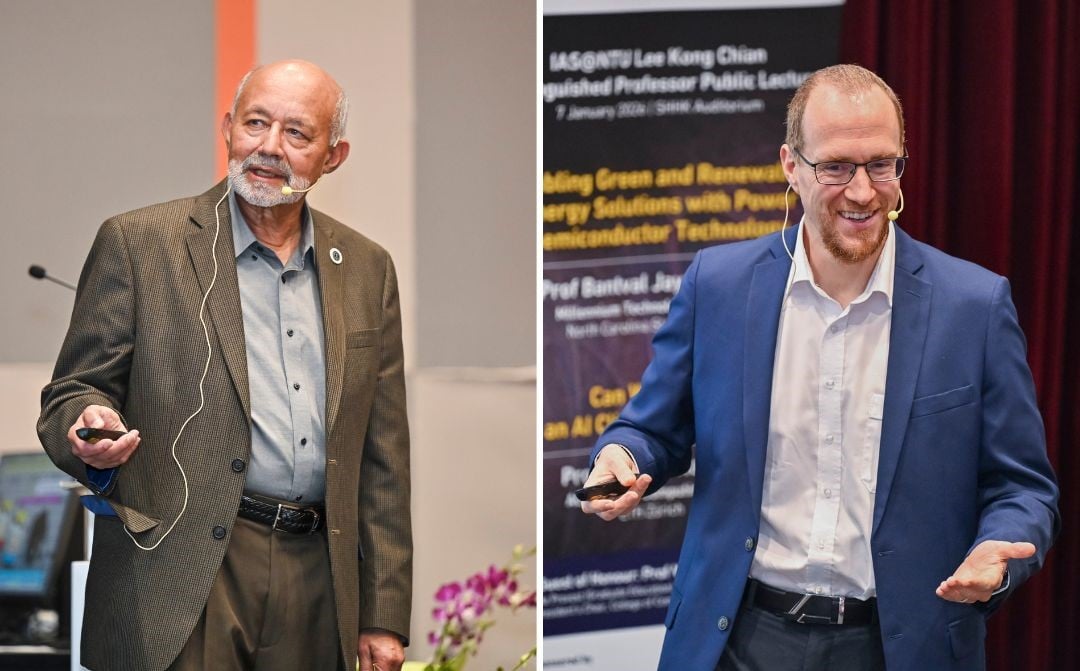
[From left] Insightful lectures by Prof Bantval Jayant Baliga on renewable energy solutions, and the exploration of AI for the future of climate science by Prof Torsten Hoefler.
Prof Bantval Jayant Baliga, Millennium Technology Prize (2024) is a globally recognised pioneer in power semiconductor devices, presented the evolution and impact of insulated gate bipolar transistor (IGBT) technology, demonstrating how advances in power electronics have enabled high-efficiency energy conversion across renewable energy systems, transportation, industrial applications, and data centres. In his lecture titled “Enabling Green and Renewable Energy Solutions with Power Semiconductor Technology”, he discussed the transition beyond conventional silicon devices towards wide-bandgap materials, highlighting both their potential for improved performance and the practical considerations involved in large-scale industrial adoption.
Prof Torsten Hoefler, ACM Prize in Computing (2024) is a leading expert in high-performance computing and AI systems, examined the growing role of computation in scientific discovery, with a particular focus on climate modelling. In his lecture titled “Can we build an AI Climate Scientist?”, he outlined the computational challenges of high-resolution Earth system simulations and explored how AI-driven approaches, when combined with physics-based models, can enhance predictive capabilities. He also addressed the importance of managing uncertainty, trust, and sustainability as computational demands continue to scale.
Together, the lectures underscored the deep interconnections between energy technologies, computation, and climate science, reinforcing the importance of interdisciplinary approaches in addressing complex global challenges and shaping responsible technological progress.
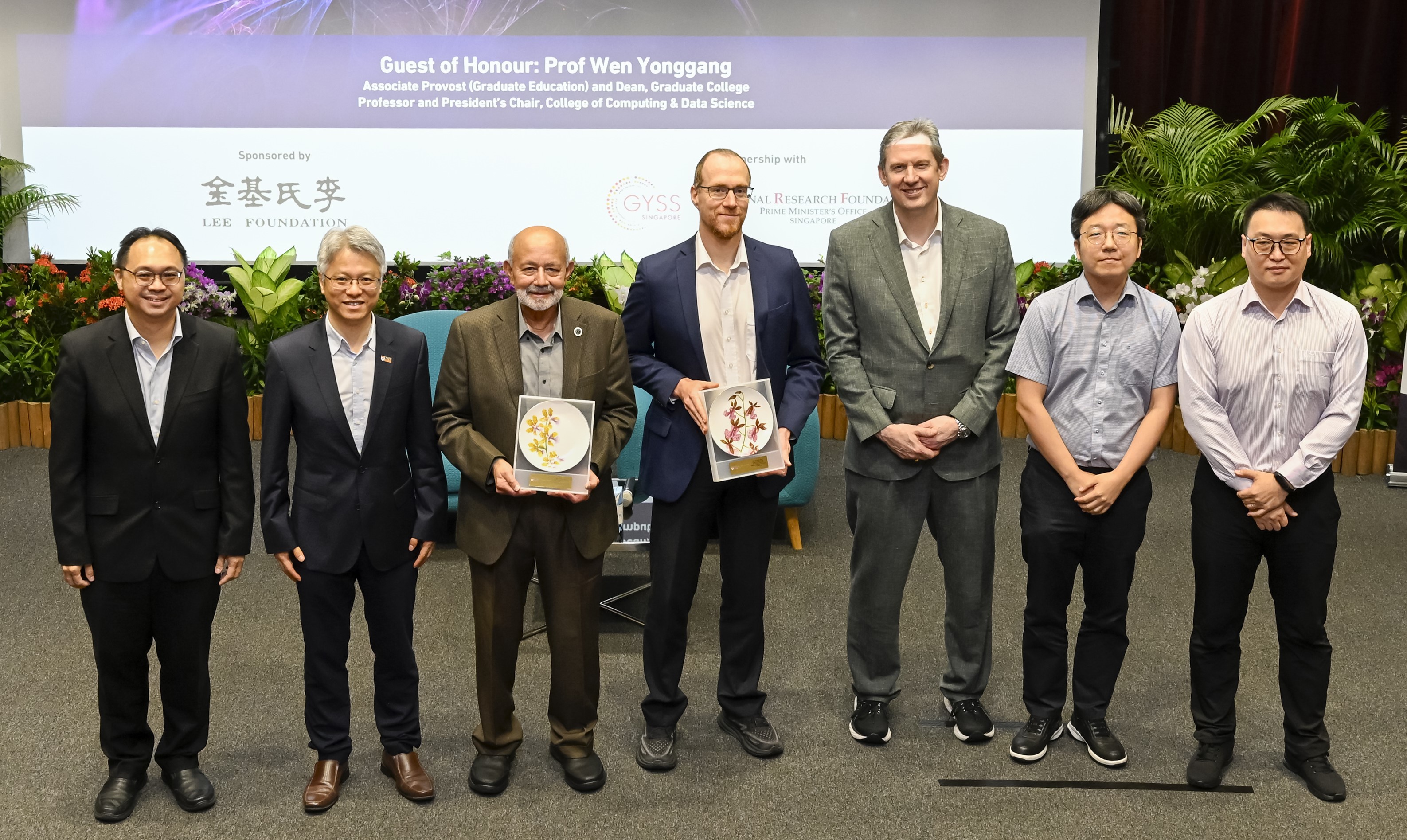
[From left to right]: Prof Sum Tze Chien (Director, IAS NTU), Prof Wen Yonggang (Associate Provost, Graduate Education), Prof Bantval Jayant Baliga, Prof Torsten Hoefler, Prof Christian Wolfrum (Provost, NTU), Assoc Prof Kim Munho (EEE, NTU) and Asst Prof Wang Jingyu (NIE, NTU).
Our eminent speaker, Professor Duncan Haldane, Nobel Laureate in Physics (2016), delivered the IAS Lee Kong Chian Distinguished Professor Public Lecture on 14 January 2026 at the Stephen Riady Auditorium in Singapore’s city centre. Sponsored by the Lee Foundation, the lecture was hosted by Nanyang Technological University’s Institute of Advanced Studies and drew students, researchers, and members of the public for an evening of reflection on the future of quantum science.
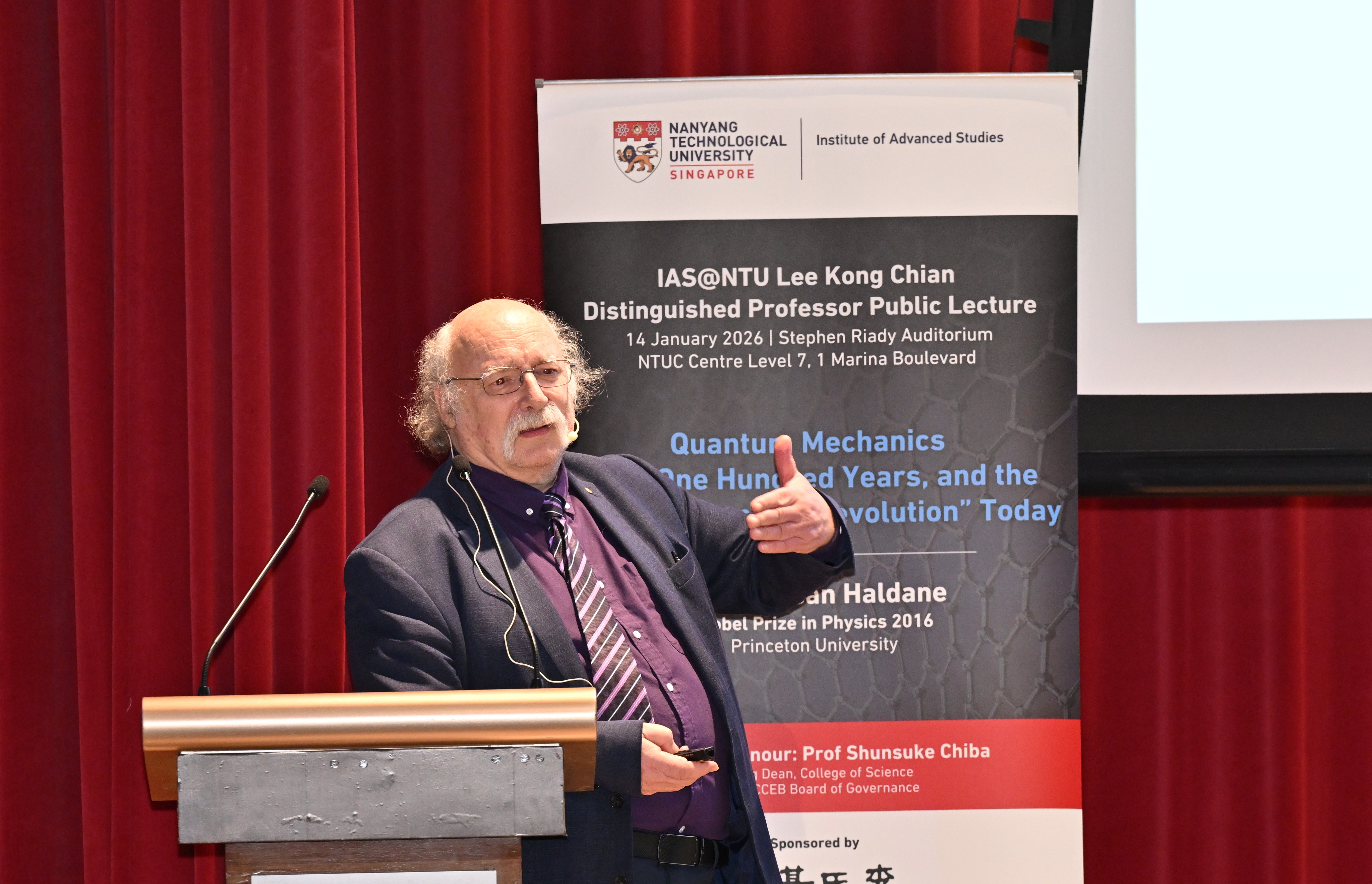 An insightful lecture by Prof Duncan Haldane on the second quantum revolution.
In his lecture, “Quantum Mechanics after One Hundred Years, and the Second Quantum Revolution Today,” Prof Haldane traced the evolution of quantum mechanics from its early foundations to the modern era, where quantum entanglement has emerged as a central feature. He explained how ideas once viewed as paradoxical—most notably entanglement, famously dismissed by Einstein as “spooky action at a distance”—are now experimentally established and underpin advances in quantum information, communication, and cryptography.
Prof Haldane highlighted how these developments define the ongoing second quantum revolution, in which long-range entanglement enables new ways of storing and transmitting information. He also discussed the role of topological quantum states, whose robustness against disorder offers promising directions for future quantum technologies. The lecture illustrated how deep theoretical insights continue to shape emerging applications, reinforcing the lasting impact of quantum mechanics as the field enters a new phase focused on quantum security and real-world deployment.
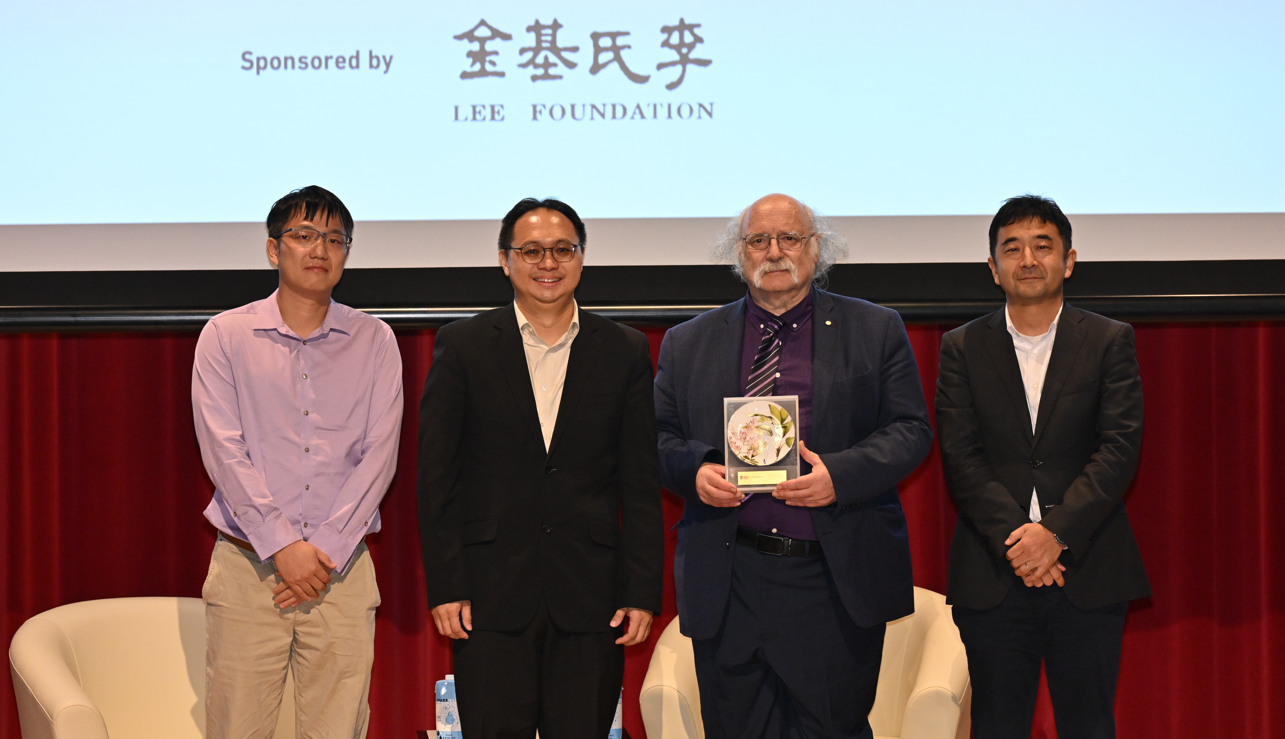 [From left to right]: Assoc Prof Yang Bo (SPMS, NTU), Prof Sum Tze Chien (Director, IAS NTU), Prof Duncan Haldane, Prof Shunsuke Chiba (Acting Dean, College of Science, NTU) and Prof Shunsuke Chiba (Acting Dean, College of Science, NTU).