
Academic Structure
Year 1
Core Courses:
- SP0001: Language and Logic
- SP0002: Duties and Dilemmas
- SP0007: Sustainability and Space (Travel Overseas Programme for Scholars (TOPS))
- SP0008: Being and Becoming
*NBS students from AY2026/2027 onwards may complete selected NTU-USP core modules in their second year, subject to curriculum requirements.
Year 2 Onwards
Students matriculating from AY2026/2027 onwards
Students are to complete elective courses from any of the available offerings.
Students who matriculated before AY2026/2027
Students are expected to complete elective modules from any of the two categories:
- Arts, Humanities and Culture (AHC)
- Science, Technology and Society (STS)
Students admitted to the programme are required to undertake four compulsory core courses in their freshmen year.
The electives include a range of diverse modules that are specially planned and produced by faculty fellows across NTU for NTU-USP scholars. The NTU-USP elective courses offered in each academic year (AY) may vary depending on the availability of teaching instructors.
NTU-USP’s academically rigorous programme comprises of a robust, interdisciplinary curriculum, enabling students to investigate both the sciences and the arts and dialogue with students from different majors to broaden their perspectives and exercise critical thinking.
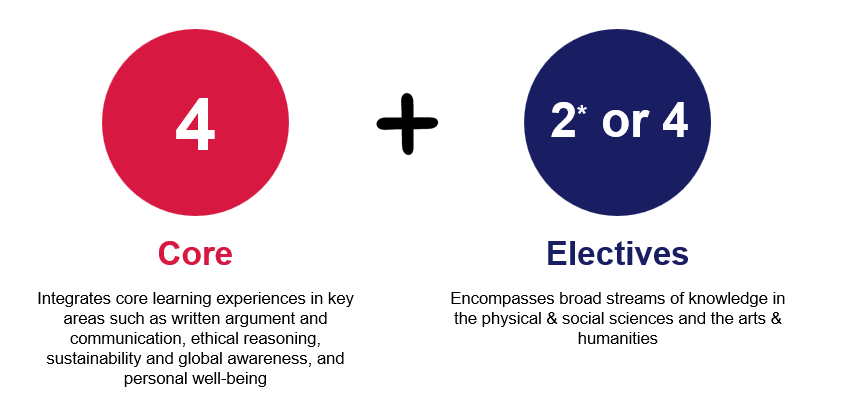
*NBS and selected degree with second major are only required to take 2 electives.
Intended for all first-semester NTU-USP students, this course has two aims.
First, you will learn to compose scholarly essays, crafting arguments that are clear, rigorous in logic and evidence, original, and persuasive. You will gain these skills through studying and discussing exemplary writing, emulating these examples in a series of increasingly demanding essay assignments, and critiquing the essay work of your peers.
Second, but no less importantly, you will develop a more critical perspective on your university education. This course asks you to reflect on the purpose of that education, the better to shape it.
The readings and essay assignments are intended to provoke hard thinking about three questions: For whom is university meant? What is education? What larger purposes does education serve?
This course aims to introduce normative ethics and metaethics to students. In addition, it encourages students to respond critically to articles and videos that make use of the concepts of normative ethics and metaethics and to become ethically reflective and responsible global citizens.
In addition, the course will also encourage students to think critically about the ethical implications of our technological implementations. Last but not least, students will be reminded from the outset to consider the benefits of a civic education, the welfare of the community or commonweal, and the ethical implications of being civic-minded.
This course aims to equip students with the necessary research skills to plan and execute a research project in sustainability at the nexus of economy, environment and societal space. Through team-based exploration of sustainability issues viewed from an interdisciplinary lens, students will gain knowledge about the process of research, including its fieldwork and documentation, and apply such knowledge in the field. They will learn how to gather and document empirical data ethically, and explain the rationale for the decisions they make as well as evaluate the success and limitations of fieldwork that centers around sustainability issues including, but not limited to, environmental sustainability (e.g., waste, pollution, energy), sociocultural sustainability (e.g., preservation and sustainability of national, regional, ethnic, racial, or other ingroup-based tangible and intangible culture and heritage), and economic sustainability (e.g., the promotion of long-term economic growth through efficient and responsible resource management).
The course is project-based, and students work in teams to go through the process of crafting their own subject matter, documenting, writing and storytelling using mixed media. This course contributes to the development of students in the NTU-University Scholars Programme in their competence as researchers with empathy, intercultural communication skills, and creativity. By crafting their own research projects from start to finish, students in this course will learn to evaluate the various sustainability challenges faced by our ever-changing world and, hopefully, cultivate the ability and interest to promote mitigation strategies that improve their own livelihoods and those of their fellow global citizens.
This course is part of NTU 2025 Education – Common Foundational & Interdisciplinary Collaborative Curriculum (ICC). It integrates major components from CC0015 Healthy Living and Well Being and adds additional philosophical analysis to the course material. This course takes an interdisciplinary approach to wellbeing based on empirical evidence and conceptual analysis. On the empirical side, this course follows the content from CC0005 by looking at how people pursue the “flourishing life” in different ways, including improving one’s physical fitness, seeking authentic relationships with others, or making a positive change in the environment. On the conceptual side, each week you will explore additional philosophical questions related to well-being, happiness, the self, and the connection between mind and body. You will examine whether it is possible to objectively define and measure the “flourishing life.” You will look at eastern and western perspectives of the self in relation to happiness and compare different theories of the mind-body connection. Lastly, you will examine positive and negative impact that technology has on our livelihood. By the end of this course, you would have developed an awareness of what constitutes living a healthy and flourishing life, both of which indirectly contributes to a successful undergraduate education.
From their second year onwards, students are expected to undertake NTU-USP elective modules.
*Prescribed Elective offerings are subject to change and may vary by semester due to scheduling and faculty availability.
SP0005 Quantitative Reasoning
The vision of the NTU-USP is “to nurture creative and reflective global citizens devoted to understanding the social, cultural, economic, and environmental forces that give shape to our ever-changing world.” Of the many skills and qualities such a citizen will possess, one key feature is the ability to reason with big data as well as information and arguments involving numbers. We will be identifying principles that help guide our understanding about claims supported by quantitative information. This will include both practicing computational skills in basic probability, statistics, and data visualization as well as critically reading and writing about quantitative information from scholarly and non-scholarly sources.
SP0013 Cultivating Heartware for Inclusivity and Diversity
We live in an era of profound transformation where we face many uncertainties and challenges in today’s fractured and volatile global environment. Our future as an interconnected and interdependent global community vitally depends upon the relations between diverse nations, societies and individuals. Since the life of humans is one of relating to self and to others in our complex world where diversity and constant change are the norms, education that prepares the young to live and work with a greater sense of meaning, self-understanding, connection and purpose in such a world is essential for the well-being of self, others and the world. This course is therefore interdisciplinary and draws upon various fields including the literature on mindfulness, contemplative education, special needs, inclusive education, critical pedagogy, positive psychology, and spirituality, etc to address and deal with difference and change. This course situates participants within the realities of global and local contexts to which the response to nurture inclusive, compassionate and respectful communities is paramount for the well-being of humans and our planet. This course will provide the opportunity for participants to cultivate the ‘heartware’ of inner capacities, as well as resources and responses as the basis for becoming more whole, integrated and inclusive in relating with self, others and the world. For this purpose, participants will have the opportunity to embark on an inner as well as an outer journey of learning about diversity and inclusivity, dealing with change and difference, and becoming an inclusive person for others.
SP0016 What is Reality? Perspectives from Quantum Physics and Philosophy
This course aims to develop students’ understanding of the epistemological and ontological perspectives of the nature of reality through parallel lines of inquiry from quantum physics and history of western/eastern philosophy, and guide students to examine philosophical and ethical issues arising from the development of quantum science and technology.
SP0020 AI: Law, Technology & Ethics, from Financial Services to Autonomous Vehicles
Purpose: This interdisciplinary course is intended to introduce the nature and elements of the technology of Artificial Intelligence (AI) in a manner that is accessible to those without a technology background, and from there, to develop a strong understanding of the relevant legal and ethical issues. This will be achieved through a deep examination of the use of AI in the financial services sector and in the autonomous vehicles sector. You will learn and understand the technologies of AI, the relevant laws and ethical principles and will develop skills to identify legal and ethical issues and to resolve them using appropriate approaches.
Intended Audience: It is a participation intensive course for students who welcome informed critical discussion based on required readings and to think critically in an interdisciplinary manner and not be constrained by the traditional disciplinary silos.
Value: The course is intended to provide a breath of vision and understanding that will stand our students in good stead in the foundations of deep interdisciplinary studies in the technology, law and ethics of AI. It provides a sound and invaluable basis for students in thinking through and tackling the concrete challenges of modern society, business and life. Those who will take on leadership roles in any field will benefit from having the profound interdisciplinary insights.
SP0023 Error and Bias
This course allows students to examine the many errors and biases that characterize our judgments about ourselves and other people. A central theme of this course is that understanding how people perceive, reason about and remember social information – especially the biases and shortcomings people show in their perceptions, inferences, and memories – is central to understanding both effective social functioning and many forms of maladaptive behavior and social conflict.
SP0024 Political Earth
The increasing global population combined with rising incomes and globalisation has put the world’s environmental resources under significant pressure. Management of the Earth’s natural and environmental assets has become a major global political focus, as increasingly people are aware that environmental problems are political problems. Although environmental actors confront trade-offs between human wellbeing and profit on a regular basis, management and governance responses are all dictated by a political process. This course aims to provide you with the tools to be able to apply scientific, political, economic and social knowledge to understand the cause of these problems, and to help society resolve issues surrounding the use of natural resources and the conservation of the environment.
SP0025 Exploring Spaces: Communities, Societies and Cultures
This NTU-USP module aims to strengthen students' understanding of sustainability issues, widely defined, in a location within ACI (ASEAN-China-India) with a focus on exploring these topics in the context of social, communal, and cultural dynamics. Students will draw parallels between these issues and similar challenges in Singapore, deepening general understanding of such problems generally while also creating space for innovation in the management and mitigation of related difficulties.
Importantly, this module will leverage upon Collaborative Online International Learning (COIL), which allows NTU students to partner with other students abroad to enhance learning outcomes, develop intercultural skills, enhance digital competencies, and reflect critically about collaborative work involving individuals who are dispersed geographically. Students who participate in COIL become 'global graduates' who are enabled to participate in a wide array of personal and professional activities that involve interactions with people from different cultures. Students from both NTU (Singapore) and overseas will participate in the module, with a fieldtrip to take place during the semester's recess week.
SP0026 Superheroes and Supervillains
This course aims to examine the distinction between good and evil, virtues and vices, and heroes and villains. You will draw on ancient, modern and contemporary philosophical literature to shed light on these issues. You will examine what makes a hero (and a villain): Is it what we do? Or what motivates us? Or what our character is like? The main objective of this course is to examine what character traits make a person admirable or contemptible, and whether the life of a moral hero or moral saint is desirable. Through exploring real life and fictional characters who resemble heroes and villains (e.g., Gandhi, Trump, Batman vs the Joker), you will develop important skills such as intellectual flexibility, critical attention and analytical rigor.
SP0027 Food Fiction: A Creative Writing and Storytelling Course
“Food for us comes from our relatives, whether they have wings or fins or roots. That is how we consider food. Food has a culture. It has a history. It has a story. It has relationships.” Winona LaDuke.
This is a creative writing course that provides you with opportunities to research the historical significance of a dish/meal, read and watch a variety of short stories where food plays an integral role to the narrative, analyze the relationship between food and people, and create short narratives pertaining to food.
You will examine food fiction in different mediums to examine the inherent relationship between food, history, culture and identity, and how these traits are represented in narratives. You will also have opportunities to understand the craft of writing, for instance through critiquing the development of theme, structure of story, characterization, the use of dialogue, narrative voice, and point of view in food fiction.
The course also aims to facilitate development of your editorial skills through the provision and acceptance of feedback on writing. The course will be workshop-based and emphasize discussion and reflection. During the course, you will create a short story and a video. To do this, you will learn how to draw on your own memories and sensory perceptions, research the origin of the food, edit your story, and present it in two different modes.SP0031 Re-negotiationg Truth and Ethics at the Nexus of Art and Journalism
This University scholars' course will introduce students to the issues fundamental to and surrounding ideas of truth, evidence, documentation, and authenticity as they relate to art, photography, documentary and journalism. This historical and aesthetic investigation will prepare students to analyze, critically reflect and investigate themselves into the creation of works that are sensitive to the difference between journalistic, aesthetic, mimetic and indexical modes of creation.
We are experiencing a time where a spike in the discussion about alternative facts and fake news, as well as an increasing popularity of true crime documentaries and fiction that is based on true stories is effecting our sense of truth, ethics and aesthetics. Against the backdrop of this development, this seminar has the goal to look deeper into the ethics of image production in the dynamic field of art and journalism. The course spans the artistic spectrum, with an eye for the journalistic, examining historical (pre-photography) fine art, photojournalism, reportage (drawn journalism), podcasts and documentary film. This course is an interdisciplinary investigation into the popularity, ethics, and cultural effects of "reporting" in the broadest sense with a deep examination into the concept of truth in media.
SP0033 Community Literacy Practices in the 21st Century
This course aims to explore the nature of social and cultural literacy practices in various contexts in the 21st century. It provides opportunities for students to conceptualize and conduct a narrative inquiry (NI) study. By taking an NI approach to understanding community literacy practices students are encouraged to examine how literacy differs in different settings and conditions especially in the face of technological developments. Students will consider theoretical basis for production and comprehension of written language, review methodological approaches to reading and writing and the impact literacy practices have on individuals and communities. Students will be encouraged to analyse the diverse reasons for the way people read and write in the communities such as for personal, social and economic reasons.
SP0037 Naughty and Nice: Deviance in Fables, Folklore, and Literature
Through literature and film, this course examines folk ‘literary’ expressions by exploring folklore and fables that influence the study of literature and film. Fables generally include stories for children, while folklore encompasses more than just fables and tales. They include a spectrum of beliefs manifested in artworks and writings, and cultural habits manifested in body language.
This course has two foci. The first examines the idea of deviance in fables and folklore. We will question why in many fables, the antagonist is presented as heroic, and conversely, why the protagonist is often presented as deviant. The second focus is on what turns a tale into a fable or folklore? This question will be explored alongside the various media that disseminate tales that eventually turn them into folkore, and even into pop culture.
SP0041 Deep Drama
This course is one of the Deeper Experiential Engagement Projects (DEEP) series of BDEs and aims to make use of projects initiated from hobby/interest-based activities to develop your awareness of the practical relevance of the principles of performance productions beyond the classroom.
In particular, you will be addressing topics common to the roles you undertook in USPresents within the past three years. You will reflect on how your involvement with USPresents have shaped your present aesthetic vision. You will do this by group discussions and quiet personal reflections. You will also plan a clear structure as to how you will achieve future aesthetic visions. To complement your artistic journey, you will go on a trip to a city to a neighbouring city to experience various genres of live performances as an audience. You will learn to be aware of audience expectations in relation to your past and future roles in drama productions. You will also be encouraged to watch a variety of live performances in Singapore before and after the overseas trip so that you will be able to compare and contrast audience expectations in both cities. With these in mind, you will be better able to shape your future individual aesthetic vision within the larger production team. You are encouraged to experiment with new approaches to your chosen craft/s and to consider how your new approaches can be used to benefit the production team and your audiences.
SP0047 Aesthetics and Philosophy of Art
This course aims to introduce aesthetics and the philosophy of art to students. In addition, it encourages students to respond critically to articles and other media that make use of the concepts of aesthetics and the philosophy of art and to become reflective and responsible global citizens. This course will also encourage students to think critically about the foundational issues in aesthetics and the philosophy of art, including the nature of the relationship between artworks and truth, knowledge, standards of taste and evaluative norms, judgment, perception, forgery and fraud, creativity, meaning, and morality.
SP0048 Global History Through Masterpieces
Through the lens of masterpieces in art, architecture, design, literature, and music we [re]examine ‘history’. The range geographically and chronologically is deliberately wide to embrace ‘artefacts’ from: the Parthenon of Athens and its associated sculpture, to the aesthetic and social significance of Titanic; from painting in Renaissance Italy and its ‘empire’ to Les Misérables (derived from the age of revolution in France); from UNESCO world heritage inscription in Singapore to digital futures globally; and from the Gallipoli Symphony and the creation of national ‘memory’, to Ai Wei Wei’s social engagement and activism on often-neglected contemporary issues. The course also utilises Singapore’s own collections through structured visits to the National Gallery and the Asian Civilisations Museum. By seeing, listening, reading and experiencing, students are offered a new ‘entry’ into world histories, one which is designed to make them passionate, inquisitive and engaged in the past.
SP0049 Watching Movies in the Digital Age
The course explores contemporary movie-watching as a psychological and philosophical experience (film as experience), film as an art form derived upon methodological production processes, film as a commercial industry, and movie-watching as a consumer practice that also trains us, its spectator. We examine how we experience a movie, how it is made, how it lives (on screen and with us), and ultimately what this says about us and our society.
This seminar-based course focuses on contemporary applications of movie-watching and its implications, and develops skills in perception, comprehension, and interpretation. A practical research component where students are asked to examine for themselves the impact of these social and cultural changes in consumption and the implications for narrative media production, encourages critical thinking and problem-solving.
SP0050 DEEP Happiness
SP0051 Astronomy
This course aims to equip University Scholars Programme (USP) students with key knowledge in modern astronomy and cosmology. Through the course, students will learn about the history of astronomy, navigating the sky, the origin and content of our solar system, and the evolution of stars and galaxies. Topics including the big bang, the geometry and structure of the universe, dark matter and dark energy, will be discussed to give students an overview of current ideas in modern cosmology and for them to ponder about our place in the universe. The course will also present exciting astronomical discoveries in recent time. Students will also have opportunities to learn practical skills in solar observation and star gazing to supplement their learning of the course.
SP0052 Make Peace, Not War
Today’s world has been repeatedly characterized by government leaders, policymakers and experts as being turbulent. The high level of turbulence is caused by multiple issues, such as the ‘new Cold War’ between the United States and China, the economic crisis caused by weakening globalization and Trump’s tariffs, Russia’s invasion of Ukraine, which was a breach of international law of sovereignty, the climate crisis, on-going territorial disputes and the list goes on. With this background, the talk of war has become more prominent in the daily news coverage, undermining the hard-earned peace and stability since the onset of the postwar period. This module spotlights peace. While this is a broad topic that could be analysed from multiple perspectives, such as philosophy, sociology, and religion, this module adopts a political science or international relations perspective. It focuses on the meanings of peace from a theoretical perspective and the determinants of peace and peaceful change, namely the military, economics and institutions, norms/rules/law, diplomacy, transnational movements and the climate. The analysis will largely be focused on Asia, albeit we will be discussing cases from other regions. The knowledge gained from this course would be valuable for anyone keen on pursuing a career in research, government and the private sector, be it in the social sciences, humanities or sciences.
SP0054 A Life Between Care, Suffering, and Resilience
Loneliness, aging, family fragmentation, work, policy reform, and other precarities put strain on people’s lives, impacting individuals’ ability to take care of themselves and others. Interdisciplinary in nature, care transects the sciences and the humanities, and it encompasses pressing issues in the world today. In this seminar, students will hone their critical thinking, leadership, and empathy skills by engaging care as a keystone concept that is good to “think with.” Students in this course will read and discuss exemplary ethnographic scholarship, craft a life history project based on individual interests, express their perspectives through oral presentations, and gain firsthand insight through domestic field trips to places like nursing homes or zoos. Course topics are global in scope, ranging from care robots for the elderly in Japan and marginalized women in post-apartheid South Africa to the lives of fathers of children with disabilities in Australia. The question this course challenges you to consider is how we can care for ourselves and others in a way that vitalizes. Why do people continue to suffer, and how do people sustain their well-being? Students in the social sciences and humanities would benefit from this course, as would those in the STEM sciences who are interested in learning new perspectives on caregiving and society. You should take this course if you are interested in developing your oral and written communication skills as well as honing a global perspective on contemporary social issues and well-being.
SP0067 Creativity, Cognition, & the Imagination
This course aims to introduce the key issues surrounding the debate about creativity, cognition and the imagination to students from all disciplines. In addition, it encourages you to respond critically to articles and videos that make use of the concepts and theoretical underpinnings of creative cognition and the imagination across a range of disciplines and to become imaginative, reflective, culturally informed and responsible global citizens, given to both critical and creative thinking.
SP0068 Artificial Intelligence: History, Philosophy, & Prospects
This course aims to introduce the key issues surrounding the philosophy of artificial intelligence (hereafter: AI) to students from all disciplines. In addition, it encourages you to respond critically to articles and videos that make use of the concepts and theoretical underpinnings of AI research across a range of disciplines and to become reflective, culturally informed and responsible global citizens in a technological age, given to both critical and creative thinking about the nature of the relation between man and machine.
SP0070 The creative conundrum: to connect or disconnect
This course invites students are to proliferate the growing discourse about creativity. Featured as one of the important 21st century skills, contemporary creativity is lauded as a necessary commodity to contribute to the success of young people in business, industry, and education. Yet, it brings about ample questions about the nature of creativity, and the conundrum whether creativity has become an obsession or a necessity. The module takes students on a reflexive and creative journey in which they engage in aesthetic exchanges with self, peers, and members of diverse communities to articulate and proliferate the commodification and exchanges of creativity. As a student, you will gain deep engagement and understand how creativity in ways of being, thinking and acting has an essential place in contemporary society.
SP0071 Love and Sex
This course aims to examine the four forms of love (Platonic, friendship, familial and romantic), the three areas of sex (erotic sex, gender-sex and the ethics/politics of sex) and the relation of love to sex. Students will draw on historical, sociological, psychological, evolutionary, feminist and philosophical work to shed critical light on these issues. In addition, you will explore ancient and contemporary texts and videos that defend opposing views to develop important skills such as intellectual flexibility, critical attention and analytical rigor.
SP0072 Enterprise, Innovation and Leadership
This entrepreneurship course offered by the NTU Entrepreneurship has been customized for students of the NTU-University Scholars Programme. This course aims to develop a strong understanding of enterprise, innovation, and leadership principles that are relevant to the dynamic and ever-changing nature of today’s business landscape. You will learn enterprising, innovative, and leadership skills which are necessary competencies for developing creative solutions to deal with challenging issues arising from the increasingly complex world we live in.
SP0074 Straight or Slant: Challenging Societal Norms
This course will provide you with the opportunity to be exposed to the knowledge and theories surrounding language and culture, and to use them to explore critical race theories (CRT) and the aspects of language and culture. This is achieved by examining the intersectionality of speakers from different backgrounds. CRT awareness is an essential skill for future professionals? personal and professional development in a multi-cultural and multilingual society living in a global society. The practice designed will increase your cultural awareness and language communication skills through the analysis of cultural styles and functions of language use in different social contexts. By the end of the course, you will be able to explain how language use interacts with and is affected by social and cultural factors, such as social and cultural norms, ethnicity, social status, and gender, and determine what can be done to increase the cultural awareness in communication among people with different ethnic backgrounds.
SP0075 Branding as culture: How brands shape our world
Brands are everywhere, woven into the fabric of everyday life. The choices we make, the communities we identify with, and even our sense of self are often shaped by how brands communicate their values and what they represent. Today, brands are more than just commercial entities—they shape culture, reflect societal values, and influence human behavior in profound ways.
SP0076 The Hot Topics of a Cool Discipline: Understanding Culture, Discovering Cultural Studies
What is culture? What is cultural identity? Is there an essential relationship between culture and society? How can the discipline of cultural studies become exciting in the twenty-first century? Is this the age of postmodernity or is the notion of supermodernity more appropriate for our digitalised private and public environment? Has the phenomenon of globalisation led to a radically new perception of time and space? Do we really interact with one another or merely with the mediated images of each other? This course will address many such questions related to the broad field of human culture, as it will draw on stimulating examples from literature, philosophy, architecture, music, theatre, performance art, sociology, history and life itself. It will familiarise you with some of the most important concepts of humanity, covering a wide range of hot topics. It will enable you to process cultural information wisely, think on your own and expand your horizons of knowledge. Whether you prepare for a journey in the world of the arts or a career in business administration, this course will help you better understand the world in which you live.
SP0086 Hantus, Yūrei, Monsters and Trauma – Exploring Asian Horror across Media
This course takes a highly accessible topic - the Horror genre in Asia - and deploys it as a lens through which students will explore culture, politics, society, art, and history and engage with them at a deeper level. Students will explore the genre of Asian Horror through multiple media and forms (literature, film, TV, art, comics, games). They will engage with Asian history, culture, and society through the lens of Horror and develop critical thinking around the expression of multiple identities and formal strategies related to genre. They will develop independent research skills and the ability to articulate a position in relation to cultural text(s), as well as explore their own creative practices across media through writing and project work. It will be useful for students interested in analysing culture, working across disciplines, writing and being creative.