
HacX! Hack for Public Safety 2025
Name of the competition: HacX! Hack for Public Safety 2025
About the competition: HacX! is a mission-driven hackathon co-organised by HTX and Microsoft, and in collaboration with SUTD. The rationale of the hackathon is to leverage science and technology to innovate solutions that can augment the Home Team's capabilities. There are 3 Challenge Tracks namely The Horizon, Makers’ Zone and Code Core. Each team is to select a Challenge Statement that plays to the strengths of the team.
Date of competition: 12 November 2025
Achievement: 1st Prize Winner (The Horizon Track) and Overall Impact Award
Prize: $10000 (1st Prize Winner) and $5000 (Overall Impact Award)
REP Students: Liu Yunqing (Leader); Goh Yu Hern, Ian, Han Yuxuan, Jing Xinling, Koh Wei Zhe
Product/Proposal: The team selected one Challenge Statement under the category of The Horizon which is an arena for bold ideas, blue-sky thinking and future-forward concepts. The chosen Challenge Statement was Future of the Singapore Police Force's Driving and Riding Training. Their solution was to have a next generation simulator ecosystem that trains officers to control, decide and adapt via hyper-realistic weather, AI driven scenarios and personalised feedback.
Description: "Protect those who protect us". That was the objective that the team set which subsequently became their tagline. Police officers put their lives on the line to keep citizens safe, but existing training presents limitations such as limited exposure to high-risk scenarios, adverse weather training capabilities and independent on-ground decision-making. The solution focuses on 3 key pillars, coined "CSA": Control, Split-second Decision-making, and AI Insights.
Under the Control pillar, the team proposed two areas:
a. Custom wind and rain tunnel to provide an immersive and safe adverse weather experience to train in.
b. 6 DOF VR driving simulator to train recovery drills for incidents during adverse weather conditions.
Under the Split-second Decision-making pillar, the two areas proposed by the team were:
a. AI-driven unpredictable traffic scenarios and incidents to train officers' judgement and decision-making on the roads
b. Allow trainers to adjust parameters to tailor training to trainee's needs.
Finally under the AI Insights pillars, the proposed solutions were:
a. AI-generated feedback to cover for blind spots and augment trainer's observations
b. Provide further personalised training plans for trainees to focus on weaknesses and improve.
The team hopes that these solutions can be implemented to enhance existing training facilities to make training more effective. This will also enhance confidence for the overall conduct of police operations involving driving and riding.
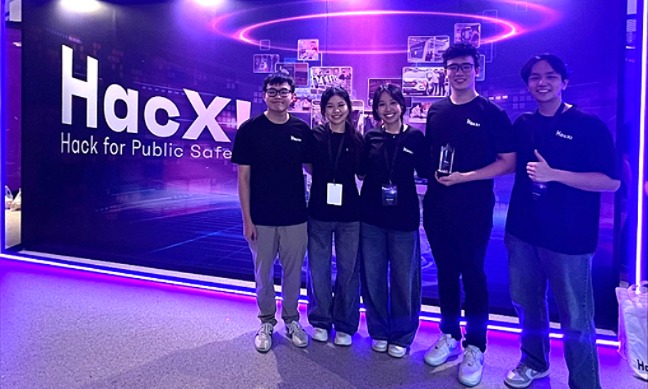
From left to right: Goh Yu Hern, Ian, Jing Xinling, Han Yuxuan, Liu Yunqing, Koh Wei Zhe