
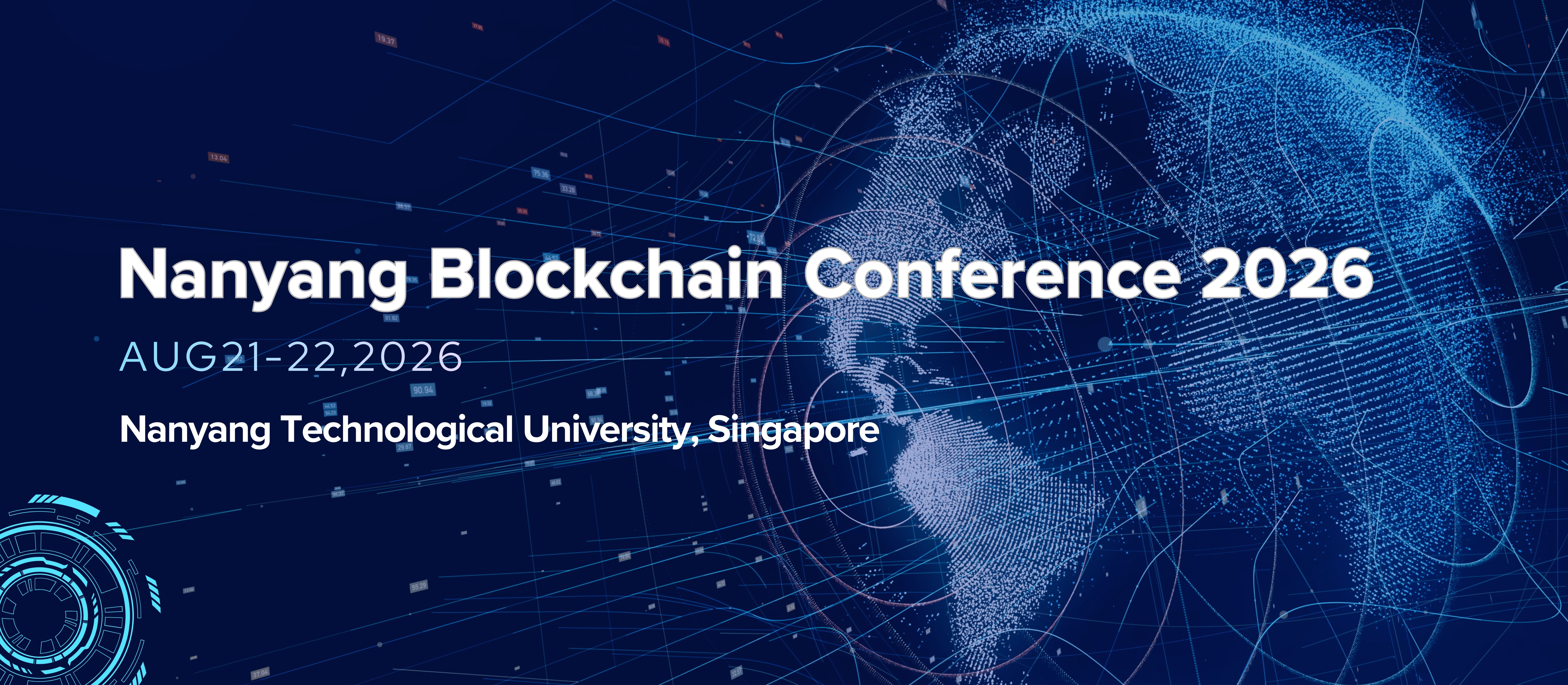
Building on the growth and international engagement of previous editions, this year’s conference continues in a full conference format with a Call for Papers (CFP) to attract high-quality research contributions. NBC’26 reflects our commitment to advancing the field by providing a structured platform for academic and industry dialogue, rigorous peer-reviewed research, and technically focused presentations. The conference focuses on technical innovations in the blockchain ecosystem and brings together researchers and practitioners working in this space. The conference brings together researchers and practitioners working across blockchain protocols, cryptography, distributed systems, secure computing, cryptoeconomics, and related AI-enabled technologies. We aim to foster collaboration among these diverse communities to accelerate innovation and deepen the scientific foundations of next-generation decentralized systems.
Past Highlights
Details
Organizer: NTU Centre in Computational Technologies for Finance (NTU-CCTF)
Period: Aug 21-22, 2026
Venue: TBC
Registration: TBC
Attendance: In-person









International Liaison Chairs
University of Texas at San Antonio, USA

International Liaison Chairs
Beijing Institute of Technology, China








Keynote

Massachusetts Institute of Technology, United States
Professor Muriel Médard is the NEC Professor of Software Science and Engineering in the Department of Electrical Engineering and Computer Science (EECS) at MIT, where she leads the Network Coding and Reliable Communications Group. She received her bachelor’s, master’s, and doctoral degrees from MIT.
She is a Member of the US National Academy of Engineering and the German National Academy of Sciences Leopoldina, a Fellow of the IEEE and the US National Academy of Inventors, and a Member of the American Academy of Arts and Sciences. She has received numerous international awards for her contributions to network coding, information theory, and communications systems, and currently serves as Editor-in-Chief of the IEEE Transactions on Information Theory.

University of Cambridge, United Kingdom
Professor Peter Bossaerts is the Leverhulme International Professor of Neuroeconomics in the Faculty of Economics at the University of Cambridge. His research focuses on the intersection of economics, finance, neuroscience, and psychology, with emphasis on decision-making under uncertainty and financial market behavior.
He is recognized for pioneering the use of controlled experiments to study financial markets and for integrating decision and game theory with cognitive neuroscience, helping establish neuroeconomics and decision neuroscience. Prof. Bossaerts received his PhD from the University of California, Los Angeles, and spent much of his career at the California Institute of Technology. He is a Fellow of the Econometric Society.
We welcome high-quality submissions in the field of blockchain that present innovative ideas, explore emerging challenges, consolidate existing knowledge, or demonstrate early-stage but impactful directions.
Submission site
Topics of Interest
Topics of interest include, but are not limited to, the following:
- Blockchain Protocols and Consensus
- Design and analysis of consensus mechanisms
- Byzantine fault tolerance and distributed coordination
- Network performance scalability latency and throughput
- Cryptoeconomics and System Design
- Tokenomics staking and incentive mechanisms
- MEV mitigation and protocol sustainability
- Decentralized governance
- Cryptography and Security Foundations
- Cryptographic primitives for blockchain systems
- Zero knowledge proofs and privacy preserving techniques
- Formal security models and provable guarantees
- Smart Contracts Programming and Formal Methods
- Languages and frameworks for smart contracts
- Formal verification and program correctness
- Static dynamic analysis and runtime monitoring
- Scalability Infrastructure and Storage
- Layer 1 and Layer 2 scaling architectures
- State storage data availability and snapshotting
- Cross chain bridges and decentralized oracle networks
- Privacy Security and Trusted Computing
- Confidential transactions and privacy preserving protocols
- Compliance aware privacy and data protection frameworks
- Security vulnerabilities and attack vectors in blockchain systems
- Threat modeling auditing and formal analysis of protocol security
- Blockchain and AI
- Decentralized and federated AI computation
- Verifiable and privacy preserving machine learning
- Tokenized models AI driven governance and data integrity
- Blockchain Based Applications
- Decentralized finance DeFi and real world asset tokenization
- Supply chain identity and data provenance systems
- Web3 infrastructure and decentralized service platforms
Submission Types
Submissions must be of one of the following types, and the recommended page length is in parenthesis:
- Original research papers (between 8 and 25 pages): These submissions present original and unpublished research results. Papers should make novel technical contributions and be supported by theoretical analysis, system design, or experimental evaluation. Submissions will be peer-reviewed based on originality, significance, technical quality, and clarity.
- Practitioner reports or case studies (up to 8 pages): These papers describe real-world implementations, deployment experiences, or engineering insights from blockchain projects. Submissions should focus on practical challenges, design trade-offs, performance outcomes, and lessons learned. This track is ideal for developers, system builders, and industry practitioners.
- Literature review / survey papers (up to 25 pages): Survey papers provide a comprehensive overview of a specific area within blockchain and related fields. Submissions should systematically analyze existing literature, categorize research trends, identify challenges, and propose future directions. Surveys must be well-structured and insightful, going beyond simple aggregation of prior work.
Note: Submissions focused on cryptocurrency price trends, investment strategies, or legal/regulatory issues are outside the scope of the conference. All papers should emphasize technical or scientific contributions, such as blockchain protocols, cryptography, distributed systems, secure computing, and crypto-economics.
Publication
NBC is a non-archival conference and does not publish formal proceedings. However, selected papers will be invited for publication in a special issue of ACM Distributed Ledger Technologies. Further details regarding this opportunity, including submission guidelines and timelines, will be provided after the acceptance notifications.
Important Dates
- Paper submission deadline: April 20, 2026, 11:59pm AoE
- Final acceptance notification: May 30, 2026
- Conference: Aug. 21-22, 2026
Submission Guidelines
- Please submit your paper via https://nbc26.hotcrp.com in Portable Document Format (.pdf).
- All submissions must be written in English and formatted using the ACM standard templates (for Microsoft Word or LaTeX), available at: http://www.acm.org/publications/authors/submissions.
- Authors must select the appropriate submission type during the submission process. The expected page limits for each category are:
- Original research papers (between 8 and 25 pages)
- Practitioner reports or case studies (up to 8 pages)
- Literature review / survey papers (up to 25 pages)
- Authors are encouraged to include a link to code or data (e.g., GitHub) in the submission form. While optional, such materials may positively impact the review.
- This conference does not require anonymized submissions. Author names, affiliations, and acknowledgments may be included in the submitted manuscript.
Co-Organizers

The Academy of Engineering, Singapore (SAEng), established in 2011, serves as the leading institution for engineering excellence in Singapore. As the national academy, SAEng unites the nation's most esteemed engineers across all sectors to champion the highest standards in the engineering practice. Our mission is to enhance Singapore's engineering capabilities and knowledge, thereby supporting the nation's sustained development and global competitiveness.
Knowledge Partner
IEEE Blockchain Technical Community (BCTC)
The IEEE Blockchain Technical Community (BCTC) serves as a global collaboration hub for advancing technology, promoting education, publishing research, sharing knowledge, and developing standards across the multidisciplinary communities interested in blockchain, distributed ledgers, and related technologies.