
Programme Overview
The NTU MiM’s one-year, full-time curriculum is designed to provide a strong foundation in business through a well-structured set of core modules. These courses equip you with essential management knowledge and practical insights, ensuring you develop the skills needed to excel in a competitive global landscape.
Programme Calendar
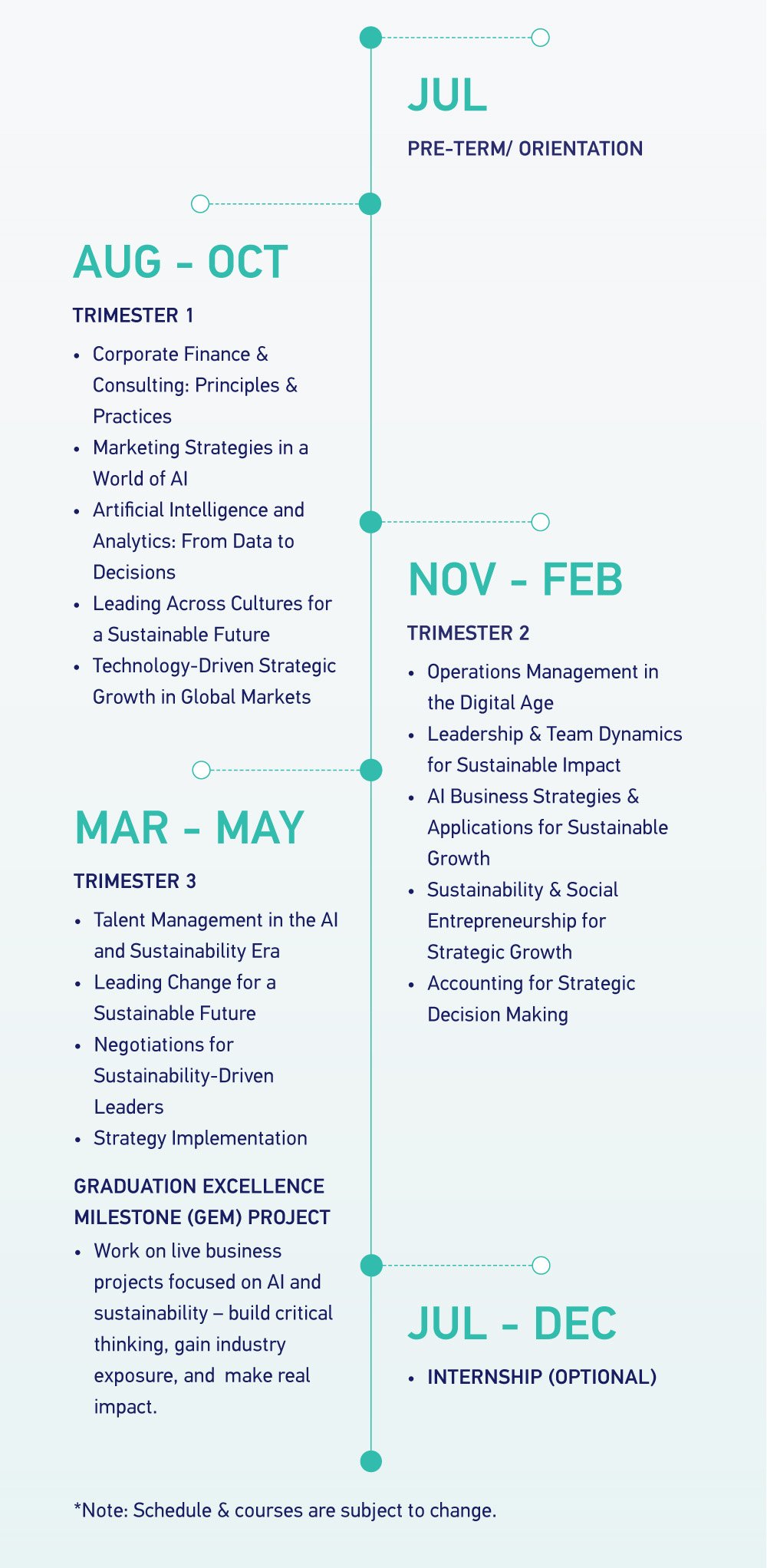
Mastering Business Fundamentals in a Digital World
This foundational course in AI and analytics empower students with the ability to analyse large datasets and make data-informed decisions. Students learn to apply machine learning techniques to solve complex business challenges and drive efficiency in various organisational contexts.
Focusing on essential principles of corporate finance, this module provides skills in financial consulting and risk assessment. Students gain insights into AI-supported investment strategy development, equipping them to drive sustainable financial practices within organizations.
Students develop cross-cultural management skills essential for today’s global workforce. This module emphasizes inclusive leadership, intercultural communication, and managing diversity, preparing students to lead sustainable initiatives across cultural boundaries.
Technology developments in AI are reshaping industries and business functions, and marketing is no exception. This course will explore how marketing is evolving in a world of AI, and teaches students how best to leverage the technology to drive business impact. While AI is rapidly transforming marketing practices, students will learn to balance innovation with core principles to build competitive marketing strategies.
This course covers contemporary talent management strategies in the context of AI and sustainability. Students learn to analyse workforce needs, plan for future skills, and implement retention strategies that align with an organisation’s sustainability objectives.
Leading People in the Age of Purpose and Innovation
This course provides a rigorous foundation in financial and managerial accounting within today’s technology-enabled business environment. Students develop the analytical skills to interpret financial information, evaluate organisational performance, and apply accounting insights to strategic decision-making. It bridges traditional accounting knowledge with its application in today’s dynamic, technology-enabled business environment.
This course explores how AI can enhance operational efficiency and profitability. Students learn to design and implement AI business strategies that drive sustainable growth, balancing technological advancements with environmental considerations.
This course focuses on developing leadership skills for sustainable impact, with an emphasis on team dynamics, ethical decision-making, and social responsibility. Students learn to lead and motivate teams effectively, fostering a culture of sustainability and long-term success.
Covering essential operations management concepts, this module emphasizes AI and data analytics for process optimisation and supply chain management. Students acquire the skills to implement sustainable operational practices, aligning with organisational goals in a technology-driven landscape.
Focusing on the intersection of sustainability and entrepreneurship, this module teaches students to develop socially responsible business models. Students learn to assess social impact and foster innovation that contributes to both business and societal value.
Driving Strategy for Sustainable Business Impact
In this module, students explore strategies for managing change in organisations aiming to adopt sustainable practices. The course emphasises stakeholder engagement and sustainable transformation, equipping future leaders with tools to navigate and implement change successfully.
Focusing on negotiation skills with a sustainability perspective, this course prepares students to engage stakeholders and achieve alignment on social and environmental goals. Ethical considerations and stakeholder management are key components of the curriculum.
Students develop the skills to align mission-critical value chain activities with corporate strategies, enabling them to achieve both corporate financial and sustainability goals. This course functions as a C-suite enabler, preparing students to implement integrated strategic initiatives aimed at securing sustainable competitive advantage for firms operating in dynamic global environments shaped by ESG risks and opportunities, as well as disruptive technological innovations.
People are a critical driver of organisational success. The strategic management of talent as a valuable resource is therefore especially important in a global, knowledge-driven digital economy. Effective leaders and managers must strategically align workforce capabilities and behaviours with business strategy and the prevailing operating environment. This is the essence of talent management.
Graduation Excellence Milestone (GEM) Project