Published on 20 Feb 2026
Dr Michael DeBakey and his Dissecting Aneurysm
By Joseph Sung MD, PhD
In 2018, I had spent a three-month sabbatical leave in Baylor College of Medicine and the Methodist Hospital in Houston, Texas. I learnt about one particularly memorable person from the hospital museum.
It was New Year's Eve, 2005. Dr Michael DeBakey was alone in his study in Houston, preparing a lecture, when a sharp pain tore through his upper chest, moved between his shoulder blades, and shot into his neck. He knew instantly what it was. He had spent decades treating it. He was the one who classified it. For those who study cardiology, you will remember that the DeBakey classification system for aortic dissection — the tearing of the inner wall of the body's largest artery — bears his name. He had developed the surgical repair technique. He had also trained hundreds of surgeons how to perform it. And now it was happening to him.
He was 97 years old when that happened. Dr DeBakey assumed his heart would stop in seconds. When it didn't, he sat with the pain and thought through it. He later told the New York Times that he never considered calling 911. "You are, in a sense, a prisoner of the pain, which was intolerable," he said. "If it becomes intense enough, you're perfectly willing to accept cardiac arrest as a possible way of getting rid of it." A CT scan confirmed what he already knew. The doctors at Houston's Methodist Hospital wanted to operate immediately. Dr DeBakey refused. He went home instead.
He wasn't being irrational. As a great cardiothoracic surgeon, he understood better than anyone alive what the surgery would do to a 97-year-old body. The recovery could leave him disabled. He had watched patients endure that outcome. He chose to die on his own terms rather than survive as less than himself. He went on to sign a Do-Not-Resuscitate order. He made his wishes clear in his chart: No surgery. And then — one week after nearly dying — he proceeded to deliver that lecture anyway.
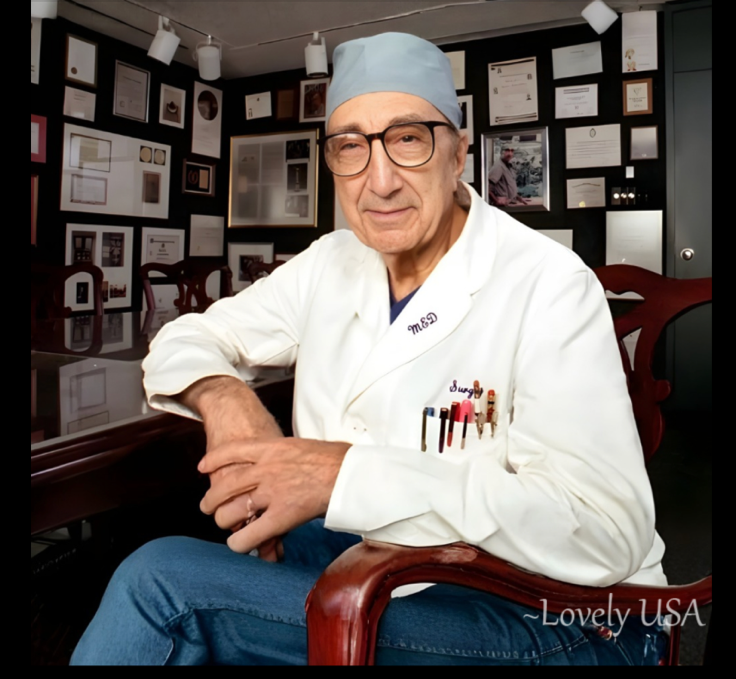 Image courtesy of the Baylor College of Medicine, sourced from the DeBakey Museum website.
For three weeks, doctors monitored him at home, managing his blood pressure, hoping the dissection might stabilise. But it didn't. The tear progressed. Dr DeBakey was readmitted to the hospital and began to deteriorate. Eventually, he went into coma. What followed was one of the most extraordinary medical ethics debates in modern history.
His wife, Katrin, and longtime colleague Dr George Noon pressed for surgery. But the hospital's anesthesiologists — the most experienced cardiac anesthesia team in the world — refused to participate. They cited the Do-Not-Resuscitate directive. They cited the chart notes. The man had said he did not want this surgery. The hospital's ethics committee convened. The question was staggering: do you honour the explicit wishes of a patient, or do you operate on the unconscious inventor of the very procedure that could save him?
Katrin DeBakey settled it. She reportedly walked into the room and said, "My husband's going to die before we even get a chance to do anything. Let's get to work." The ethics committee approved the surgery. On 9 February, 2006, an anesthesiology team from another hospital — the Methodist team still refusing — put Dr DeBakey under. His own surgical team, many of them his former students, opened his chest and replaced the torn section of his aorta with a Dacron graft. The same kind of graft Dr DeBakey had invented decades earlier on his wife's sewing machine, after a department store happened to be out of Nylon. The surgery took seven hours. The recovery took eight months. The hospital bill exceeded one million dollars. But he, Michael DeBakey, walked out alive.
While studying medicine at Tulane University, in his early 20s, Dr DeBakey invented the roller pump, a device for blood transfusion, that would later become a critical component of the heart-lung machine, making open-heart surgery possible. He was still a student at that stage. Then he became the first surgeon to perform a carotid endarterectomy, pioneer of coronary artery bypass, creator of the first functional Dacron vascular grafts, developer of left-ventricular assist devices, first surgeon to transplant multiple organs from a single donor. He recorded over 60,000 cardiovascular surgeries in his career. He was, by every measure, one of the most influential surgeons in history.
After his surgery in 2006, miraculously, Dr DeBakey recovered fully. He returned to work. He wrote papers. He gave lectures. He thanked the surgical team that had overruled him. And on 23 April, 2008, at the ripe age of 99, he received the Congressional Gold Medal from President George W Bush.
On 11 July, 2008, less than two months before what would have been his 100th birthday, Dr Michael DeBakey died of heart failure at the hospital that bears his name.
He had invented the classification system for the condition that nearly killed him. He had developed the surgery to treat it. He had trained the surgeons who performed it. He even created the graft they used to treat his aneurysm. And he had tried to stop them from saving his life. But they saved him anyway. They used his sewing method. They used his grafts. They used his classifications, his techniques, his philosophy. And they used them on him.
What a legend! What have you learned about respecting the patient’s will and exercising your professional judgement?