Learning with AI: Strengthening Computing Education in an AI-Shaped World
The College of Computing and Data Science (CCDS) at Nanyang Technological University, Singapore (NTU Singapore) is embedding artificial intelligence into the way computing is taught, practised and assessed through its Learn with AI framework.
The move reflects rapid advances in artificial intelligence, particularly large language models capable of generating, explaining, testing and refining code – developments that are reshaping computing practice.
Through the Learn with AI framework, CCDS is integrating AI into its curriculum in ways that strengthen students’ foundations while preparing them to operate effectively in AI-enabled development environments.
The framework focuses on how artificial intelligence is changing computing practice and, in turn, computing education, from curriculum and assessment to the development of design and control judgement when working alongside agentic AI systems.
Professor Luke Ong, Dean of NTU’s College of Computing and Data Science, said the emphasis remains firmly on strong fundamentals.
“Artificial intelligence is a multiplier. But if the multiplicand is zero, the outcome is zero.”
Under the Learn with AI framework, students engage with AI tools while remaining accountable for their own reasoning and technical judgement.
“AI is rapidly becoming embedded in the practice of computing. These systems can generate code, explanations, and solutions at remarkable speed. But responsibility for design, correctness, and judgement still rests with the human. Our role as educators is to ensure that students develop the intellectual foundations required to engage with these systems critically and responsibly.”
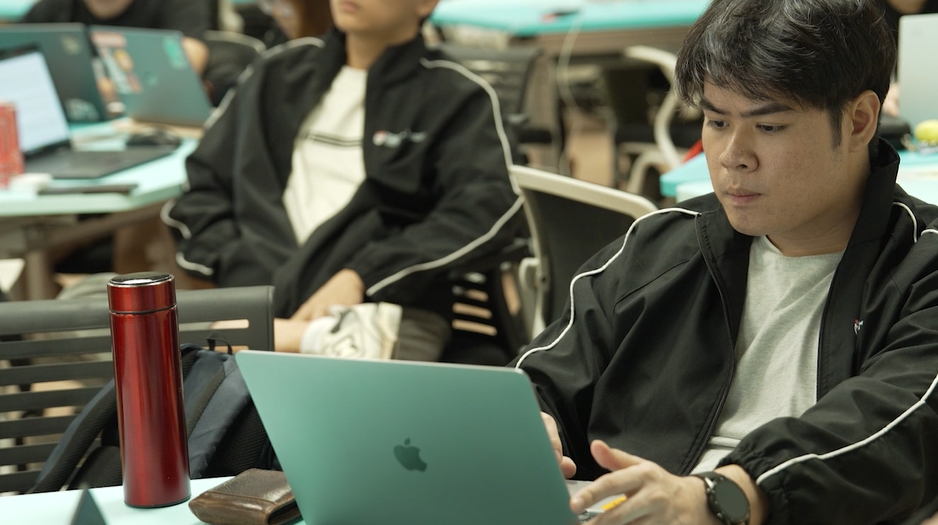
This approach includes a structured model of AI-ON and AI-OFF assessments, where students work with AI-assisted workflows in AI-ON assessments and complete more traditional assessments without AI assistance in AI-OFF settings, ensuring they demonstrate both effective use of AI tools and independent understanding.
AI Integration Across Core Computing Courses
The Learn with AI framework is already being implemented through a pilot group of core computing courses:
- SC1007 – Data Structures and Algorithms
- SC2000 – Probability and Statistics for Computing
- SC2006 – Software Engineering
- SC4052 – Cloud Computing
Across these courses, students are provided with AI-supported learning environments such as coding assistants, debugging workflows, domain-specific AI tutors, and structured human–AI collaboration practices.
Together, these pilots signal that AI integration spans the breadth of computing education, from foundational theory to systems and engineering practice.
SC1007 – Data Structures and Algorithms
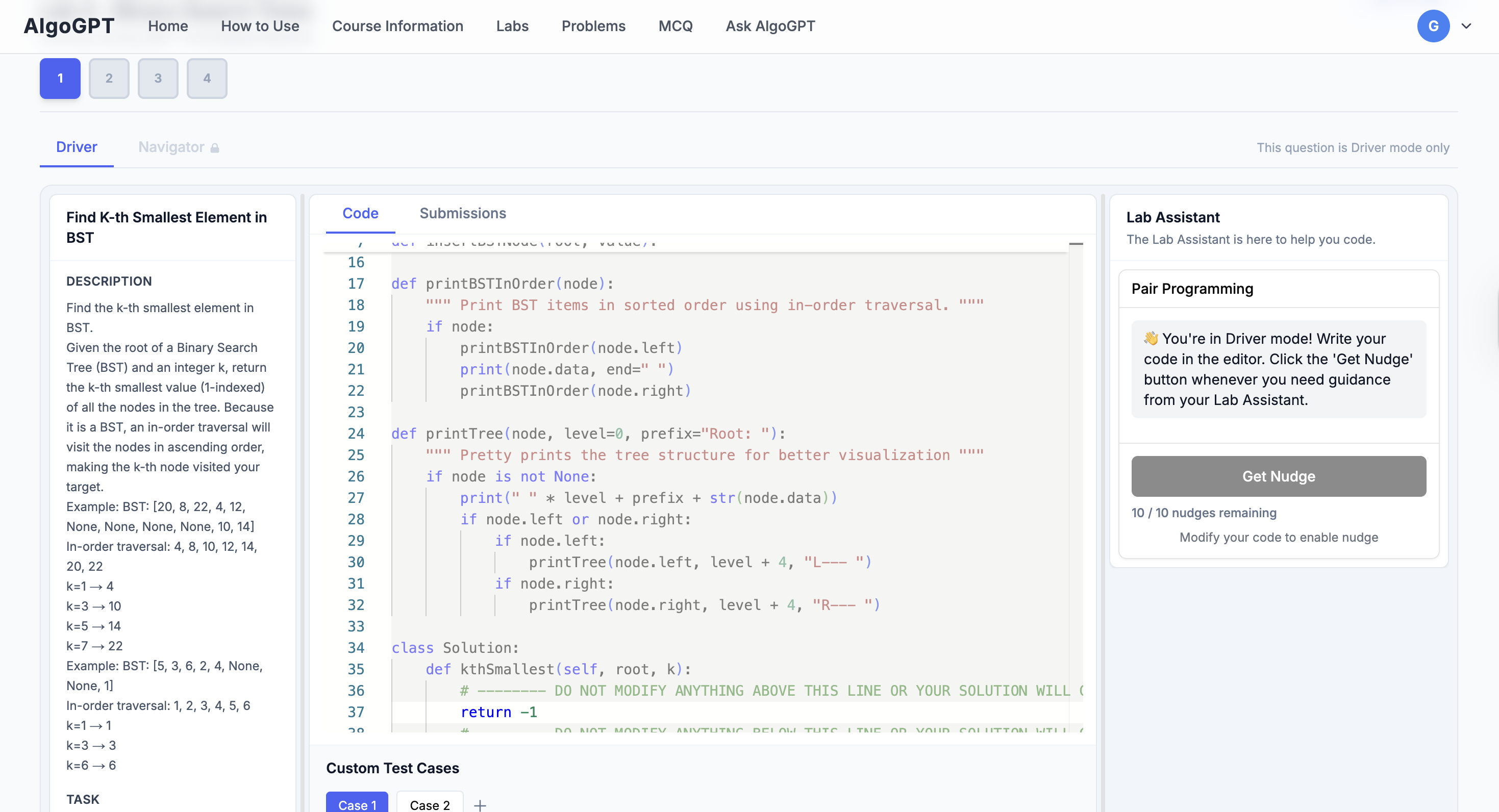
In SC1007, students explore core data structures and algorithms through an AI-supported learning environment that provides guided hints and feedback while they solve problems.
The course adopts a structured approach where students alternate between explaining algorithmic reasoning, implementing solutions independently, and reviewing AI-assisted outputs. Practice problems are dynamically generated based on each student’s skill level, helping students learn at their own pace while building strong algorithmic reasoning and the ability to evaluate AI-generated code.
Dr Newton Fernando, faculty member responsible for the Data Structures and Algorithms course, said the changes are designed to ensure students continue to develop a deep understanding of computing fundamentals even as AI tools become more widely used in practice.
“AI systems can generate code remarkably quickly, but understanding why that code works remains fundamental. In our courses, students learn to use these tools responsibly while still making sound design decisions, reasoning through problems, and verifying the correctness of their solutions.”
SC2000 – Probability and Statistics for Computing
SC2000 incorporates a custom AI tutor trained on the course’s own lecture materials to support students in studying and revising key concepts in probability and statistics. The AI system functions as a guided learning assistant rather than a solution generator, encouraging students to work through the underlying reasoning. Optional assignments also allow students to use AI-assisted coding tools to explore larger datasets and statistical simulations while maintaining a focus on core mathematical concepts.
SC2006 – Software Engineering
SC2006 introduces students to emerging practices in AI-assisted software development through a series of lab exercises using coding agents. Students are required to reflect on the AI’s outputs and evaluate how these tools can support tasks such as debugging, documentation and code extension. By first developing software solutions manually before introducing AI-assisted workflows, the course emphasises that engineering judgement remains central to software development.
SC4052 – Cloud Computing
SC4052 exposes students to how AI tools are reshaping modern cloud systems and software architectures. Students use AI-assisted tools to analyse cloud scheduling algorithms, investigate security vulnerabilities and explore the design of next-generation cloud platforms influenced by generative AI. Industry talks and project work further introduce emerging practices such as AI-driven cloud optimisation and agentic software systems.
Upskilling CCDS Students with AI-Enabled Development Workflows
In addition to curriculum integration, CCDS students will also be participating in an intensive programme developed by AI Singapore (AISG) that introduces students to emerging AI-enabled development workflows.
The programme will be offered to final-year CCDS students, providing free access to advanced AI coding assistants such as AWS Kiro, GitHub Copilot, OpenAI Codex and Z.ai GLM, and guided exercises covering areas such as context engineering, agent development and AI-assisted software architecture.
The experience complements the Learn with AI framework by allowing students to operate these tools in a structured environment while continuing to apply the computing fundamentals developed through their coursework.
Participants who complete the programme will receive a certificate issued by AI Singapore.
Preparing Graduates for AI-Enabled Computing Environments
By embedding AI directly into computing education while maintaining strong expectations around rigour, accountability and engineering judgement, CCDS aims to prepare graduates who are equipped to operate confidently in AI-enabled computing environments.
The Learn with AI framework reflects the College’s broader commitment to ensuring that students graduate not only with technical knowledge, but with the ability to work thoughtfully and responsibly alongside increasingly powerful AI systems.
1a38155d-12ed-4765-9618-410d4861990f.tmb-listing.jpg?Culture=en&sfvrsn=7ce90a01_1)