
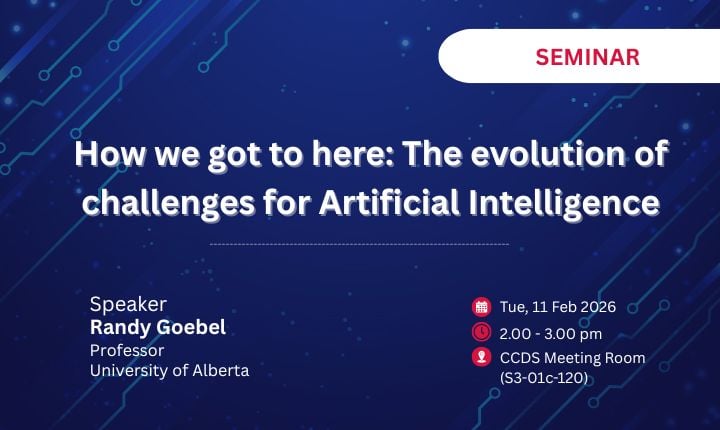
How we got to here: the evolution of challenges for Artificial Intelligence by Prof. Randy Goebel
Abstract
The history of artificial intelligence as a scientific discipline is relatively young, but the significant increase in activity over the past decade has created a lot of challenges in identifying the scientific foundations. We sketch a framework that may help students of AI (including all researchers) identify recurrent themes and avoid the confusion that seems inevitable when a discipline changes so quickly. Two or three examples of identifying recurring themes include learning and continuous learning, explanation and so-called explainable AI (XAI), as well as the re-emerging them of combining foundation methods (e.g, neurosymbolic AI) by so-called situated agents that both learn to adapt to the world (e.g., reinforcement learning) and learn to build models of the world to provide a basis for semantically constrained continual learning.
Biography
Randy Goebel is a Professor of Computing Science and adjunct Professor in the Faculty of Medicine at the University of Alberta, and Fellow and Co-founder of the Alberta Machine Intelligence Institute (AMII), one of three Canadian federally-funded AI research organizations. He has had faculty appointments and visiting faculty appointments at the University of Waterloo, University of Regina, University of Tokyo, Hokkaido University (Sapporo, Japan), Multimedia University (Kuala Lumpur, Malaysia), Instituto Tecnológico de Monterrey (Monterrey, Mexico), and has been a visiting researcher at the German Center for AI Research (DFKI), the National Institute for Informatics (NII, Tokyo), and the Volkswagen Data Lab (Munich). His research interests include formal knowledge representation and reasoning (induction, belief revision, explainable AI (XAI)), knowledge visualization, algorithmic complexity, natural language processing (NLP), systems biology, with applications in clinical medicine, legal reasoning, and automated driving.