
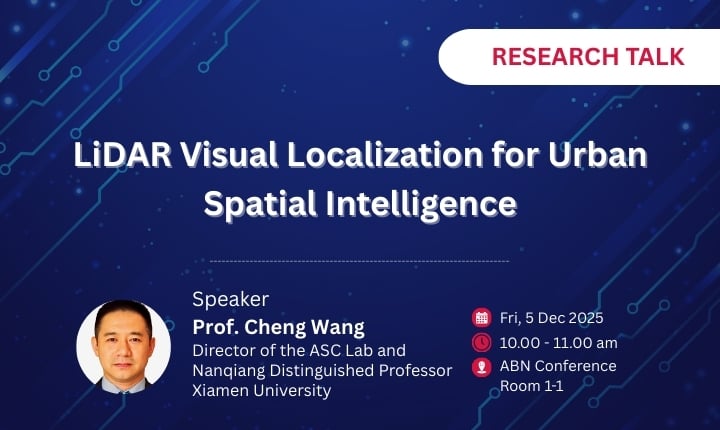
LiDAR Visual Localization for Urban Spatial Intelligence by Prof. Cheng Wang
Abstract
Spatial intelligence forms the cognitive foundation for artificial general intelligence (AGI) to interact with the physical world. As embodied intelligence scales to urban environments, the need for urban spatial intelligence grows accordingly. However, conventional geospatial representations are inadequate to embed city-level spatial intelligence, necessitating a new end-to-end paradigm for geospatial information representation.
This talk examines LiDAR-based visual localization within the context of urban spatial intelligence and presents recent advances from the ASC Laboratory at Xiamen University. End-to-end LiDAR visual localization is evolving from lab-scale validation to city-wide deployment, with key improvements in both large-scale modeling efficiency and robustness in complex settings. By integrating visual localization, LiDAR vision tasks such as object detection, human motion capture, and re-identification are enhanced with precise geolocation attributes—opening new potential for perceiving vehicles and pedestrians across expansive urban areas.
Biography
Dr. Cheng WANG is a Nanqiang Distinguished Professor at Xiamen University, where he directs the Spatial Sensing and Computing Laboratory (ASC) and the Fujian Provincial Key Laboratory of Sensing and Computing for Smart Cities. He also holds several key academic roles, including Executive Council Member of the China Society of Image and Graphics, Chair of its Imaging Detection and Perception Committee, and Chair of the ISPRS Working Group on Multi-Sensor Integration and Fusion. His research focuses on computer 3D vision, LiDAR, and geospatial information systems for smart cities. He has authored over 300 papers published in leading journals and conferences such as TPAMI, Nature Communications, CVPR, NeurIPS, ISPRS-JPRS, and IEEE TGRS, with more than 17,000 citations and an H-index of 65. His distinctions include the ISPRS Giuseppe Inghilleri Award, five Fujian Provincial Science and Technology Progress Awards, and a Fujian Provincial Special Prize for Teaching Achievements.