
Vascular Nanomedicine Delivery: Fortuitous Homing vs Cognizant Targeting
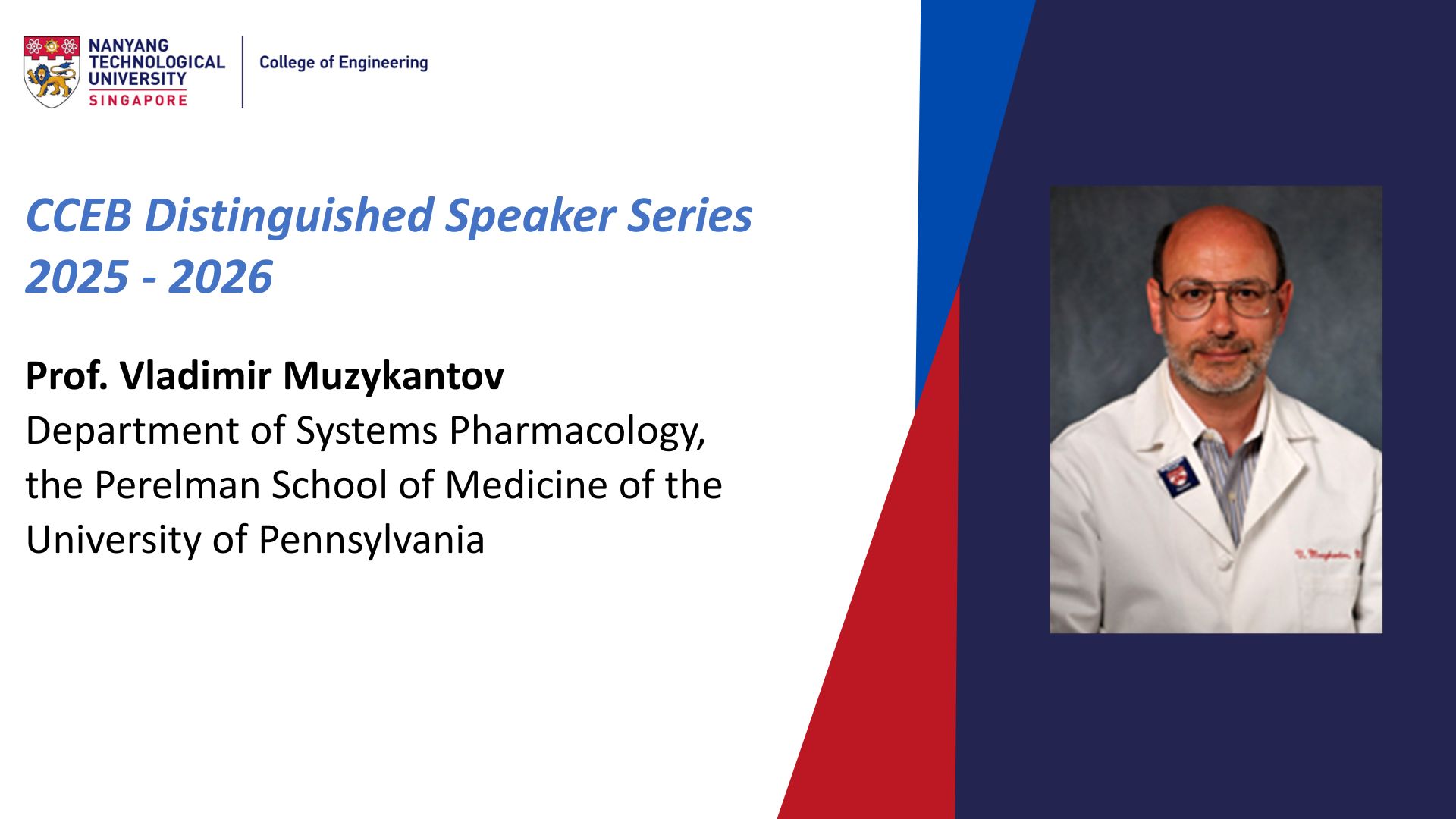
Hosted By: Asst. Prof. Tong Ling / Asst. Prof. Liang Kaicheng
Click here to register for the seminar
Abstract
Biologics and many other agents require nano-scale precision delivery to desired sites. “Cognizant targeting” deals with known binding sites. normal vs abnormal localization and access, uptake vs shedding, inhibition vs activation, engaging vs clustering parameters. Tracing isotope-labeled carrier and cargo yields their level in blood and organs, guiding rational design and reiterative engineering of delivery system enabling control of sub-cellular addressing and effect of cargoes. This focused low-throughput approach unlikely to yield discoveries but may offer efficacy and safety. In contrast, detecting reporter signals of chemical or biological libraries (e.g., LNPs or phage display) may reveal “fortuitous homing” to diverse sites via enigmatic mechanisms such as interactions with blood leading to enlargement, rigidification and acquired avidities, causing mechanical or charge retention, adhesion or extravasation. Factors modulating delivery: A) configuration of multi-molecular assembly delivery system (ligand nature, affinity, valence, conjugation and steric freedom), B) carrier’s size, shape, plasticity, pharmacokinetics and stability; and, C) Biological regulation of perfusion, permeability, functional status of the target tissue and consequences of carrier anchoring. Permutations of design and biological factors yield multifaceted and diversified means for vascular drug delivery, for example endothelial targeting of antioxidant, anti-thrombotic and anti-inflammatory agents provides beneficial effects unrivaled by untargeted counterparts in animal models of human diseases including acute lung injury, ischemia-reperfusion and sepsis. Current studies aim to define mechanisms and utility of “vascular nanomedicine”.
Biography
Prof. Vladimir Muzykantov (MD in Internal Medicine from First Moscow Medical School, 1980 and Ph.D. in Biochemistry from Russian National Cardiology Research Center, 1985), joined PENN in 1993, got tenure in 2003 and in 2010 became a Full Professor and Vice-Chair of the Department of Systems Pharmacology and Translational Therapeutics. In 2010 he established Center for Targeted Therapeutics and Translational Nanomedicine (CT3N) at PENN, which he directs. For four decades he works on targeted delivery of pharmacological agents in the cardiovascular system. His research focuses on drug delivery by RBCs and endothelial targeting for treatment inflammation, thrombosis and ischemia. He published ~300 papers (h-index 82) and edited a book “Biomedical Aspects of Drug Targeting” (Kluwer, 2003). Honors include: AHA Established Investigator (1996), AHA Bugher Stroke Award (2000), Chair of Transatlantic Airway Conference on Targeting Molecular Signatures in Lungs (Luzerne, 2009), Gordon Conference on Drug Carriers (2012) and HLBI Division of Lung Diseases Workshop “Precision Therapeutics Delivery for Lung Diseases” (2014), Keynote Speaker in many forums. In 2022 he was elected as a Fellow of the International Society of Controlled Drug Release and in 2023 become the inaugural endowed PENN Founders Professor of Nanoparticle Research.