
Computing and Predicting Properties of Energy Materials
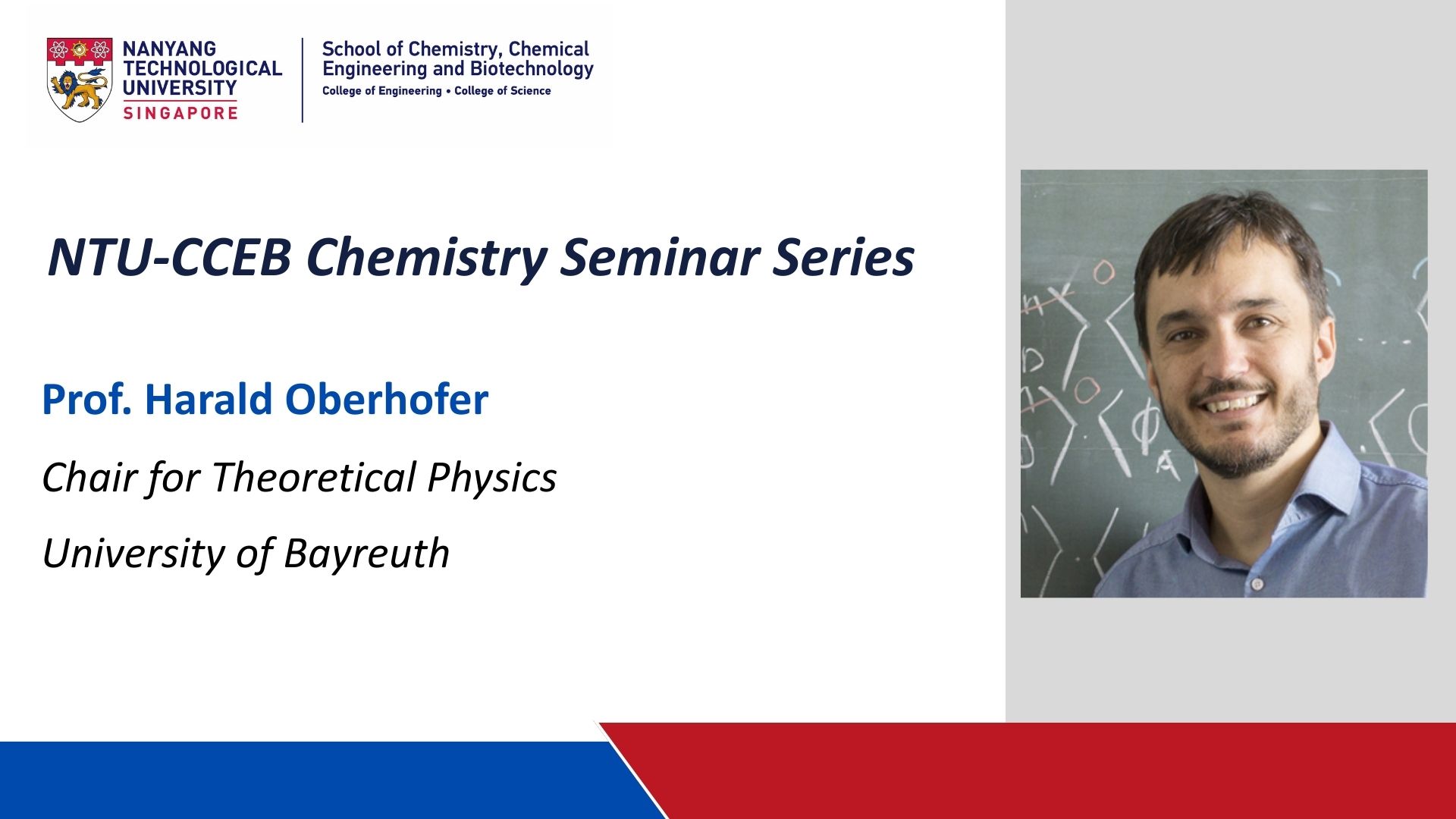
Speaker: Prof. Harald Oberhofer
Host: Asst. Prof. Li Haobo
Date: 5 March 2026
Time: 10:00 AM to 11:00 AM
Venue: CCEB NL conference room (02-01l)
Abstract
With the advent of ever more powerful computers and more accurate, yet efficient algorithms, computational science has by now been widely accepted as a valuable and equal contribution to both pure theory and experiment. Traditionally, computation thereby played the roles of elucidating microscopic properties and mechanisms of given systems and reaction pathways, leading to numerous breakthroughs not otherwise possible. The choice of system or reaction, thereby was mostly guided by experiment or the intuition and experience of the researcher. Recently, though, modern data science approaches such as data-mining and explainable machine learning allowed computation to take on a role of proactive exploration and design, supplementing the traditional roles of computational materials science. In my presentation, I will outline some of our research regarding method development and application in this field. First, I will present our efforts to improve the popular DFT+U method often used open up band-gaps usually under-estimated in standard semi-local DFT, thanks to which we now reproduce hybrid DFT band structures at the cost of semi-local DFT. Second, I will show how our use of low-data machine learning aids in our sampling of polaron states, i.e. polarisation-localised charge carriers, in battery materials. Using carefully chosen training sets for the machine learning, we can greatly reduce the number of DFT calculations needed to characterise the material. I will show how the use of explainable machine learning models not only allows us to predict properties of materials, but also to extract the materials' characteristics leading to these properties. Thus, we show how such an approach can yield useful structure-function relationships.
Biography
Prof. Harald Oberhofer
Harald Oberhofer is a theoretical physicist specializing in computational materials science and charge‐transport phenomena. Since 2021, he has held the Chair for Theoretical Physics VII at the University of Bayreuth, where his group advances computational and data‑driven methods to uncover microscopic mechanisms governing charge carriers in materials ranging from battery components and photo‑electrocatalysts to organic and metal–organic semiconductors. His research integrates first‑principles simulations with statistical data‑mining and machine‑learning approaches to extract transferable design principles that support experimental materials discovery. Harald Oberhofer studied physics at the University of Vienna and earned a PhD in computational and statistical physics from the same institution in 2008. He subsequently held a postdoctoral research associate position at the University of Cambridge from 2008 to 2011, followed by a postdoctoral and later independent group‑leader role at the Technical University of Munich between 2011 and 2021.
His scientific contributions span free‑energy methods, charge‑transfer theory, and multiscale simulation techniques. He contributed several works on first-principles methods for the computation of electronic couplings and charge transport in molecular materials, as well as for advances in implicit solvation models at electrified interfaces. His group also develops machine‑learned surrogate models to accelerate the computation of charge‑transport parameters and enable predictive materials design. His recent work extends to perovskite materials, kinetic Monte Carlo simulations, and explainable machine learning for hybrid semiconductors.